

Assess Blended Learning Programs to Improve Business Performance

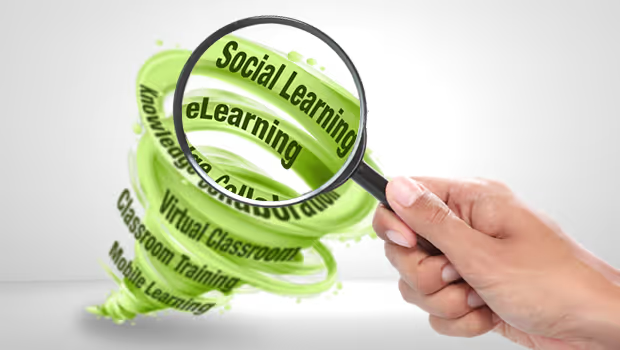
Did you ever imagine the day would come where you could use: A game of World of Warcraft to build leadership skills? Augmented reality to deliver dental training? Train online avatars to transform offline?
It’s just like it is in the movies, right?
Well, the Chief Learning Officer (CLO) at a leading management consulting, technology services and outsourcing company implemented a new way of training to enhance business and people skills of senior managers. How? By combining two different methods of instruction: face-to-face role-playing training sessions with online business simulation models. Then, there’s one of the world’s largest tire and rubber company who saved more than $100,000 in travel expenses by adopting the blended learning model. It successfully delivered Six Sigma Black Belt training through eLearning and online sessions.
Blended learning has caught the attention of many learning and HR departments across organizations and industries, and many companies are excited about combining technology with training. While it may sound cool to use the latest device or technology, the underlying focus should be on whether it is effective and does it provide a productive learning environment that improves business performance. The looming questions are:
- Are blended learning initiatives combining technology and conventional learning methods effectively?
- Are training objectives aligned with business objectives?
- Is there an ‘optimal blend’ or a standard tool to measure performance?
How to assess Blended Learning programs – go back to school
Assessing blended learning programs is essential to understand feasibility and benefits. While there are no industry standard tools of measurement yet, we could learn from another sector that has been implementing blended learning methods for a while now -- the education industry. Various institutions worldwide have developed their own evaluation methods of assessment. The Quality Matters (QM) and the Community of Inquiry (COI) Framework developed by the faculty at University of Maryland, Sloan-C Pillars model created by education professionals from San Diego State University, Brigham Young University and University of Central Florida are some examples.
By looking at different evaluation methods, we’ve compiled a list of the important variables to be measured to assess blended learning programs. These include:
- Fulfillment of objectives - The most important aspect to measure is whether blended training programs have fulfilled their objectives based on needs assessment, and whether they are aligned with business goals.
- Learning effectiveness - The inherent value of a learning program is the knowledge it provides. Learning effectiveness could be measured through in-depth surveys of participants or by evaluating work performance post training sessions
- Participant satisfaction - In order to understand participant satisfaction, an online survey or anonymous feedback session should be conducted including important questions such as: was the training useful? Was the method used relevant? Was the content of the program helpful?
- Trainer satisfaction - Professional trainers are the best judges when it comes to providing insights into the success of a training program. Feedback on aspects such as training content, method of instruction and combination of delivery modes are valuable in assessing and improving future programs
- Cost effectiveness - The training department needs to analyze the cost incurred when using various methods such as trainers for ILT and purchasing exclusive material or online access to training programs. It is possible to identify those methods, which prove to be not only cost effective but provide quality knowledge transfer as well.
With a fluctuating global economy, companies are focusing on cost savings without comprising on quality. Blended learning provides access to best-in-class training solutions at optimal costs. Through proper assessment, the ‘optimal blend’ is just a click away.
Our latest blogs



Ready to Revolutionize Learning at Your Organization?
Join 400+ enterprises using Invince to upskill, reskill, and retain top talent.
Ready to Revolutionize Learning at Your Organization?
Join 400+ enterprises using Invince to upskill, reskill, and retain top talent.

Ready to Revolutionize Learning at Your Organization?
Join 400+ enterprises using Invince to upskill, reskill, and retain top talent.