

The Rehearsal Gap: Why Enterprise Teams Need an AI Roleplay Platform for 2026 and Beyond
Most large organizations encounter these three scenarios.
A sales representative who passed product certification goes quiet when a CFO asks why renewal costs are higher this year.
A newly promoted director finishes the leadership program, then fumbles the first hard performance conversation.
An analyst who completed compliance training notices something odd in a transaction and can't decide whether it's worth escalating.
Each individual had the necessary knowledge. What they lacked was rehearsal.
This gap lies between knowledge and performance under pressure. Courses, playbooks, policies, and certifications provide information.
Completion reports show who finished, but not who is prepared.
Knowledge Is Not Readiness
Pilots train in simulators before they fly passengers. Surgeons practice procedures before they operate. Athletes scrimmage before game day.
The employees who handle your most consequential business conversations usually get no equivalent training.
Your sellers, managers, and frontline decision-makers go straight from the training module to the real thing. The client call, the escalation, and the judgment call under pressure all happen live.
Traditional roleplay was meant to fill this gap, and it rarely does. It depends on a manager's free time. It feels awkward, so people avoid it.
Feedback changes from coach to coach. And it barely scales within one region, let alone across dozens of business units in several countries.
So most organizations skip this step and have employees practice on real customers instead.
What an AI Roleplay Platform Changes
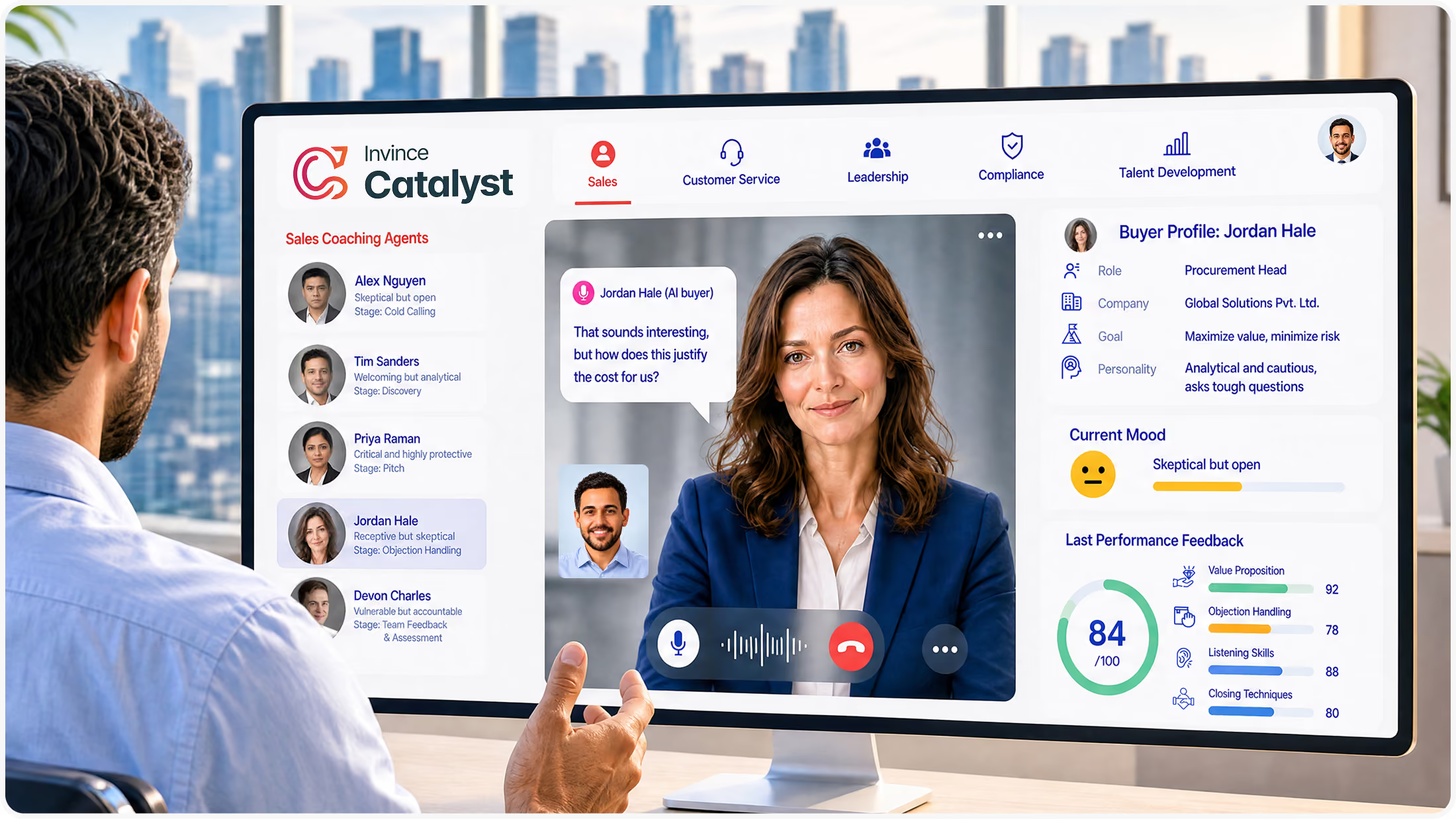
Invince Catalyst provides employees with a safe environment to rehearse critical conversations with AI personas that respond realistically.
Each persona features a defined role, company context, and temperament, such as skeptical, frustrated, anxious, demanding, or warm. Difficulty levels range from beginner to expert.
Learners can practice via text or voice to match their real work environment.
Each session follows a straightforward process:
- Brief. The learner opens a briefing that sets the scenario, the stakes, and the objectives. Supporting material such as a product sheet or a policy document can be attached.
- Practice. The learner works through the conversation while the AI persona reacts in real time. It pushes back, changes direction, and keeps them focused on the objective.
- Get scored. Grade every attempt against a rubric. The learner sees their strengths, what they missed, and one specific thing to work on next time.
- Repeat. Many scenarios take less than ten minutes, enabling regular practice rather than infrequent workshops.
This cycle transforms knowledge into readiness: learn, practice, receive feedback, improve, and perform.
Where Practice Pays off Most
AI Roleplay for Sales Coaching
In sales, an unrehearsed conversation's impact shows up immediately in the pipeline.
Catalyst lets sales representatives practice the moments that decide deals: discovery, the pitch, objection handling, and cold calls. The personas are intentionally difficult.
One is a VP of Finance who won't sit through a pitch and only cares about ramp time, forecast accuracy, and unused software seats.
Another is a buyer who has stalled on budget for the second quarter in a row. The learner either earns the next step or loses it again.
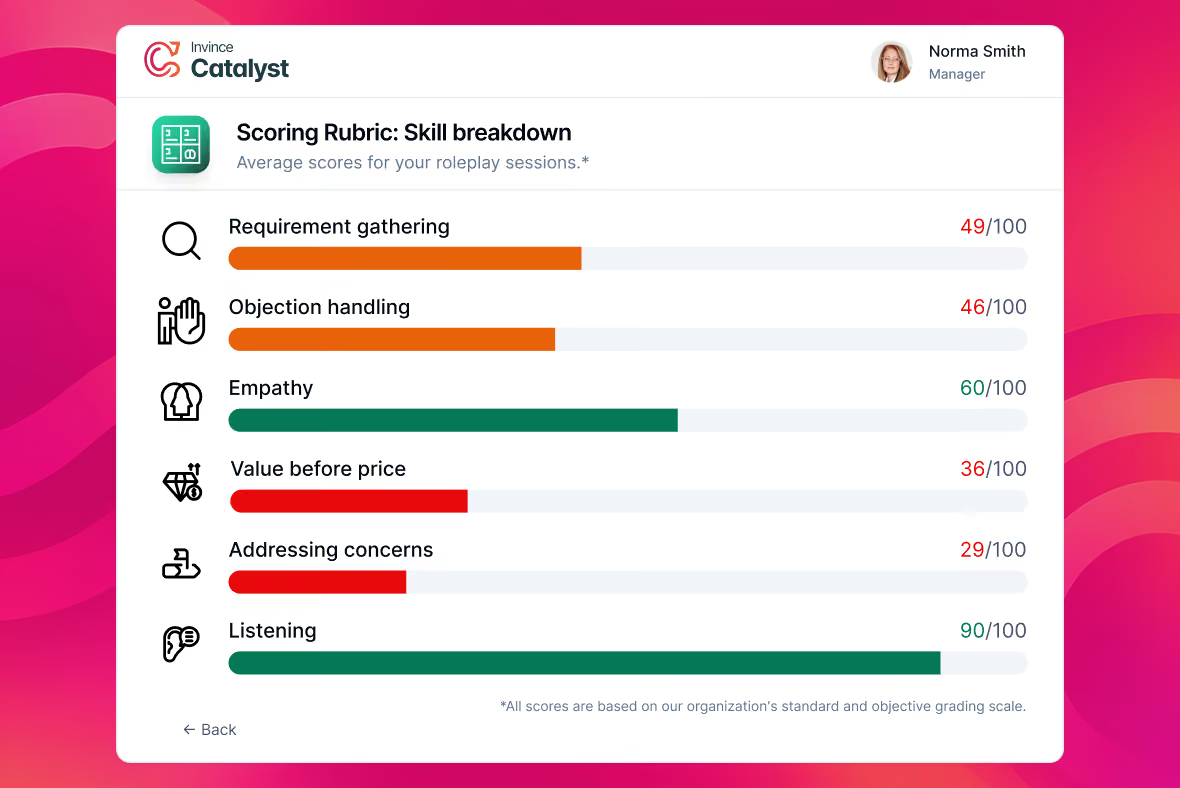
With standardized scoring, coaching becomes targeted. Managers can review team averages, pass rates, talk share, and identify the lowest-scoring skills.
If setting next steps is a weakness, coaching can focus there. Managers also coach using actual practice data rather than relying on recollections.
New hires benefit significantly, as they can rehearse with realistic buyers before managing actual accounts.
[[sales-coaching]]
AI Roleplay for Leadership Training
Leadership programs often teach frameworks, but the real challenge is conducting difficult conversations.
Most leaders develop these skills on the job, sometimes at their teams' expense.
Catalyst presents leaders with familiar scenarios:
- A demanding project lead who tests how you handle ownership, competing priorities, and stakeholder expectations
- A strategic functional lead who probes your decision-making and how well your team's work aligns with business goals
- A business unit leader who checks whether you can balance results, people leadership, and cross-functional pressure
Catalyst also addresses talent conversations, such as advocating for internal moves or developing plans to address skill gaps.
The key benefit is privacy. Leaders can make mistakes, receive candid feedback, and improve without impacting their teams.
[[leadership-training]]
AI Roleplay for Compliance Training
Compliance programs have a well-known limitation: signing an attestation does not demonstrate judgment.
Employees may pass policy quizzes but hesitate when real situations differ from textbook examples.
Catalyst shifts compliance practice from "Did they read it?" to "Would they act on it?" Scenarios include:
- Policy application: explaining a policy and applying it to everyday situations
- Risk recognition: spotting subtle red flags while a skeptical auditor pushes back
- Decision-making under pressure: making the right call in an ambiguous situation while someone pressures you toward the wrong one
- Incident handling: responding to, reporting, and escalating a simulated compliance incident
In regulated industries, the expensive mistakes rarely come from not knowing the rule. They come from hesitating when it matters. Rehearsal targets that moment.
[[compliance-training]]
Built Around Your Scenarios, Not a Generic Library
Your business conversations are unique: your pricing objections, policies, escalation paths, and customers.
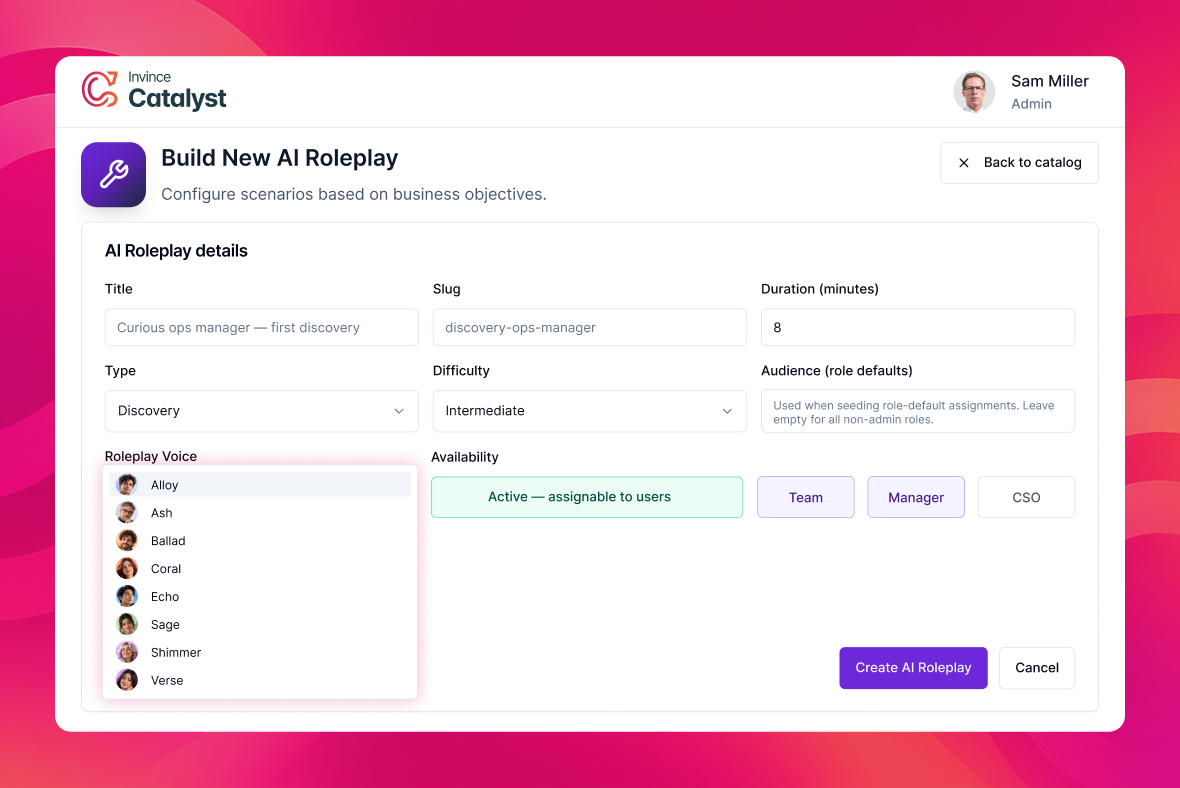
Catalyst includes a builder for creating custom roleplays. Administrators write the briefing learners will see and attach a supporting PDF.
They set objectives and a playbook, then configure the AI persona's voice, difficulty, and duration.
You can assign each roleplay to specific roles or people, so sales representatives, managers, and senior leaders can practice what matters for their jobs.
Any team with a business-critical conversation can build scenarios, including sales, customer service, leadership, compliance, and talent.
What Executives Get: A Readiness Signal
For a CXO, an AI roleplay platform's most useful offering may be visibility.
Catalyst reports at multiple levels, primarily for individual learners, managers, and function leaders.
Leaders can track practice activity, average scores, pass rates, skill breakdowns, and score trends over 7, 30, or 90 days. They can also see where capability is lagging.
A standardized rubric keeps feedback quality consistent regardless of the coach. You can measure readiness proactively, rather than explain it after the fact.
The Question Worth Asking
Most enterprises already ask, "Did our people complete the training?"
A more valuable question is, "Have they practiced the moments that matter?"
A good AI roleplay platform helps you answer the second question with evidence, not hope.
[[catalyst-faq]]

A senior, skeptical stakeholder weighing a market-expansion decision — advanced-level pressure.

Open to a conversation about messy handoffs — diagnose the process before you pitch anything.

Won't tolerate a pitch. Cares about ramp time, forecast accuracy, and unused SaaS seats.

A buyer stalling on budget for the second straight quarter — earn the next step, or lose it again.

Run a performance review: diagnose root causes, and preserve dignity without lowering the bar.

Evaluates how you would transition from individual contributor to leading and motivating a team.

Tests how you handle project ownership, competing priorities, deadlines, and stakeholder expectations.

Assesses your ability to lead a function, make decisions, and align teams with broader business goals.

Probes your ability to balance business outcomes, people leadership, and cross-functional priorities.

Run a performance review: diagnose root causes, and preserve dignity without lowering the bar.

Tests whether the learner can explain policies and apply them to everyday situations.

Presents subtle red flags and challenges the learner to identify potential compliance risks.

Creates ambiguous situations where the learner must make the right decision under pressure.

Simulates a compliance incident and evaluates how the learner responds, reports, and escalates.

Tests how leaders reinforce compliance, handle difficult situations, and influence team behavior.
Our latest blogs

Ready to Revolutionize Learning at Your Organization?
Join 400+ enterprises using Invince to upskill, reskill, and retain top talent.
Ready to Revolutionize Learning at Your Organization?
Join 400+ enterprises using Invince to upskill, reskill, and retain top talent.

Ready to Revolutionize Learning at Your Organization?
Join 400+ enterprises using Invince to upskill, reskill, and retain top talent.