

What Is Workplace Coaching? Benefits, Types, and the Role of AI-Powered Practice

Employees can understand what good leadership looks like and still struggle when they need to lead a difficult conversation. A sales representative may know how to handle objections but find it challenging to respond to a frustrated customer. An emerging leader may understand decision-making frameworks but hesitate when faced with a high-pressure situation.
Workplace coaching helps employees bridge the gap between knowing what to do and applying it effectively.
Coaching is a personalized development process in which a coach helps employees improve their skills, overcome challenges, and achieve professional goals. It encourages reflection, accountability, and practical action. For organizations investing in enterprise learning, coaching can complement formal training by helping employees apply knowledge to real workplace situations.
However, traditional one-on-one coaching can be difficult to scale across large workforces. AI-powered role-play and practice solutions, such as Invince Catalyst, offer another way for employees to rehearse conversations, receive feedback, and build confidence before applying their skills at work.
How Does Workplace Coaching Work?
Workplace coaching follows a structured process that connects individual development goals with practical action.
- Identify development needs: Understand the employee's strengths, challenges, and areas for improvement.
- Set clear goals: Define outcomes such as improving communication, negotiation, or decision-making.
- Explore real-world challenges: Discuss workplace situations and identify possible approaches.
- Practice and apply: Rehearse relevant skills through role-play, simulations, or workplace activities.
- Review progress: Evaluate performance, reflect on feedback, and identify the next steps.
This process helps employees take ownership of their development while giving managers and L&D teams a clearer framework for supporting progress.
What Are the Main Types of Workplace Coaching?
Organizations use different coaching approaches depending on employee needs and business priorities.
- Leadership coaching: Helps current and emerging leaders strengthen decision-making, communication, delegation, and people management.
- Performance coaching: Focuses on improving job performance and addressing specific capability gaps.
- Career coaching: Helps employees explore career goals and prepare for future responsibilities.
- Executive coaching: Supports senior leaders in strategic thinking, stakeholder management, and organizational leadership.
- Peer coaching: Enables colleagues to share experiences, exchange perspectives, and support one another's development.
- AI-powered practice: Gives employees opportunities to rehearse workplace conversations and receive structured feedback in a simulated environment.
These approaches can complement one another. For example, a manager may receive guidance from a human coach and use AI-powered practice between sessions to rehearse difficult conversations.
Why Is Coaching Important for Enterprise Learning?
Enterprise learning must do more than deliver information. Employees need opportunities to practice skills, receive feedback, and apply what they learn in realistic situations.
Consider a leadership program that teaches managers how to give constructive feedback. A course can explain the principles, but a manager may still struggle when an employee becomes defensive or disagrees with the feedback.
Coaching can help the manager prepare for the conversation, explore different responses, and reflect on the outcome.
Effective coaching can support:
- Personalized development: Focuses on an employee's specific needs.
- Stronger accountability: Encourages employees to take responsibility for agreed development goals.
- Practical skill application: Connects learning with real workplace situations.
- Leadership readiness: Helps employees prepare for more complex responsibilities.
- Continuous improvement: Creates opportunities for reflection, feedback, and repeated practice.
For L&D leaders, the challenge is to make these development opportunities accessible across roles, locations, and employee groups.
How Does Invince Catalyst Support Coaching Through AI-Powered Role-Play?
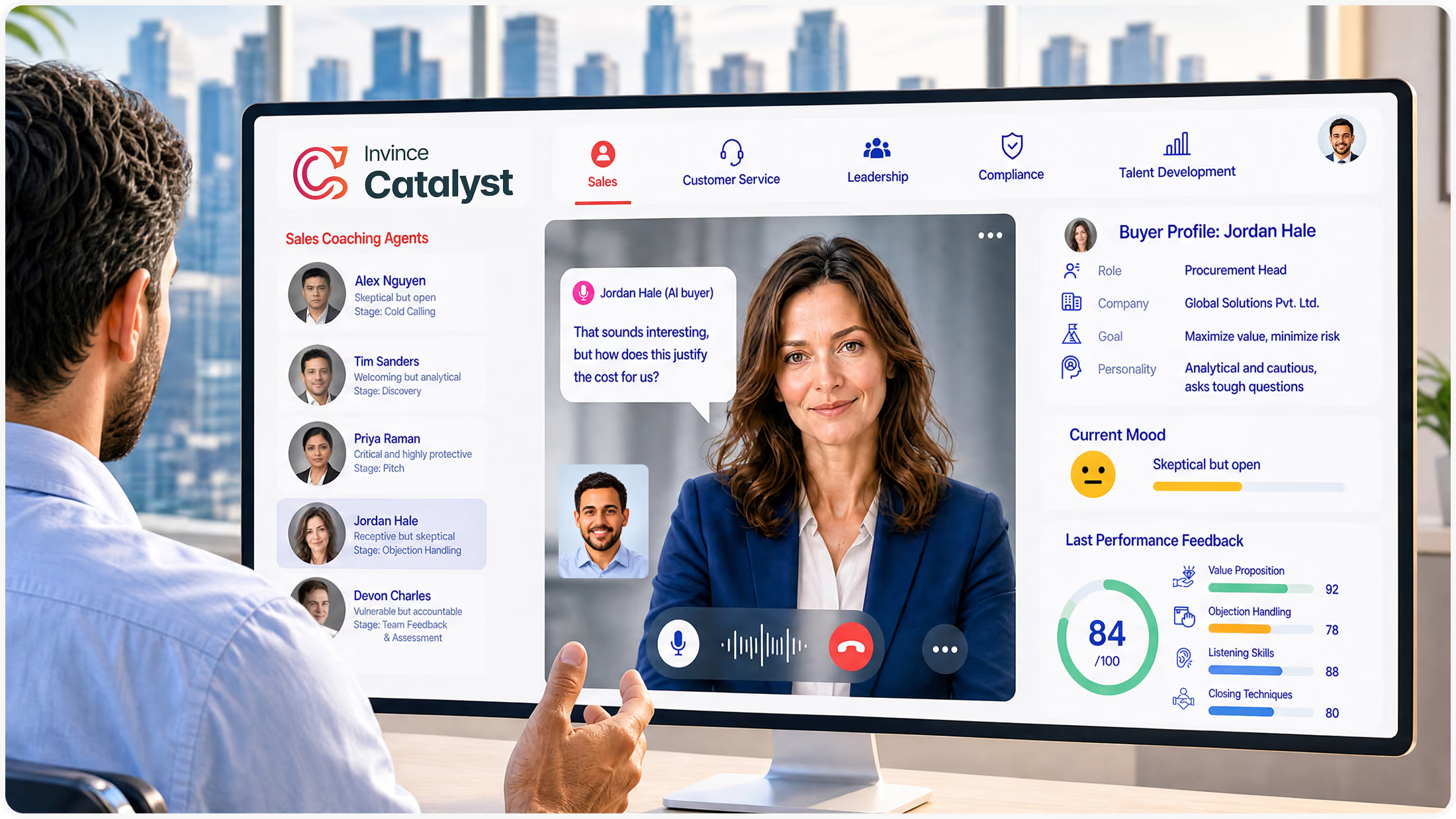
Invince Catalyst is an AI-powered role-play platform that helps employees practice workplace conversations in simulated scenarios. It can complement coaching by giving learners a structured environment to rehearse skills before using them in real interactions.
For example, a sales representative preparing for a challenging negotiation can practice responding to an AI-driven customer persona. An emerging leader can rehearse a performance conversation, while a customer service employee can practice handling an escalation.
These practice experiences can help employees work on:
- Communication and active listening
- Sales conversations and objection handling
- Negotiation and persuasion
- Leadership and people-management conversations
- Conflict resolution
- Customer service interactions
- Confidence in high-pressure situations
Rather than relying only on theoretical instruction, employees get opportunities to make choices, respond to realistic conversational challenges, and learn from feedback.
How Can AI Role-Play Complement Human Coaching?
AI-powered practice is not a replacement for every aspect of human coaching. Human coaches bring context, empathy, professional judgment, and an understanding of individual circumstances.
Invince Catalyst can complement that expertise by making practice more accessible between coaching sessions.
A combined approach might look like this:
- Learn: The employee completes a course on effective communication.
- Practice: The employee uses Invince Catalyst to rehearse a difficult conversation.
- Review: The employee reflects on the feedback and identifies areas for improvement.
- Coach: A manager or coach discusses the employee's approach and provides additional guidance.
- Apply: The employee uses the improved approach in a real workplace situation.
This model can help organizations extend opportunities for practice beyond scheduled coaching sessions.
How Can Invince LMS, Craft, Plethora, and Invince LXP Complement Coaching?
Coaching is most effective when it connects with the broader learning environment.
InvinceLMS can support structured learning programs, assessments, and competency development, helping organizations organize learning activities around employee development needs.
Invince Craft can help L&D teams create digital learning modules and assessments that introduce concepts before a coaching session or reinforce them afterward.
Invince Plethora can provide additional learning resources that employees can explore as they work on specific development goals.
Invince LXP can support a more learner-focused experience by helping employees discover relevant content and development opportunities.
Within this ecosystem, Invince Catalyst adds a practical role-play layer, allowing employees to rehearse workplace conversations rather than relying exclusively on courses and reading materials.
For example, a leadership development pathway could combine a short learning module, an AI-powered difficult-conversation role-play, a follow-up assessment, and a coaching discussion. Each component serves a different purpose, but together they support a more connected development experience.
How Can Organizations Measure Coaching Effectiveness?
Organizations should measure coaching against the goals established at the beginning of the process.
Useful indicators may include:
- Progress against individual development goals
- Improvements in competency assessments
- Performance in role-play or simulation exercises
- Manager and peer feedback
- Changes in observable workplace behaviors
- Readiness for new responsibilities
- Relevant team or business performance measures
With AI-powered role-play, organizations can also use scenario performance and feedback as inputs for development discussions, where the platform supports those capabilities.
However, performance in a simulated scenario should not be treated as definitive proof of workplace improvement. It is one useful indicator that should be considered alongside real-world observations, assessments, and relevant business measures.
What Is the Role of Coaching in Modern Enterprise Learning?
Workplace coaching helps employees turn knowledge into practical capability. It supports reflection, encourages accountability, and gives employees a way to address the challenges they encounter in their roles.
For enterprise L&D teams, combining human coaching with AI-powered practice creates additional opportunities for employees to rehearse important skills. Invince Catalyst can help make workplace role-play more accessible, while InvinceLMS, Invince Craft, Invince Plethora, and Invince LXP can support the wider learning and development journey.
The result is a more connected approach to enterprise learning: employees gain knowledge, practice applying it, receive feedback, and continue developing their capabilities.
Ultimately, effective coaching is not simply about telling employees how to improve. It is about helping them build the confidence, judgment, and practical skills to perform better when real workplace situations demand it.
To know more about such learning and development terms, click to visit Invince's L&D Glossary.
Our latest blogs
Ready to Revolutionize Learning at Your Organization?
Join 400+ enterprises using Invince to upskill, reskill, and retain top talent.
Ready to Revolutionize Learning at Your Organization?
Join 400+ enterprises using Invince to upskill, reskill, and retain top talent.

Ready to Revolutionize Learning at Your Organization?
Join 400+ enterprises using Invince to upskill, reskill, and retain top talent.