

The 5 Hidden Costs of Ineffective Training: And How AI-Powered Learning Ecosystem Invince Fixes Them for Good (with Real Case Studies)

Learning and Development (L&D) is now a strategic pillar for enterprise performance, yet its true impact is often difficult to quantify.
Organizations continue to invest in digital learning platforms, content libraries, and leadership academies, but many still struggle to demonstrate how these investments translate into measurable business outcomes.
This gap is not due to indifference, but rather to complexity. Modern oragnizations operate across dispersed geographies, changing skill requirements, and rapidly evolving business priorities.
Without real-time visibility into employees' knowledge, skill application, and capability gaps, measuring and optimizing learning performance is difficult. The consequences are cumulative, leading to execution inefficiencies, uneven compliance, slower innovation, and inconsistent employee engagement.
These hidden costs erode competitiveness over time. Recent research highlights the scale of this issue. Only 30% of L&D leaders can confidently link learning initiatives to measurable business impact.
This analysis examines five hidden costs of ineffective training that limit organizational performance and demonstrates how Invince, an AI-powered learning ecosystem, can restore visibility, consistency, and strategic value.
1. The Hidden Cost of Manual Competency Management
Problem Statement
Billions are spent every year on training, yet few organizations can answer one critical question: What skills do we actually have, and which ones are holding us back? Competency data often lives in fragmented spreadsheets, outdated HR records, or siloed learning systems.
Reviews are infrequent, feedback loops are slow, and analytics often measure participation rather than proficiency. Without clear insight into the skill landscape, hiring becomes reactive; promotions rely on perception, and learning investments remain unmeasured.
Managers rely on intuition rather than data when deploying talent.
These hidden costs accumulate over time: Delayed decision-making because the capability data is incomplete or outdated. Redundant training is spent on programs that don’t address real gaps. Bias and inconsistency in performance reviews and succession planning.
In essence, what cannot be measured cannot be improved, and what cannot be seen cannot be scaled.
The Invince AI Solution
Invince eliminates this visibility gap by embedding intelligence into every layer of learning — connecting people, performance, and potential through data.
A multinational employing over 10,000 people across manufacturing, supply chain, sales, and corporate functions struggled to track and manage over 50 core competencies across its diverse workforce.
The process relied on manual self-assessments and spreadsheet-based reviews, which were slow, inconsistent, and prone to bias. With Invince, the company digitized and automated its entire competency framework.
At its center was UpsideLMS, our AI-Powered learning experience platform, using which employees selfassessed digitally, while managers validated results through AI-calibrated scoring thresholds that ensured fairness and consistency.
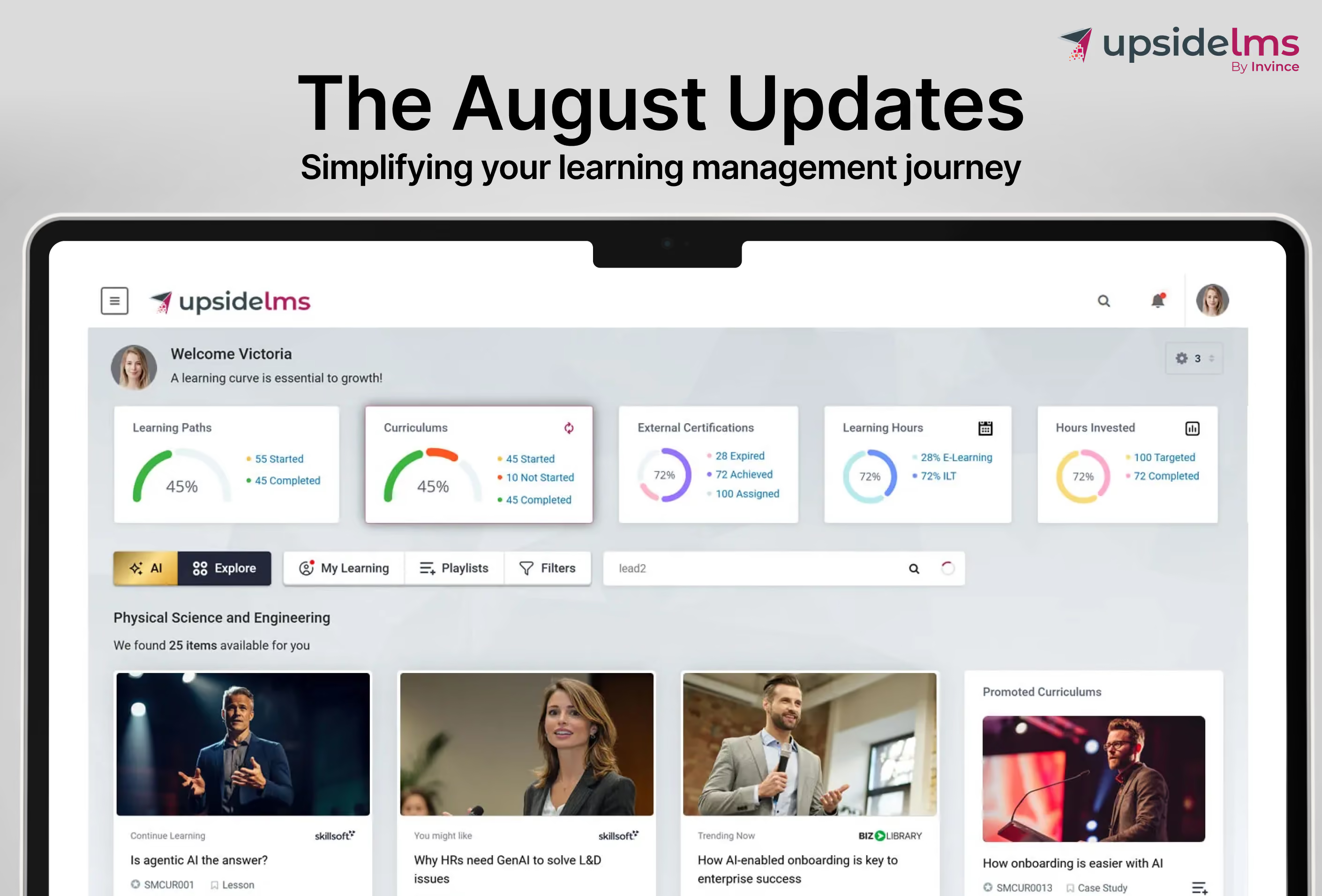
The platform’s real-time dashboards visualized workforce capability across regions, roles, and business units, enabling HR and business leaders to quickly identify strengths, gaps, and readiness for internal mobility or leadership roles.
When a skill gap emerged, Craft, Invince’s GenAI-powered microlearning builder, automatically generated interactive courses from internal policies, SOPs, or frameworks.
These micro-modules used adaptive assessments, AI voiceovers, and multilingual delivery to ensure comprehension and accessibility.
To accelerate capability building, Plethora, Invince’s AI-curated content library, aligned over 80,000 expert-led courses to the company’s competency framework, instantly filling niche and emerging skill gaps without manual curation.
The Invince ecosystem created a closed learning feedback loop — where capability was continuously assessed, skill gaps were instantly addressed, and learning outcomes were tied directly to performance data.
The Business Outcome
a. Administrative workload reduced by 70%
b. Acceleration in skill-gap closure accelerated by 30%
c. Minimized evaluation bias minimized, as AI-calibrated validation replaced subjective manager scoring
d. Surged managerial efficiency with real-time dashboards driving faster, evidence-based talent decisions.
2. The Hidden Cost of Failing to Build Employee Retention and Career Mobility
Problem Statement
Every organization encounters a point when capable, motivated employees begin to plateau, not because they have stopped caring, but because they cannot see the next step in their learning journey.
Checks completed, certificates issued — but employees are left wondering: what does this mean for my growth? That’s where the problem begins.
When learning lacks visibility into career pathways or measurable impact, employees often disengage long before they officially leave.
Industry studies estimate it takes 6–9 months of salary to replace a mid-level employee, and up to 3x that for high-potential talent already deep in the learning curve. But the greater cost lies in the vacuum left behind — broken project continuity, lost institutional knowledge, and declining morale among remaining teams
The Invince AI Solution
Invince’s AI-powered learning ecosystem unifies performance data, skill intelligence, and leadership readiness on a single platform.
An organization with over 12,000 professionals faced an increasingly familiar challenge: a strong inflow of talent but a weak succession pipeline.
Employees completed training, but internal promotions lagged, and leadership readiness remained inconsistent across regions.
With UpsideLMS, the company unified scattered learning data from its HRMS and performance systems.
AI algorithms analyzed this data to create readiness heatmaps that map every employee’s current skill level against defined leadership competencies.
AI-driven personalization then recommended targeted leadership journeys — powered by Plethora’s— automatically aligning each learner’s path with the competencies needed for their next role.
Craft created existing leadership frameworks and policy documents into interactive, scenario-based micro-courses, tailoring tone, visuals, and pacing each learner’s role.
Together, the ecosystem created a live, intelligent talent mobility framework.
The Business Outcome
a. 25% increase in internal promotions within 12 months.
b. 50% faster leadership readiness cycles.
c. 18% improvement in retention among high-potential employees.
3. The Hidden Cost of Treating Compliance Like a Checklist
Compliance training is intended to protect the organization, yet many treat it as a simple checklist. Certificates get issued, dashboards turn green, and leadership assumes the organization is safe.
However, the hidden cost lies in what is not tracked. Behavioral lapses, missed updates, and unaddressed gray areas build up until a minor oversight becomes a systemic failure.
In 2024, TD Bank paid nearly $3 billion in anti–money laundering (AML) penalties, not because it lacked a compliance framework, but because the framework failed to translate into accountable behavior.
When employees view training as bureaucracy rather than protection, accountability erodes internally. As culture declines, even the best policies cannot maintain standards.
The Invince AI Solution
Here’s how Invince turns compliance learning into a living system of accountability — one that’s continuous, adaptive, and behavior-driven.
A leading African airline operating under one of the world’s most demanding regulatory frameworks faced a recurring challenge — high training completion rates but low audit readiness.
Employees completed modules, but comprehension was inconsistent, and procedural lapses persisted in the field.
By adopting Invince’s, the airline rebuilt its compliance learning model from the ground up:
a. Craft converted dense safety manuals and legal documents into five-minute interactive microlearning modules. AI-generated voiceovers, contextual storytelling, and scenario-based questions trained employees to think through decisions, not memorize rules.
b. UpsideLMS tracked comprehension, not just completion. AI analytics identified patterns of repeated errors, flagged at-risk teams, and auto-assigned refresher modules before the next audit cycle.
c. Plethora ensured consistency and global reach — with thousands of certified courses covering aviation safety, data protection, ethics, and workplace conduct, automatically updated to the latest regulatory standards.
The Business Outcome
a. 34% increase in compliance completion rate within one year.
b. Audit readiness became real-time with automated dashboards and evidence logs.
c. 40% reduction in yearly incidents
4. The Hidden Cost of Learning Infrastructure Misfit
Problem Statement
Organizations today invest heavily in learning — advanced strategies, world-class content, and multimillion-dollar systems — yet one quiet flaw still undermines it all: technology that doesn’t work where people do.
Across industries like logistics, manufacturing, aviation, and retail; workforces operate in bandwidth-restricted, device-fragmented environments — warehouses, vessels, terminals, and shop floors.
The result?
But most learning platforms are built for offices and high-speed networks, not for the realities of distributed operations.
Courses crash mid-session, progress isn’t saved, and completion data gets corrupted.
Over time, these micro-failures accumulate into measurable business risk.
The Invince AI Solution
Invince engineered its AI-powered ecosystem around one fundamental truth — learning must perform wherever work happens, not just where connectivity exists.
A leading North American maritime operator needed to ensure continuous compliance and safety training for thousands of employees spread across ports, warehouses, and vessels.
Connectivity was unpredictable, and the organization’s existing systems couldn’t handle offline execution or data synchronization.
With Invince, the organization redefined its learning infrastructure:
Offline-first architecture allowed employees to download courses, complete them during voyages, and auto-sync progress once reconnected. AI-driven compression and adaptive streaming optimized video and course content for low bandwidth, ensuring smooth performance even in constrained networks.
Real-time analytics and dashboards gave administrators complete visibility into completions, compliance scores, and certification renewals — regardless of where the learner operated.
Craft created lightweight microlearning modules designed for mobile-first use — short, engaging, and relevant to the learner’s environment.
The Business Outcome
a. Learning continuity exceeded 99%, even in low-connectivity environments
b. Compliance adherence stabilized at 99.7%, across multiple remote locations
c. Administrative overhead reduced by 40% through automated sync and tracking
5. The Hidden Cost of Decentralized Learning Delivery
Problem Statement
Some large organizations train employees, service partners, franchise networks, and even customers — all at different skill levels, in different geographies, and under different business mandates. Yet most learning systems were never designed for this kind of operational complexity.
Traditional LMS platforms function as isolated environments, each managing its own users, content, and data.
As organizations grow, they bolt more systems — one for internal learning, another for partner training, and often several more for franchise or customer education.
Each system has its own admins, content workflows, and reporting formats. Updates must be made manually across portals. Analytics remain disconnected, making it impossible to see who’s learning what, where, and why.
The hidden cost lies in this duplication.
Redundant content creation drains budget and time. Inconsistent branding and messaging dilute customer experience. Delayed rollouts of training and compliance programs impact readiness and performance. Administrative overhead multiplies as teams manage parallel systems.
The Invince AI Solution
A global consumer enterprise managing multiple retail, service, and franchise networks faced this exact challenge — inconsistent training, redundant systems, and slow content deployment.
With UpsideLMS’s multi-portal AI architecture, the organization launched distinct, branded portals for each audience — employees, partners, and service networks — all connected to a single AI-powered backend.
AI content tagging automatically classified and distributed learning materials across relevant audiences. AI-driven personalization delivered context-aware learning paths, adjusting content based on role, geography, and learning behavior.
Predictive analytics surfaced insights on engagement, skill development, and compliance gaps before they impacted performance.
Supporting this was Craft, which turned lengthy product manuals and SOPs into interactive, multilingual microlearning within minutes.
Plethora used AI to recommend curated modules that filled emerging skill gaps instantly.
Together, the system became a self-updating learning ecosystem — intelligent enough to adapt content, personalize delivery, and unify learning experiences across audiences, without manual intervention.
The Business Outcome
a. 60% reduction in administrative effort for training delivery and reporting.
b. 45% faster rollout of compliance and product programs across all business units.
c. 30% increase in learner engagement through AI-personalized learning paths.
d. 100% consistency of branding and compliance standards maintained across learning portals.
The Way Forward: Building a Smarter Learning Future with the Invince AI Ecosystem
The future of organizational learning isn’t about doing more training; it’s about building smarter systems that connect learning with real business outcomes.
The organizations that will thrive aren’t the ones spending the most on training; they’re the ones that treat learning as a living, intelligent system powered by data, driven by AI, and aligned with strategy.
That’s the vision we’ve built into the Invince AI-powered learning ecosystem, where Craft, UpsideLMS, and Plethora come together to make learning intelligent, measurable, and business-focused.
With Craft, course creation becomes instant, interactive, and multilingual. What once took weeks of manual work, converting policy documents, onboarding materials, or product guides into structured learning, now takes minutes.
AI ensures every course is contextual, every module is engaging, and every learner receives information that fits their role and pace. With UpsideLMS, learning transforms into a connected, enterprise-grade experience. It delivers training where employees are, on any device, in any environment, tracking performance, comprehension, and skill mastery in real time.
From competency assessments to compliance cycles, it makes learning administration nearly invisible, yet operationally indispensable. And with Plethora, organizations gain immediate access to over 80,000 expertly curated courses across compliance, leadership, and professional development, content that grows with your workforce and keeps skills future-ready.
Together, these platforms create an ecosystem where AI doesn’t replace human learning; it enhances it. It ensures that learning is not just delivered, but embedded into daily work.
Where insights drive decisions, and where every learning moment builds capability, culture, and measurable ROI. Because when learning systems think as fast as your business moves, training stops being a cost and becomes a competitive advantage. That’s not the future of learning. That’s the Invince way forward.

Ready to Revolutionize Learning at Your Organization?
Join 400+ enterprises using Invince to upskill, reskill, and retain top talent.
Ready to Revolutionize Learning at Your Organization?
Join 400+ enterprises using Invince to upskill, reskill, and retain top talent.

Ready to Revolutionize Learning at Your Organization?
Join 400+ enterprises using Invince to upskill, reskill, and retain top talent.