

LMS in Healthcare: Building a Safer, Compliant Workforce at Scale
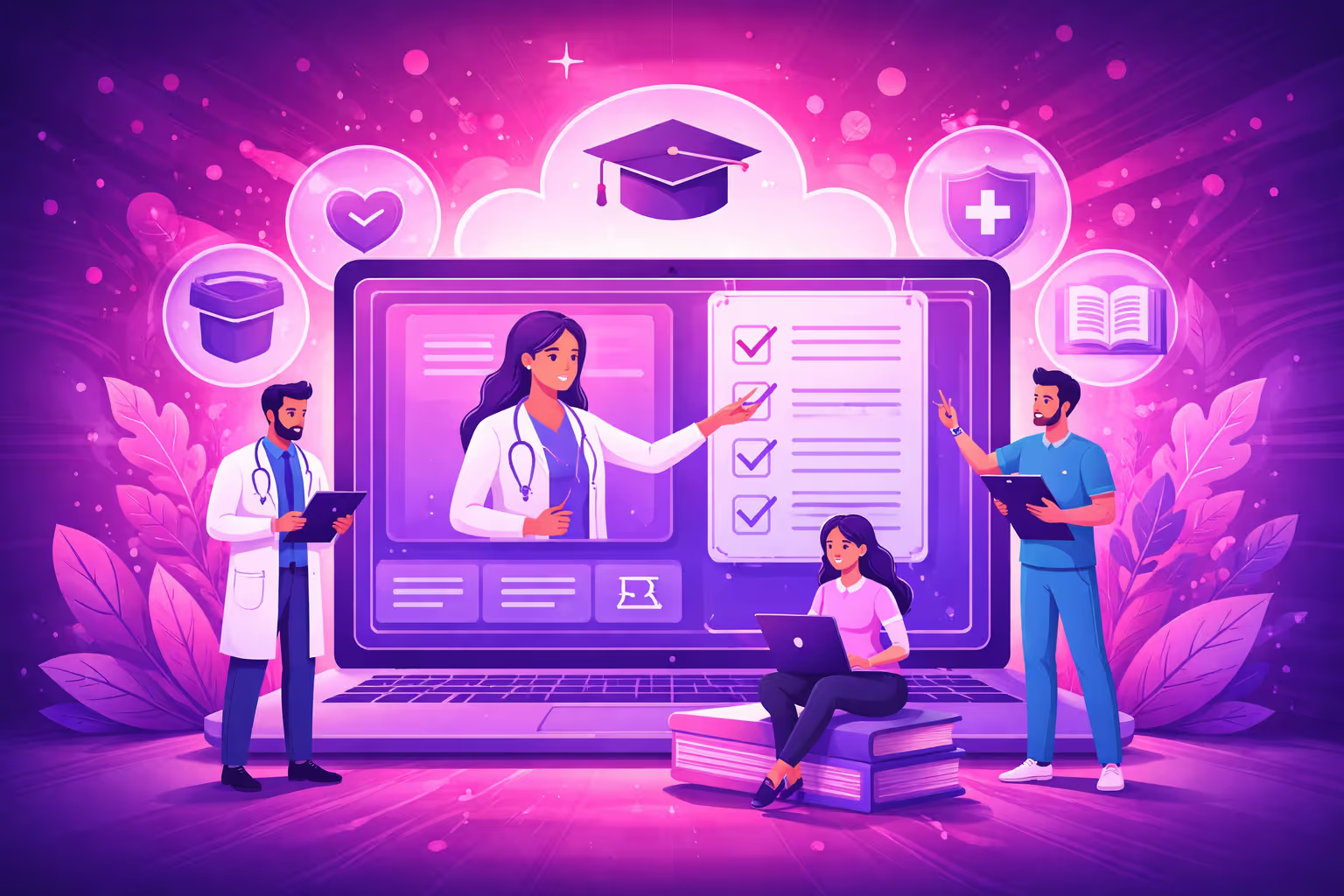
In healthcare, risk does not arrive with fanfare. It slips in quietly, hiding in overlooked steps, forgotten protocols, and tiny inconsistencies that quietly multiply. A hand not washed in the rush of a shift. A privacy rule misread by a newcomer. A safety procedure recalled one way in one department, another way in the next.
These are not system failures. They are human ones.
Systems may be advanced, equipment may be state-of-the-art, but care is still delivered by people operating under pressure.
Many adverse events can be traced to training gaps, fading memories, or unevenly implemented protocols. In the pressure cooker of healthcare, even seasoned professionals need regular reinforcement to stay sharp.
The stakes could not be higher. Compliance missteps now bring clinical consequences, not just legal or reputational fallout. A missed document can spark an audit. A protocol slip can put patients at risk. And public trust, once broken, is a fragile thing to restore.
As a result, training can no longer be viewed solely as an HR responsibility. It is a core component of clinical quality and patient safety. In healthcare, training gaps do not just slow operations; they also compromise patient care. They put lives at risk.
Why Traditional Healthcare Training Models Fall Short
Healthcare organizations operate within one of the most complex risk environments of any industry.
Regulatory obligations vary by region and function, from patient privacy requirements like HIPAA to workplace safety standards under OSHA and accreditation expectations from the Joint Commission. Requirements evolve frequently, often with limited lead time.
Beyond regulation, clinical risk remains ever-present. Protocol deviations, whether intentional or accidental, can compromise care quality. Operational risks compound this further. High staff turnover, workforce shortages, and reliance on temporary or contract staff strain consistency.
Technology introduces another layer. Digital health records, connected devices, and remote care expand access but also increase exposure to data privacy and security risks, many of which stem from human error.
Rules and policies seldom fail us. It is the steady, reliable execution that proves elusive.
Most healthcare organizations still rely on training models designed for a slower, more predictable world.
Annual compliance training is common, but retention fades quickly. Classroom-heavy approaches struggle to scale across shifts, locations, and roles. One-size-fits-all programs fail to account for the stark differences between clinical staff, administrators, support teams, and contractors.
Most concerning of all, training is too often judged by who shows up rather than by who truly understands. Completion reports may offer comfort, but they reveal little about real-world readiness.
Compliance might look perfect on paper. In reality, true preparedness is patchy and unpredictable.
What an LMS Must Deliver in a Healthcare Environment
Before introducing any technology, healthcare leaders need clarity on the role an LMS is meant to play. In a sector where lives are at stake, a learning system cannot be judged solely by its features. It must be evaluated by how effectively it supports safe, consistent execution across the organization.
First, an LMS must mirror the reality of healthcare roles. Clinical staff, administrative teams, support functions, and external contractors operate under very different risk profiles. A single learning path cannot serve all of them.
Role-based learning ensures that individuals are trained on what they are accountable for, not what is generically required. This alignment reduces noise, improves recall, and lowers the risk of critical steps being missed under pressure.
Second, regulatory compliance demands automation, not manual vigilance. Certifications and recertifications are constant, overlapping, and time-sensitive. Relying on spreadsheets or reminders creates blind spots. An LMS must continuously track credentials, surface upcoming expiries, and ensure that only compliant staff are cleared for regulated tasks. This shifts compliance from a periodic scramble to a controlled, ongoing process.
Visibility is equally critical. Leaders need to see more than completion rates. They need insight into where readiness is weakening, which departments are falling behind, and where training gaps overlap with operational risk.
Real-time visibility allows intervention before issues escalate into incidents or audit findings.
Equally important is responsiveness. Healthcare policies and protocols change frequently, often in response to new evidence, regulations, or emergencies. An LMS must allow learning to be updated and redistributed immediately.
Delays between policy change and workforce understanding introduce silent risk, particularly in high-pressure environments where staff rely on habit and memory.
Finally, an LMS must support consistency without rigidity. It should reinforce standard practices while allowing for contextual application across departments and locations. The goal is not to turn learning into bureaucracy, but to create a reliable foundation that supports confident decision-making.
LMS Platforms and Clinical Compliance
Clinical compliance demands consistency across shifts, departments, and locations.
An LMS enables standardized training for infection control, hygiene protocols, patient privacy, and data protection. Medication handling and administration standards can be reinforced with scenario-based learning rather than static guidelines.
Incident reporting and escalation training sticks when staff grasp not just the how, but the why. Regular reinforcement keeps procedures sharp, even under pressure.
The goal is not rigid routines, but dependable performance.
Operational Safety Beyond Clinical Roles
Patient safety depends on more than clinicians alone.
Support and facility teams are just as vital to safety as clinicians. Emergency preparedness must reach every corner of the organization. How equipment is handled, how workplaces are kept safe, and how contractors are brought on board—all shape the risk landscape.
Temporary staff and external partners often account for the greatest variability in training quality. An LMS provides structured, repeatable learning paths that ensure everyone operates to the same standards, regardless of tenure or employment type.
Safety is a shared responsibility.
Managing High Turnover and Skill Gaps in Healthcare
Workforce realities add further complexity. High turnover rates, staffing shortages, and rapid onboarding cycles create continuous skill gaps.
When seasoned staff walk out the door, their hard-won knowledge often goes with them. New hires are asked to hit the ground running, sometimes before they are truly ready. This breeds reliance on informal mentoring, a solution that cannot keep up.
An LMS provides structured learning that accelerates time-to-competence. Knowledge is captured, standardized, and made accessible, reducing reliance on individuals and improving continuity.
How Continuous Learning Improves Retention and Safety
One-time training is inherently fragile in healthcare environments. Even when initial understanding is strong, memory degrades over time, and it degrades faster under stress. In moments of urgency, clinicians and staff do not recall slides or manuals. They rely on patterns that have been reinforced repeatedly.
Continuous learning addresses this reality by shifting the focus from exposure to reinforcement. Instead of concentrating learning into a single session, it distributes it across time, allowing critical knowledge to be revisited in manageable doses. This approach aligns with how people actually retain information, especially in high-pressure settings.
Microlearning plays a central role here. Short, focused refreshers can be absorbed quickly and applied immediately, without pulling staff away from patient care for extended periods. These moments of learning are designed around specific actions or decisions, not broad concepts, making them easier to recall when it matters.
Scenario-based learning adds another layer of depth. By simulating real clinical situations, it strengthens judgment rather than rote memory. Staff are not just reminded of procedures; they practice choosing the right response in context. Over time, this builds cognitive muscle memory, allowing individuals to act decisively even when conditions are less than ideal.
The cumulative effect is confidence. When learning is reinforced continuously and grounded in real-world scenarios, staff are less likely to hesitate or second-guess themselves. Performance becomes more consistent across shifts and teams, and preventable errors decline.
In healthcare, safety depends not only on knowing what to do, but on being able to do it reliably under pressure. Continuous learning makes that reliability possible.
Measuring What Matters in Healthcare Training
Completion rates offer reassurance, but they offer little protection. In healthcare, knowing that training was completed does not mean it was understood, retained, or applied correctly when it mattered most.
Leaders need visibility into comprehension and readiness, not just participation. This means understanding whether staff can interpret protocols accurately, recognize risk scenarios, and respond appropriately under pressure. Training that looks complete on paper can still leave critical gaps in practice.
More mature measurement connects learning data with operational signals. Patterns in near-misses, incident reports, and audit findings often align with areas where understanding has weakened or reinforcement has lapsed. When learning data is viewed alongside these indicators, it becomes a tool for prevention rather than post-event explanation.
Analytics also allow leaders to see trends over time. They can identify departments or roles where readiness is declining, where turnover is eroding institutional knowledge, or where protocol changes have not been fully absorbed. This level of insight enables targeted intervention instead of broad, disruptive retraining.
When the impact of training remains invisible, risk remains unmanaged. An LMS with robust analytics and reporting capabilities brings training into the same visibility framework as safety, quality, and compliance. It allows organizations to move from reacting to incidents to anticipating them, strengthening both patient safety and organizational resilience.
Common Mistakes Healthcare Organizations Make with LMS Adoption
Several missteps appear repeatedly when healthcare organizations adopt or expand an LMS, often undermining the very outcomes the system is meant to support.
The most fundamental mistake is positioning the LMS as an HR system rather than an operational one. When learning is treated as an administrative requirement, it becomes disconnected from patient safety, clinical quality, and risk management. Training may be completed on schedule, but it fails to influence day-to-day behavior where it matters most.
Another common error is equating more content with better preparedness. In an effort to cover every requirement, organizations overload staff with information, much of it only loosely relevant to their roles. This creates cognitive fatigue, reduces engagement, and weakens retention. In high-pressure environments, excess content does not improve performance; it obscures what is critical.
Timing is another frequent failure point. Healthcare protocols evolve quickly, yet training updates often lag behind policy changes. Even short delays introduce uncertainty, forcing staff to rely on outdated habits or informal guidance. Over time, this erodes confidence and consistency, particularly across shifts and locations.
Perhaps the most damaging mistake is the absence of leadership ownership. When training is delegated entirely and no longer championed at the executive level, it loses strategic direction. Priorities blur, accountability weakens, and learning becomes reactive rather than intentional.
These missteps are understandable. Healthcare environments are complex, and operational pressures are relentless. But the cost of misalignment is not measured only in inefficiency. In healthcare, it surfaces as increased risk, uneven care quality, and avoidable harm.
How Invince Approaches Healthcare Training with LMS
Invince approaches healthcare training with a clear premise: in clinical environments, learning is not a support activity. It is part of the safety infrastructure. The goal is not to deliver more training, but to ensure that the right people are consistently prepared to act correctly in high-risk, real-world situations.
This is why Invince designs healthcare learning as an integrated ecosystem rather than a single platform. Safety, compliance, and scale require coordination between structure, speed, and visibility.
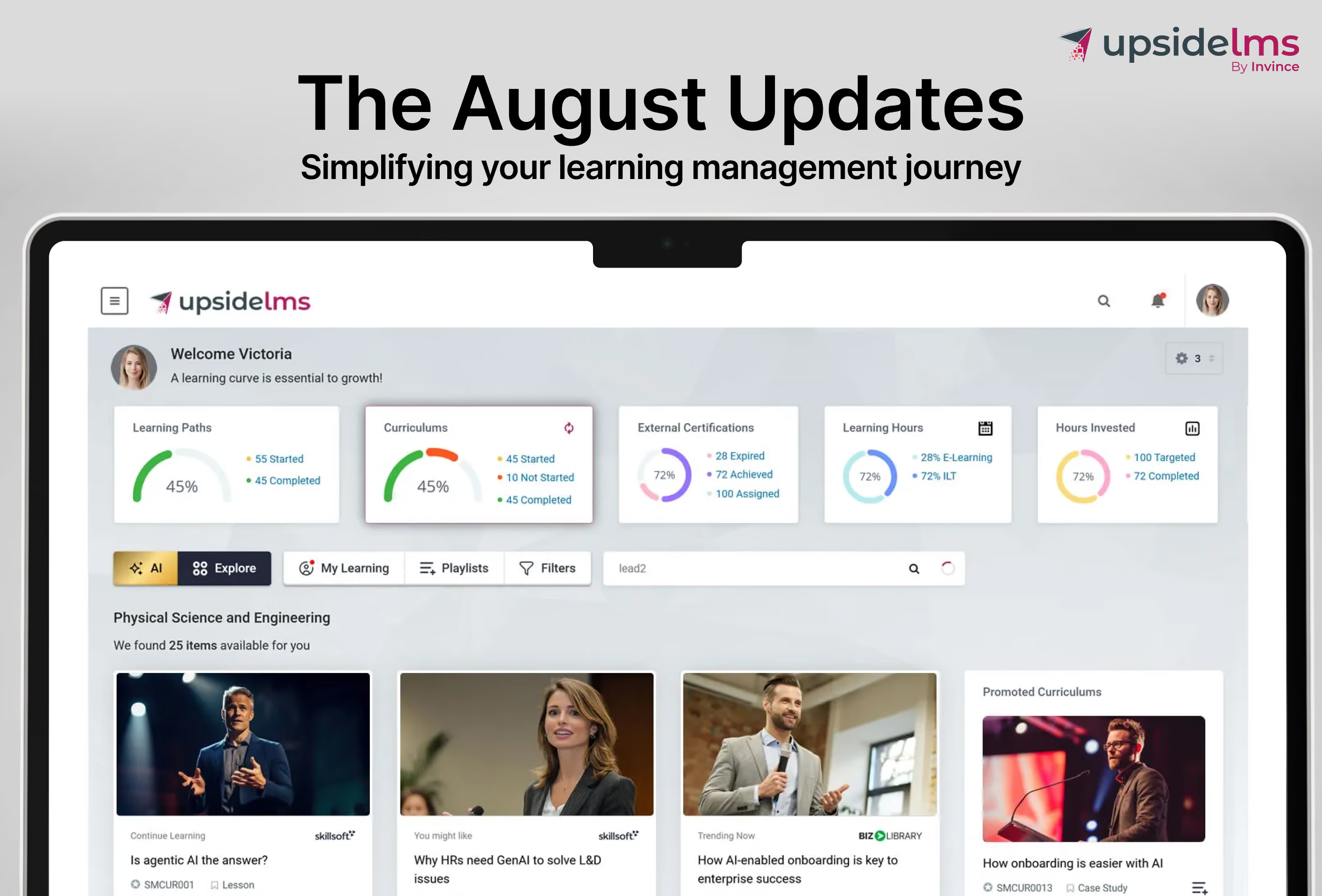
UpsideLMS provides the structural backbone of this ecosystem. It enables role-based learning that reflects the realities of healthcare work, distinguishing clearly between clinical staff, administrative teams, support roles, and external personnel.
Training paths align directly with regulatory and clinical responsibilities, ensuring that individuals are trained on what they are accountable for, not overwhelmed with generic content.
Automation for certifications, recertifications, and compliance deadlines reduces manual effort and improves audit readiness. For healthcare leaders evaluating the Best LMS for healthcare, this combination of structure and visibility is essential to maintaining consistent standards across shifts, departments, and locations.
Craft addresses one of healthcare’s most persistent risks: the gap between policy change and workforce understanding.
Clinical guidelines, safety protocols, and regulatory requirements evolve constantly, often in response to new evidence or external mandates. Craft enables rapid creation and updating of learning directly from policies, protocols, and internal expertise.
When a guideline changes, learning can be refreshed immediately and distributed consistently, reducing the lag that often introduces confusion and variation in practice. This capability is particularly critical in environments where outdated knowledge can directly impact patient safety.
Plethora completes the ecosystem by accelerating coverage of common healthcare competencies through an AI-powered, off-the-shelf content library.
Rather than rebuilding foundational training from scratch, organizations can quickly establish a baseline of consistent learning across areas such as safety, compliance, and operational readiness.
This allows internal teams to focus their effort on organization-specific risks and protocols while maintaining a strong, standardized foundation.
Together, these components create a closed loop between learning, readiness, and care delivery. Leaders gain continuous visibility into who is trained, who is ready, and where gaps may pose risk.
Training is no longer detached from operations or compliance reporting. It becomes directly tied to patient safety, regulatory confidence, and organizational trust.
In this model, learning supports healthcare’s core mission: delivering safe, reliable care at scale, even as complexity grows.
Ready to Revolutionize Learning at Your Organization?
Join 400+ enterprises using Invince to upskill, reskill, and retain top talent.
Ready to Revolutionize Learning at Your Organization?
Join 400+ enterprises using Invince to upskill, reskill, and retain top talent.

Ready to Revolutionize Learning at Your Organization?
Join 400+ enterprises using Invince to upskill, reskill, and retain top talent.