

Why CEOs Must Treat Learning Culture as a Growth System, not an HR Program
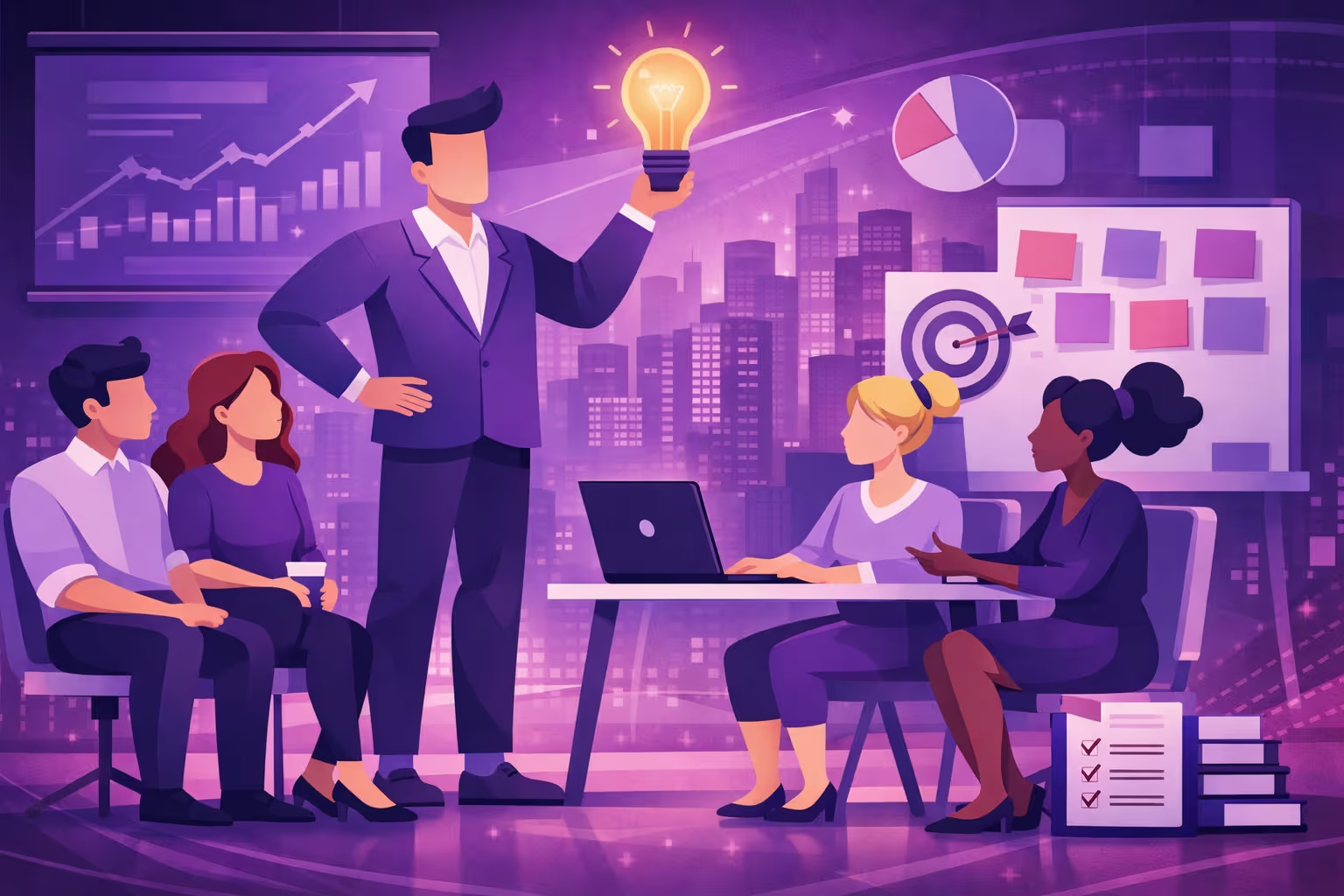
As companies expand, CEOs sense a subtle but undeniable shift. Momentum stutters. Decisions that once flowed now pile up at the top. Teams hesitate, waiting for guidance instead of charging ahead. Gradually, a handful of people become linchpins, and when they step away, everything slows to a crawl.
These warning signs are often dismissed as leadership gaps, process hiccups, or hiring woes. But beneath it all, a deeper shift is underway: the organization has outpaced its own ability to learn.
Early on, closeness sparks progress. Leaders and teams huddle together, sharing information in real time, while top performers bridge gaps with grit and know-how. But this model has an expiration date. As the company grows, knowledge splinters, context fades, and the very strengths that once powered execution start to undermine scale.
This is the turning point when learning culture leaps from the sidelines to the heart of the CEO’s agenda. It is no longer an HR checkbox or a training calendar, but the engine that decides whether the organization can keep performing as complexity rises.
Why Learning Culture Has Become a CEO Problem
In the initial stages of growth, learning is embedded in daily work. People observe how decisions are made, ask questions freely, and solve problems together. Knowledge circulates because teams are small and communication is constant.
As the organization grows, the informal web of learning starts to fray. New hires lose the luxury of learning by osmosis. Managers are thrust into leadership before experience can catch up. Teams scatter across functions, regions, and time zones, eroding shared understanding. The silent agreements that once united everyone begin to unravel.
Over time, CEOs start seeing the effects:
- Execution quality varies across teams doing similar work
- Decisions rise upward instead of being resolved close to the information
- A few individuals become critical dependencies
At this point, learning is no longer about courses or workshops. It is about how the organization thinks on its feet, adapts in real time, and delivers again and again. Growth reveals knowledge gaps faster than hiring can fill them, and no amount of documentation can make up for a missing understanding.
What is Meant by “Learning Culture” and Why It’s Often Misunderstood
A strong learning culture is not about packing the calendar with training sessions. It is about sharper judgment, quicker decisions, and fewer mistakes that could have been avoided.
The misunderstanding begins when learning is equated with activity. Courses completed, hours logged, and certifications earned may signal effort, but they say little about whether people can apply what they know when it matters most.
A true learning culture reveals itself in everyday actions. It lives in how teams tackle new problems, how leaders offer feedback, and how decisions are explained and re-examined. It is built not on one-off lessons, but on learning that sticks through repetition.
There is an important distinction:
- Compliance-driven learning prioritizes coverage and completion
- Performance-driven learning builds capability and confidence
Similarly, event-based training delivers information at fixed moments, while continuous learning strengthens understanding over time and in real situations. Culture is not shaped by reminders. It is shaped by repetition.
The Hidden Costs of Not Having a Strong Learning Culture
The lack of a strong learning culture does not shout its presence. Instead, it creeps in as friction, quietly building up across the organization.
Decision bottlenecks form as teams wait for approval. Customer experiences become a roll of the dice as processes are interpreted differently. Onboarding drags on, slowing productivity and forcing new hires to lean on peers. Rework becomes the norm as misunderstandings surface late in the game.
The gravest risk is becoming dependent on a select few. When knowledge is locked inside individuals rather than systems, growth becomes fragile. Progress hinges on who shows up, not on what the organization as a whole can do.
Many execution issues, when examined closely, turn out to be learning challenges in disguise.
The CEO’s Role in Shaping Learning Culture
CEOs often overlook how powerfully their own actions shape the learning culture, treating it as a program rather than a daily pattern of signals.
In truth, learning culture is set by what leaders reward, allow, and demonstrate. If learning is only talked about, it vanishes fast. When it is woven into decisions, it lasts.
This shows up in simple but powerful ways:
- Asking questions that invite thinking instead of demanding immediate answers
- Recognizing reflection and improvement, not just final results
- Making it safe for leaders to acknowledge gaps before they turn into failures
CEOs do not have to architect learning programs themselves. Their job is to shape an environment where learning flows naturally and continuously from the work itself.
Employees quickly learn what truly matters by watching how leaders behave.
Punish mistakes, and people bury them. Give vague or no feedback, and growth grinds to a halt. Make decisions in a vacuum, and teams lose their bearings. Skip reflection, and old errors return for an encore.
When leaders explain their choices, revisit results, and show curiosity, learning weaves itself into daily work. Over time, what leaders do becomes what the whole organization does.
Building Learning Into the Flow of Work
One of the biggest missteps organizations make is treating learning as an add-on, separate from the real work.
Learning that battles with deadlines rarely survive. Learning that fuels execution, on the other hand, grows effortlessly.
This means embedding learning into:
- Project reviews and retrospectives
- Decision-making conversations
- Role changes and leadership transitions
Bite-sized, relevant learning moments replace marathon workshops. Knowledge is drawn from real experience, not just paperwork. Learning becomes the natural result of doing great work, not a disruption.
For CEOs, this matters because it ties learning directly to execution and results.
The Systems CEOs Need to Support a Learning Culture
Culture is not powered by good intentions alone. It runs on the strength of its systems.
As organizations scale, informal tools break down. Spreadsheets scatter information. Visibility into skills and readiness dims. Consistency crumbles across teams and locations.
At this crossroads, leaders must choose: accept mounting inconsistency or invest in systems that make learning scalable.
Effective systems provide:
- Clear visibility into who knows what
- Insight into where capability gaps exist
- Consistent learning experiences across the organization
Whether built with care or left to chance, these systems quietly mold how people behave.
Common Mistakes CEOs Make When Trying to “Fix” Learning
Even well-meaning efforts can fall flat.
Common pitfalls include delegating learning entirely to HR, investing heavily in content without addressing behavior, measuring participation instead of capability, and launching initiatives without leadership alignment.
These missteps are easy to make. Learning feels less tangible than revenue or operations. The real shift comes from treating learning as a core leadership discipline, not a quick fix.
What a Mature Learning Culture Looks Like in Practice
A mature learning culture is not a vague idea. It is something you can see in action.
Onboarding accelerates because knowledge is structured and accessible. Leaders delegate with confidence because expectations are clear. Teams solve problems independently rather than defaulting to escalation. Execution becomes consistent across functions. Learning data informs talent decisions and strategic priorities.
This is not a quest for perfection. It is a pursuit of reliability. The organization shifts from relying on individuals to thriving as a unified system.
How CEOs Can Start Building a Learning Culture Today
Building a learning culture does not require a sweeping reorganization or a branded transformation initiative. It requires intentional leadership choices, made consistently.
The starting point is visibility. CEOs need a clear understanding of where critical knowledge actually lives today. In many organizations, it sits informally with long-tenured employees, in private documents, or inside conversations that never get captured. Until this is surfaced, learning efforts remain disconnected from real work.
From there, attention should shift to risk and impact. Not all roles carry the same margin for error. CEOs can accelerate progress by identifying positions where mistakes are most costly, whether financially, operationally, or reputationally, and ensuring those roles receive deeper, continuous reinforcement rather than one-time training.
Equally important is the tone of leadership conversations. When discussions focus only on outcomes, learning becomes invisible. When leaders ask what teams learned, what assumptions changed, and what decisions would be made differently next time, learning becomes part of how performance is evaluated. This shift alone can change behavior across the organization.
Finally, CEOs need to support learning with the right systems. Informal learning cannot scale indefinitely. Systems that make knowledge visible, track readiness, and reinforce learning over time allow the organization to grow without increasing dependency on individuals.
This work does not end. Learning culture is not a milestone or a deliverable. It is a leadership discipline that compounds over time, shaping how the organization adapts, decides, and executes as it grows.
How Technology Enables Learning at an Organizational Scale
As complexity increases, technology becomes a vital enabler.
Modern learning platforms extend beyond content delivery. They personalize learning based on role and responsibility. They reinforce understanding continuously rather than relying on one-time events. They provide insight into readiness, not just attendance.
For CEOs, the real value is alignment. Learning keeps up with change without endless manual effort. This is when top learning management systems are seen as growth engines, not just HR utilities.
Blended approaches make the difference. A blended learning management system fuses digital reinforcement with human connection, keeping learning meaningful and scalable.
How Invince Thinks About Learning as a Growth System
Invince approaches learning as an integrated ecosystem built to support execution as organizations scale. The underlying belief is straightforward: growth increases cognitive load across the organization long before it shows up in systems or structures. If learning does not evolve deliberately, decision quality and execution consistency begin to erode.
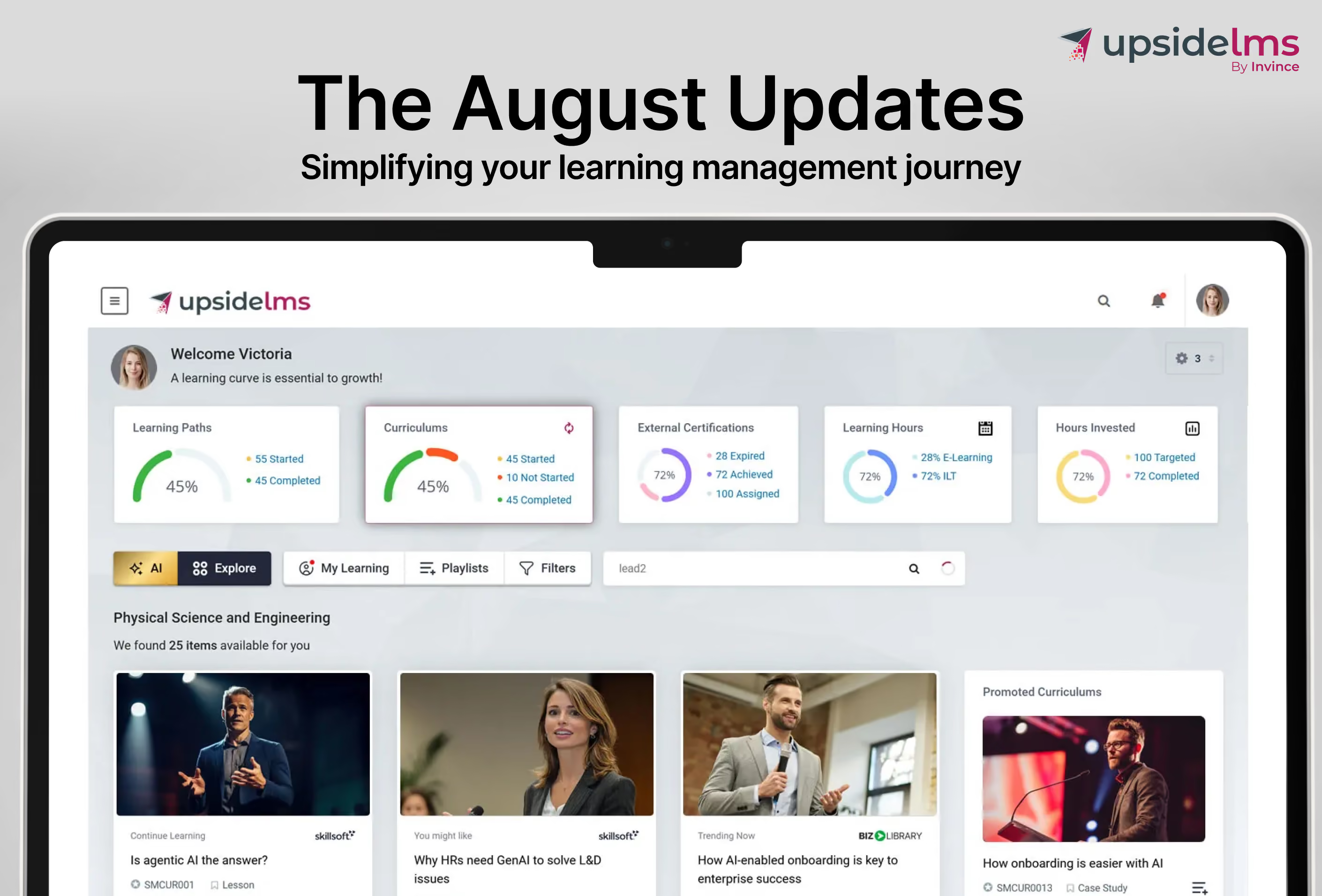
At the core of this ecosystem is UpsideLMS, an AI-powered LMS and LXP designed to operate at enterprise scale. Rather than functioning as a passive course repository, UpsideLMS structures learning around roles, responsibilities, and readiness expectations. Its AI-driven intelligence helps personalize learning journeys based on what individuals need to perform effectively in their roles, not just what they are required to complete. For leadership, this creates visibility into organizational capability across teams and regions, making learning a living system tied directly to execution rather than a static HR process.
Craft addresses the speed and complexity of knowledge change in growing organizations. As policies evolve, processes are refined, and new priorities emerge, traditional content-creation models struggle to keep pace. Craft is a GenAI-powered, multilingual microlearning builder that enables teams to transform policies, internal documentation, and subject-matter expertise into concise, role-ready learning assets. This capability shortens the distance between change and understanding, enabling organizations to communicate critical updates consistently and quickly across geographies and languages. In doing so, Craft reduces the risk created by delayed or uneven knowledge transfer.
Plethora completes the ecosystem by providing an AI-powered, off-the-shelf content library aligned to common enterprise capability needs. It ensures that organizations do not start from scratch when building foundational skills, leadership capabilities, or functional competencies. Beyond content access, Plethora brings structure and relevance to learning consumption by aligning curated content with roles, growth paths, and readiness goals. For leaders, this means faster coverage of capabilities without compromising quality or consistency.
Together, these three components create a closed-loop learning system. UpsideLMS provides the AI-powered foundation for role-based learning and visibility. Craft ensures that new knowledge is converted into actionable learning at the speed of business. Plethora accelerates capability building through ready-to-use, curated content. Learning remains current, contextual, and continuously reinforced.
In this model, learning is no longer an isolated initiative or periodic intervention. It becomes part of the organization’s growth infrastructure, supporting consistency, confidence, and execution as complexity increases.
So, are you ready to transform your organization’s learning experience with our AI-powered learning ecosystem? Book a free demo.

Ready to Revolutionize Learning at Your Organization?
Join 400+ enterprises using Invince to upskill, reskill, and retain top talent.
Ready to Revolutionize Learning at Your Organization?
Join 400+ enterprises using Invince to upskill, reskill, and retain top talent.

Ready to Revolutionize Learning at Your Organization?
Join 400+ enterprises using Invince to upskill, reskill, and retain top talent.