

How AI Is Redefining Customer Education for High-Growth Enterprises
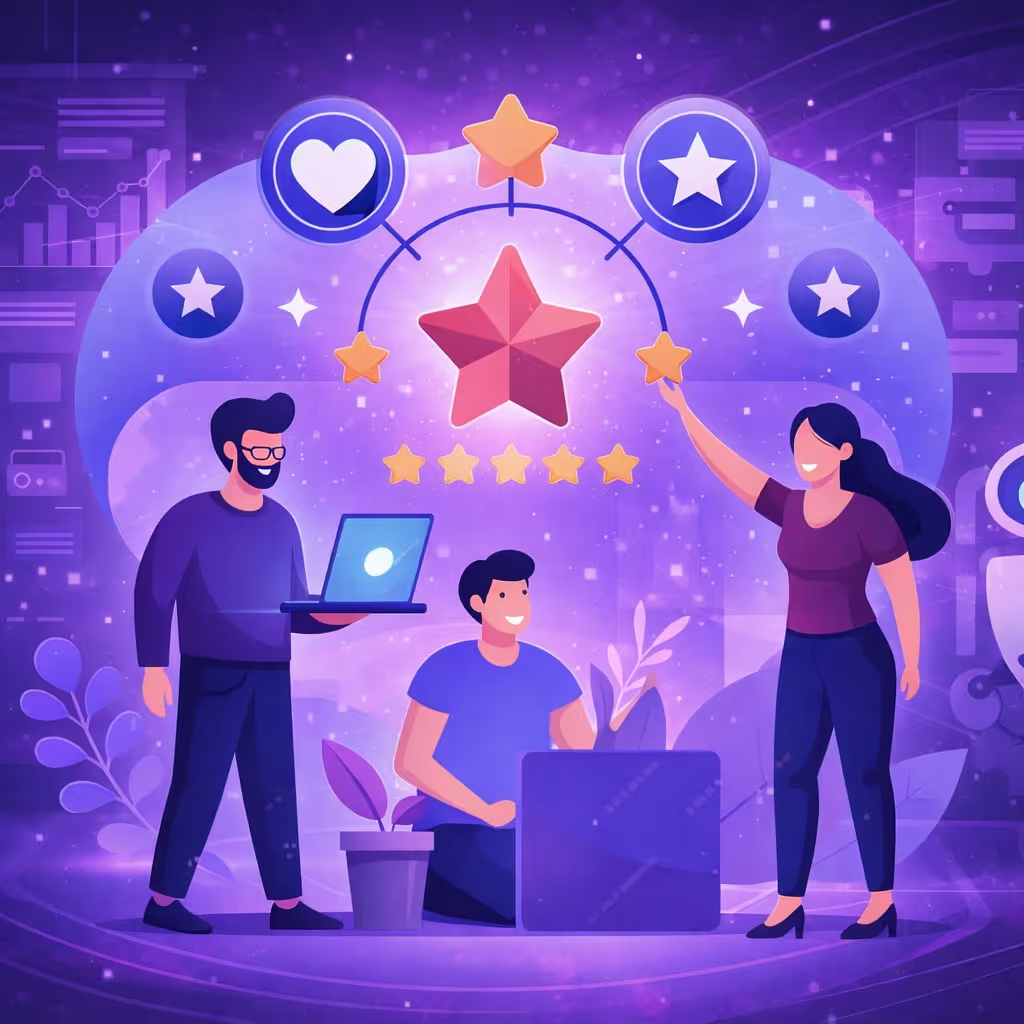
Customer education once lingered in the background. A handful of onboarding sessions, a help center brimming with articles, and the occasional webinar for power users. Helpful, yes, but almost never a strategic force.
That has changed.
Now, customer education stands at the crossroads of product adoption, customer experience, revenue growth, and operational efficiency.
As products grow more complex and releases accelerate, customers stretch across continents and job titles. The price of confusion has never been higher. When learning lags, businesses feel the impact instantly through churn, mounting support tickets, and stalled growth.
Why Customer Education Has Become a Strategic Priority
Today’s enterprises deliver more capabilities than ever. Features multiply, integrations sprawl, and configuration options run deeper. Meanwhile, customers expect instant value and seamless experiences.
This creates growing tension: products evolve at a pace customers struggle to keep up with.
Early on, customer education feels manageable. Founders lead onboarding. Customer success managers guide users through workflows. Learning happens through close conversation and hands-on support.
But scale changes the game entirely.
Dozens of customers become thousands. Use cases multiply. Skill levels span a wide spectrum. Different roles within the same organization require different knowledge. What worked for the first hundred customers quietly falls apart for the next ten thousand.
At this stage, one-size-fits-all onboarding falls flat. Support teams scramble to fill the gaps, becoming accidental educators. Education turns reactive, inconsistent, and costly.
The Hidden Business Costs of Poor Customer Education
The true cost of weak customer education is easy to miss because it seeps into every corner of the business.
Onboarding drags on, delaying time-to-value. Customers skim the surface, missing out on deeper, stickier features that drive expansion. Support queues swell with “how do I” questions. Customer-facing teams burn hours repeating themselves instead of fueling growth.
Even a small delay in customer proficiency can snowball into major lifetime value loss, as internal models show. The problem isn’t willingness to learn—it’s that the learning experience fails to fit how customers actually work.
Customer education debt builds up just as technical debt does. The longer it lingers, the tougher it is to untangle.
Why Traditional Customer Education Models Don’t Scale
Many organizations try to solve education challenges by piling on more content—more documentation, more videos, more live sessions.
The result? A flood of content with little real impact.
Static documentation goes stale the moment products evolve. Live training cannot keep up with global schedules. Generic learning paths miss the mark for different roles and levels. Most critically, leaders are left in the dark about what customers truly understand versus what they have simply seen.
Education effort increases, but outcomes plateau. The system is busy, but not effective.
Rethinking Customer Education as a Continuous System
Scaling customer education demands a new mindset.
Customer learning cannot be a one-off event linked to onboarding. It must grow with product usage. Education should be contextual, role-aware, and always-on, surfacing exactly when customers need it and not weeks before or after.
Success is not about how much content is consumed. It is about adoption, confidence, and real-world outcomes.
Customer education is not a single event. It is a living system.
Common Mistakes Companies Make When Scaling Customer Education
As customer education expands, a familiar set of missteps tends to surface across organizations, regardless of industry.
The most common mistake is treating education as a downstream support function rather than an upstream growth capability. When education sits solely with support teams, it becomes reactive by design, responding to problems after customers are already struggling instead of preventing friction in the first place.
Another frequent issue is content accumulation without learning feedback. Teams invest heavily in creating guides, videos, and tutorials but rarely build mechanisms to understand what customers actually absorb, where they get stuck, or how their behavior changes afterward. Content exists, but insight does not.
Learning data is also often siloed. Education platforms operate separately from customer success and product analytics, leaving leaders unable to connect learning signals to adoption, churn risk, or expansion readiness. Without this linkage, education decisions are made in isolation.
Finally, many organizations overestimate customer self-navigation. Well-intentioned portals and libraries assume customers will find what they need, when they need it. In reality, complexity grows faster than customer patience, and learning without guidance quickly becomes noise.
These mistakes are understandable. Education feels less tangible than features or revenue. But the cost does not disappear. It shows up later as higher support load, slower adoption, and missed growth opportunities.
How AI Changes the Economics of Customer Education
AI rewrites the rules, shattering the old trade-off between relevance and scale.
Without AI, personalization is a manual slog. With AI, learning adapts on the fly to each customer’s role, behavior, and maturity. Content no longer follows a rigid timeline; it responds to real usage in real time.
This matters because relevance drives learning. When customers see content that reflects their context, they engage. AI makes that relevance scalable without linear increases in cost or headcount.
Personalizing Customer Learning Journeys with AI
Within every customer organization, learning needs diverge. An administrator, a power user, and an executive sponsor each need a unique perspective.
Learning paths adjust automatically based on customer actions, feature usage, and progression. A customer who explores advanced features receives deeper guidance. A customer who stalls receives targeted reinforcement.
Learning nudges surface right in the flow of work, not as interruptions. Customers learn by doing, not before or after the fact.
This is how education becomes invisible and frictionless.
Using Microlearning to Drive Faster Adoption
Long onboarding sessions overwhelm more than they educate. Retention drops sharply when customers are asked to absorb too much, too soon.
Microlearning shifts the format. Short, targeted learning moments focus on one action, one concept, or one decision at a time. Reinforcement happens over weeks, not hours.
This approach mirrors how customers actually work. They learn in small increments and apply them immediately. Over time, understanding compounds.
Scaling Globally with Multilingual, Consistent Education
Global growth quickly reveals education gaps. Language turns into a barrier to confidence. Regional teams craft their own materials, splintering consistency.
AI-enabled localization allows organizations to deliver multilingual education without duplicating effort. Content remains aligned as it adapts to language and regional nuances.
Global scale calls for consistency, not sameness. AI makes striking that balance possible.
Measuring What Matters in Customer Education
Traditional metrics miss the mark. Course completions and content views reveal little about true readiness.
What matters is whether customers can act. Are they using key features? Are they progressing to advanced workflows? Are support tickets declining for known topics?
Modern education systems tie learning insights directly to churn, expansion, and support metrics. If leaders cannot see the impact of learning, they cannot steer it.
What Scaled, AI-Driven Customer Education Looks Like in Practice
When customer education is designed to scale, the change is visible across the business.
Onboarding becomes shorter and more focused, allowing customers to reach meaningful value earlier. Support escalations decline for known topics because learning addresses gaps before they turn into tickets. Customers begin adopting advanced features independently, without waiting for hand-holding from customer success teams.
Education aligns naturally with the customer lifecycle. Early-stage users receive foundational guidance. Mature users encounter deeper workflows and optimization paths. Learning evolves as usage evolves, rather than resetting with each product update.
Customer-facing teams gain a clearer picture of readiness. Instead of guessing who needs help, they see signals that indicate where intervention will matter most. Conversations shift from reactive problem-solving to proactive value creation.
The result is not perfection. It is predictability. Leaders can anticipate adoption patterns, resource needs, and growth potential with greater confidence.
How Invince Approaches AI-Powered Customer Education
Invince treats customer education as a core part of the enterprise learning ecosystem, designed to scale alongside product complexity and customer growth.
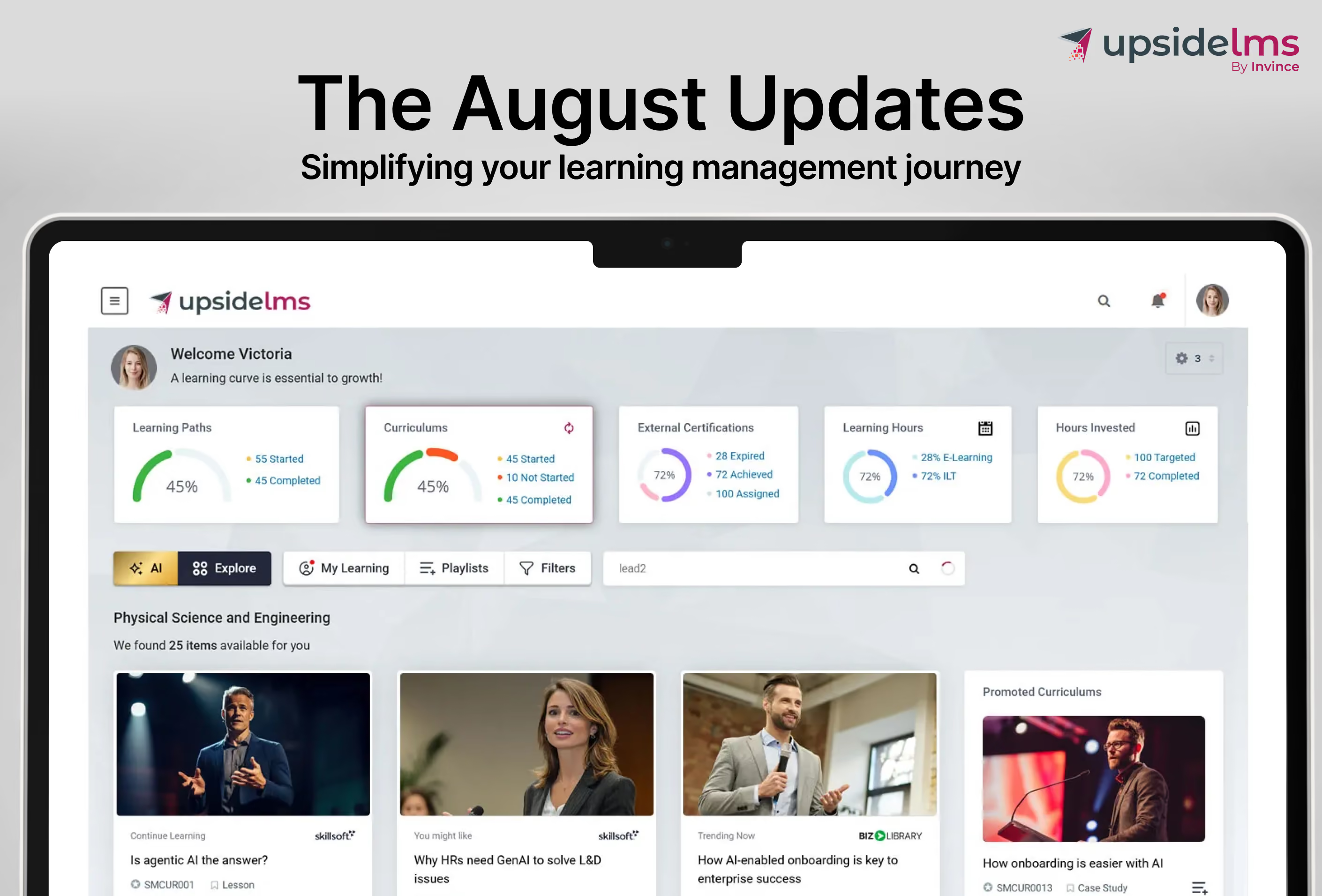
UpsideLMS provides the structural foundation as an extended enterprise learning management system. It organizes customer learning around roles, use cases, and maturity levels rather than generic course catalogs. This allows organizations to deliver targeted education experiences while maintaining centralized visibility into customer readiness. For enterprises evaluating the best LMS for customer education, this role- and context-driven structure is critical.
Craft addresses the speed at which customer knowledge changes. Using GenAI, it enables teams to transform product documentation, release notes, and internal expertise into multilingual microlearning assets quickly and consistently. As products evolve, learning stays current, reducing the lag between change and understanding that often undermines adoption.
Plethora complements this ecosystem with an AI-powered, off-the-shelf content library that accelerates capability coverage. Instead of building everything from scratch, organizations can provide customers with ready-to-use learning aligned to common workflows and skill needs, ensuring consistency without slowing momentum.
Together, UpsideLMS, Craft, and Plethora create a cohesive system. Structured learning, continuous reinforcement, and actionable visibility work in concert, aligning education efforts across product, customer success, and leadership. Customer education shifts from a reactive necessity to a scalable growth enabler.
The Way Forward
Products will keep outpacing human understanding. That gap will separate the winners from the rest.
AI lets customer education scale without sacrificing relevance. Organizations that teach customers well reduce friction, boost loyalty, and unlock new growth.
Market leaders are rarely those with the most features; they are the ones who help their customers learn the fastest.
For enterprises investing in the best AI-enabled LMS for customer education, the goal is no longer just training but momentum.
Ready to Revolutionize Learning at Your Organization?
Join 400+ enterprises using Invince to upskill, reskill, and retain top talent.
Ready to Revolutionize Learning at Your Organization?
Join 400+ enterprises using Invince to upskill, reskill, and retain top talent.

Ready to Revolutionize Learning at Your Organization?
Join 400+ enterprises using Invince to upskill, reskill, and retain top talent.