

Compliance Training That Works: HR Leader’s Toolkit | 2027
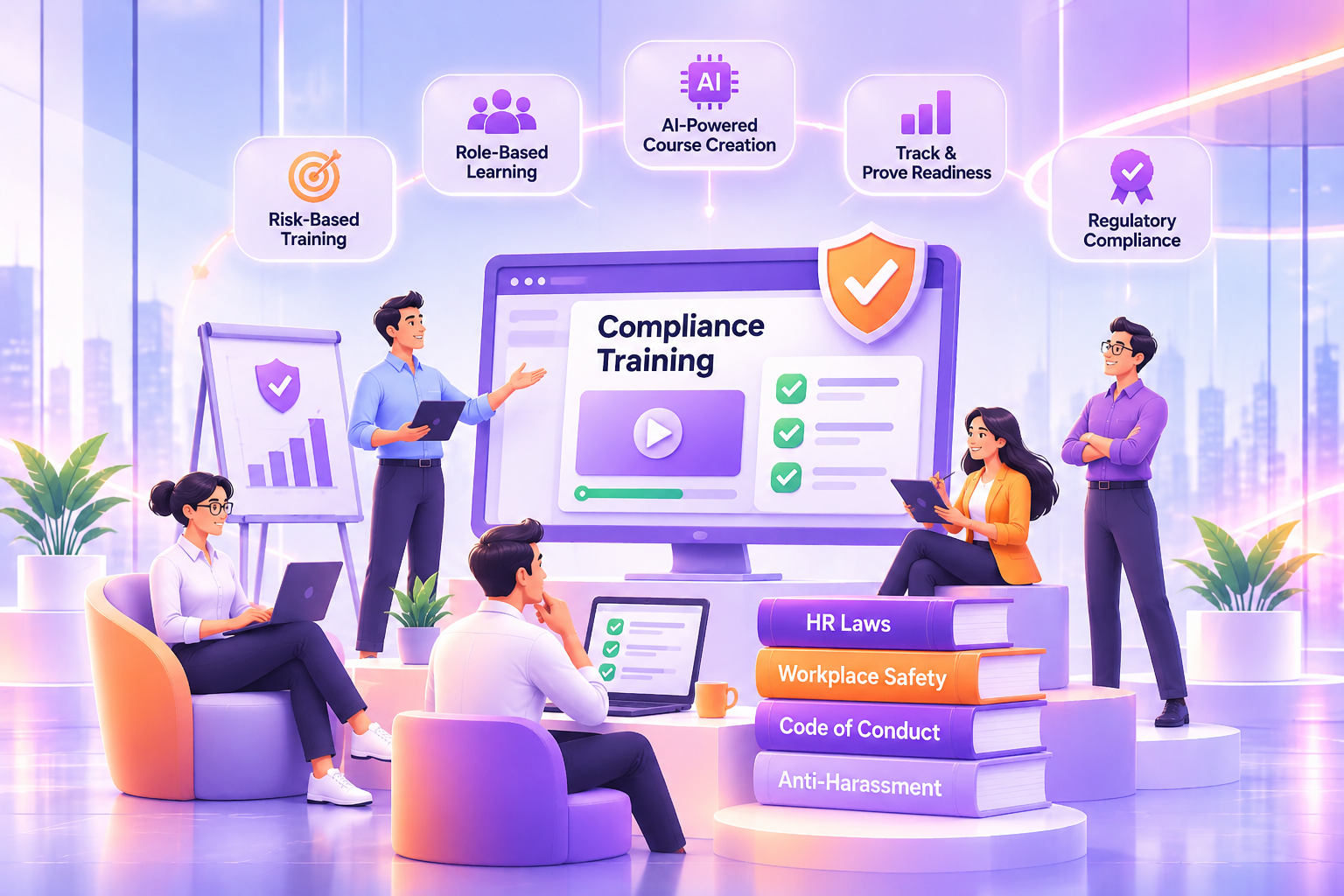
Picture the last week of the financial year. The compliance dashboard glows green: 98% completion on the annual code-of-conduct module. Then an employee in a regional office mishandles a customer complaint that should have been escalated, and nobody in the chain recognises it as a reportable issue. Everyone did the training. Very few people could use it.
[[toc]]
That gap between “completed” and “capable” is where most compliance programmes quietly fail. HR law and compliance is not a filing exercise. It is the set of legal duties, internal policies and everyday behaviours that keep people safe, treated fairly and protected from avoidable risk. Training is one of the main ways an organisation turns those duties into action, and regulators increasingly look at whether that training actually works, not just whether it happened.
This toolkit is written for CHROs, CLOs, HR directors and L&D leaders who want compliance training employees understand, remember and apply. You will find a practical way to map obligations, prioritise risk, segment audiences, design role-based learning, use AI with care, measure understanding and keep evidence that stands up to scrutiny, with regional notes for the US, UK, KSA, the wider Middle East, India and APAC.
What HR law and compliance covers across workplaces
“HR law and compliance” is a broad label, so it helps to break it into the areas most enterprises have to manage. The exact list depends on your industry, headcount and countries of operation, but most programmes touch the following.
- Employment and equality law: anti-discrimination, harassment prevention, equal pay, working hours, leave and fair dismissal.
- Health and safety: general duties of care, hazard-specific rules, incident reporting and, increasingly, psychosocial risks such as stress, bullying and fatigue.
- Conduct and ethics: codes of conduct, conflicts of interest, gifts and hospitality, anti-bribery and whistleblowing.
- Data protection and information security: how employees collect, store and share personal data, including the data held in HR and learning systems.
- Sector regulation: for example, anti-money-laundering and know-your-customer rules in financial services, patient safety and clinical governance in healthcare, product safety in manufacturing, and food hygiene in retail and food services.
Two points matter for training design. First, these areas overlap. A harassment complaint can also be a data protection issue and a whistleblowing issue. Second, the obligations differ by jurisdiction, and some apply to specific roles only. A training plan built on one generic list will over-train some people and under-train others.
Why compliance training fails
Before building something better, it is worth naming what usually goes wrong. Most failures are design failures, not employee failures, and they show up in risk management training as often as in conduct courses.
- One course for everyone. A warehouse supervisor, a relationship manager and a software engineer face different risks, yet often sit through the same 45-minute module.
- Legal language instead of working language. Policies are written to be legally precise. Learning needs to be practically clear. When training simply reproduces the policy, people skim.
- Annual events with nothing in between. Knowledge fades quickly when it is not used. A single annual push leaves eleven months for habits to drift.
- Weak assessment. Ten easy recall questions at the end of a module test short-term memory, not judgement.
- Completion treated as the outcome. A completion rate tells you who clicked through. It does not tell you who can spot a problem and act.
- Patchy records. When evidence sits across spreadsheets, email confirmations and classroom sign-in sheets, proving what happened becomes slow and stressful.
These are the familiar pitfalls of bad learning and development practices, and they are expensive. The cost shows up as repeat incidents, longer investigations, audit effort and lost trust. The US Department of Justice's guidance for evaluating corporate compliance programmes, updated in September 2024, asks prosecutors to consider whether a programme works in practice, whether training fits the audience and its risks, and how the company measures its effectiveness. That is a useful test for any organisation, wherever it operates.
Build a risk-based training needs map
A training needs map links each obligation to the people it affects and the level of risk involved. It turns a long legal register into a clear list of who needs to learn what, how deeply and how often.
Step 1: list your obligations by jurisdiction
Start with your legal and compliance teams. For each country and, where relevant, each state or emirate, record the laws, regulations and internal policies that create training needs. Note where a law sets a specific frequency, duration or audience. Keep the source and the date you last checked it.
Step 2: score risk by role, not by department
For each role family, ask three questions:
- How likely is this role to encounter the risk? A cashier handles cash daily; an HR analyst rarely does.
- How serious would a mistake be for people, customers or the business?
- How much discretion does the role have? Roles with authority to approve, hire, sign or spend usually need deeper training.
A simple high, medium and low rating is enough to start. The aim is prioritisation, not perfect scoring.
Step 3: decide depth and frequency
Use the risk rating to set the learning response. Low-risk roles may need a short awareness module and a policy acknowledgement. High-risk roles may need scenario practice, a stronger assessment, manager follow-up and more frequent refreshers. Where the law sets a minimum, treat it as the floor.
Step 4: add trigger events
Some learning should happen because something changed, not because the calendar says so. Common triggers include joining, promotion into a people-management role, a move to a new country, a new regulation, a policy update and an internal incident or near miss.
Illustrative example: a mid-sized private bank maps anti-money-laundering obligations against its roles. Branch tellers and relationship managers rate high, so they receive scenario-based modules and quarterly micro-refreshers. Back-office HR staff rate low, so they complete a short awareness module and an annual acknowledgement. Everyone gets the same core message about reporting suspicions, but the depth matches the exposure.
Design role-based learning journeys
Once you know who needs what, design learning around the moments people actually face. A role-based journey is a sequence of short learning experiences connected to a person's job, not a single long course.
Keep the core common, make the edges specific
Most organisations benefit from a shared core: values, the code of conduct, how to raise a concern and where to find policies. Around that core, add role modules. A people manager needs to know how to respond to a harassment disclosure. A procurement lead needs to recognise conflict-of-interest red flags. A plant supervisor needs task-specific safety procedures.
Use scenarios that sound like your workplace
Scenarios work because they ask people to make decisions, not just recall rules. Write them in the language your employees use, set them in places they recognise and include grey areas. “A long-standing supplier offers your team tickets to a cricket final the week before contract renewal” teaches more than a definition of a conflict of interest.
Break learning into short pieces
Microlearning, meaning short focused modules of a few minutes each, suits compliance well. It fits around shifts, works on mobile devices and makes spaced refreshers practical. It also lets you update one piece when a rule changes instead of rebuilding a whole course.
Plan for language and access
Multinational and frontline workforces need learning in the languages people work in, on devices they actually use. Factory, retail and logistics teams may not have a desk or a corporate laptop. If the training is hard to reach, completion becomes a supervisor's chasing exercise rather than a learning experience.
Illustrative example: a retail chain with stores in the UAE and India builds a common code-of-conduct core, then adds store-manager modules on handling customer complaints and staff grievances, and short food-hygiene refreshers for counter staff in the languages used on the shop floor.
Use AI-powered compliance training responsibly
AI-powered compliance training can reduce the time it takes to build and update content, translate modules, generate scenario variations and practice questions, and help learners find answers to policy questions. Used well, it frees your specialists to focus on judgement and review rather than formatting.
It also introduces new risks, and compliance is the last place to accept output without checking. A sensible set of guardrails:
- Keep a qualified human in the loop. Every AI-generated module, question and translation should be reviewed by someone who understands the law and the policy before it goes live.
- Ground content in approved sources. Generate from your own policies and verified regulatory material, not from open-ended prompts.
- Watch for false confidence. AI tools can produce text that sounds authoritative and is wrong, particularly on jurisdiction-specific rules. Check every legal reference.
- Protect personal data. Training records, assessment results and learner questions are personal data. Confirm where the data is processed and stored and how it is used, and check this against the data protection laws that apply to you.
- Be transparent. Tell employees when they are interacting with an AI assistant and how their data is handled.
- Document your approach. Record which tools you use, for what purpose and how outputs are reviewed. Regulators are paying closer attention to how organisations manage risks from new technologies, and the 2024 DOJ guidance explicitly added questions about this.
The practical rule: let AI speed up the drafting and personalisation, and keep people accountable for accuracy.
Include health, safety and conduct topics
Health and safety training is often managed separately from HR compliance, by EHS teams with their own systems. That separation can leave gaps, especially for office-based staff, contractors and people moving between sites. A joined-up programme should include the following.
- General safety duties: fire, first aid, emergency procedures, incident and near-miss reporting.
- Task-specific safety: machinery, chemicals, working at height, driving, manual handling, laboratory or clinical procedures, depending on the role.
- Psychosocial risk: stress, fatigue, bullying and harassment are increasingly treated as health and safety issues, not only HR issues.
- Conduct and respect: anti-harassment, anti-discrimination and speaking-up, with specific modules for managers who receive complaints.
- Contractors and temporary workers: they often face the highest risks with the least induction. Plan their onboarding and records deliberately.
Illustrative examples by industry:
- Healthcare: clinical staff need infection prevention, patient data confidentiality and incident reporting; managers also need training on handling concerns raised by staff.
- Manufacturing: shift workers need task-specific safety refreshers whenever equipment or processes change, delivered in short modules they can complete at the start of a shift.
- BFSI: beyond AML and KYC, branch staff benefit from training on handling vulnerable customers and reporting suspected fraud.
- Retail: store teams need food safety, customer data handling and guidance on dealing with abusive customers, which is both a safety and a harassment issue.
Track completion, understanding and evidence
Measurement should answer three different questions. Mixing them up is one of the most common reasons programmes look healthy on paper and weak in practice.
1. Did the right people complete the right learning on time?
This is your completion and timeliness view. Track it by role, business unit, location and manager. Overdue learning should be visible to managers, not just to the L&D team.
2. Do people understand and can they apply it?
Use scenario-based questions, confidence ratings and, for high-risk roles, practical observation or manager sign-off. Look at which questions people get wrong most often; that tells you where the policy or the training is unclear.
3. Can you prove it?
Your records should show who was assigned what, when they completed it, which version of the content they saw, their assessment result and any acknowledgement they signed. Some laws set specific record-keeping expectations. New York City's training law, for example, requires covered employers to keep records of annual training, including signed acknowledgements. Even where no rule is that specific, version-controlled records make audits and investigations far easier.
Useful indicators to review
- Completion and overdue rates by high-risk role
- First-attempt assessment scores and most-missed questions
- Time from policy change to updated training going live
- Volume and type of concerns raised through speaking-up channels
- Repeat incidents in areas where training was delivered
Treat these as signals for improvement. A rise in reported concerns after better training, for instance, can mean people now recognise problems and trust the process.
Regional considerations: US, UK, KSA, Middle East, India and APAC
Compliance obligations vary widely by country and sometimes within a country. The summaries below are general information, current to the best of our knowledge as of November 2026. They are not legal advice. Laws change, so confirm requirements with qualified local counsel before acting.
United States
There is no single federal rule requiring all employers to deliver harassment prevention training, but several states and cities do. In California, employers with five or more employees must provide at least two hours of sexual harassment prevention training to supervisors and at least one hour to non-supervisory employees, repeated every two years. New York State requires all employers to provide interactive sexual harassment prevention training every year, and New York City adds its own requirements for employers with 15 or more employees. Federally, sector regulators set their own expectations, and the DOJ's compliance programme guidance shapes how companies design and measure training.
United Kingdom
The Health and Safety at Work etc. Act 1974 requires employers to provide the information, instruction, training and supervision needed to protect employees' health and safety. Since 26 October 2024, employers have also had a preventative duty under the Equality Act 2010 to take reasonable steps to prevent sexual harassment of their workers. The Employment Rights Act 2025 strengthens this to “all reasonable steps”, with that change scheduled for October 2026. The Equality and Human Rights Commission's guidance treats training as an expected part of meeting the duty, and tick-box training is unlikely to be enough.
Kingdom of Saudi Arabia
Saudi Arabia's Personal Data Protection Law became fully enforceable on 14 September 2024, after a one-year transition period. It applies to organisations processing the personal data of individuals in the Kingdom, which includes employee and training records. HR and L&D teams should confirm how learning platforms collect, store and transfer that data. Employment, workplace safety and conduct obligations under Saudi labour and sector rules should be reviewed with local counsel, as requirements differ from other GCC countries.
UAE and the wider Middle East
In the UAE, Federal Decree-Law No. 33 of 2021 on the Regulation of Labour Relations governs most private-sector employment. It requires employers to provide a safe and appropriate work environment and to invest in developing workers' skills, with more detailed safety obligations in its executive regulations. Free zones such as DIFC and ADGM have their own employment laws. Other GCC states have separate labour and data protection frameworks, so a single “Middle East” training plan rarely fits every country.
India
The Sexual Harassment of Women at Workplace (Prevention, Prohibition and Redressal) Act, 2013, commonly called the POSH Act, requires employers to organise workshops and awareness programmes at regular intervals and to run orientation programmes for Internal Committee members. India's four labour codes, including the Occupational Safety, Health and Working Conditions Code, 2020, came into force on 21 November 2025, consolidating 29 earlier central labour laws; state rules are still being finalised in places. The Digital Personal Data Protection Rules, 2025 were notified on 13 November 2025, with most substantive obligations taking effect after an 18-month transition, around May 2027.
APAC
Requirements vary sharply across the region. Two examples: in Australia, model work health and safety laws, adopted with variations by most states and territories, require businesses to manage psychosocial hazards, supported by an approved code of practice. In Singapore, the Workplace Fairness Act, passed in 2025, is expected to come into force around the end of 2027 for larger employers, turning fair employment guidelines into enforceable obligations. Employers there can use the lead time to prepare training for managers and HR teams.
The takeaway: build a global framework, then localise. Keep one core curriculum and one evidence model, and add country modules owned by local HR and legal teams.
HR leader's implementation checklist
Use this checklist to plan the next training cycle. It works as a starting point for a programme review or a business case.
Governance
- Name an accountable executive owner and a working group from HR, L&D, legal, compliance and EHS
- Agree a review cycle for the obligations register, at least annually and after major legal changes
- Define who approves content, especially AI-assisted content
Needs analysis
- Build or refresh the obligations register by jurisdiction, with sources and dates
- Rate risk by role family
- Define trigger events for just-in-time learning
Design and delivery
- Create a shared core curriculum and role-specific modules
- Rewrite policy language into practical, scenario-based learning
- Break content into short modules with spaced refreshers
- Provide content in the languages and on the devices employees actually use
- Include contractors, temporary staff and people who change roles
Measurement and evidence
- Track completion and overdue learning by role, location and manager
- Use scenario-based assessments and review most-missed questions
- Keep version-controlled records, acknowledgements and assessment results
- Report to leadership on risk indicators, not completion alone
Improvement
- Review incidents and concerns for training lessons
- Update modules within an agreed time after policy or legal changes
- Gather learner feedback and act on it
How corporate learning technology can support the programme
Good process matters more than any tool, but the right technology makes a risk-based programme much easier to run at enterprise scale. When you assess options, look for the ability to assign learning automatically by role and location, run reminders and escalations, deliver short modules on mobile devices, support multiple languages, manage assessments and keep audit-ready records and reports. Integration with your HR system keeps assignments accurate as people join, move and leave.
This is where the Invince AI-powered corporate learning ecosystem fits. It supports learning for internal teams, partners and customers across use cases such as compliance, onboarding, sales and customer success.
- Invince LMS (formerly UpsideLMS) is an AI-powered enterprise learning platform for onboarding, compliance, upskilling and workforce development, giving HR and L&D teams one place to assign, deliver and track compliance learning.
- Craft is a GenAI-powered multilingual course builder that helps teams create learning content quickly, with support for more than 150 languages and over 25 ready-to-use instructional design templates. That makes it practical to turn policies into short, localised modules and refresh them when rules change, with your experts reviewing every output.
- Plethora is a curated library of more than 80,000 ready-to-use learning resources, useful when you need off-the-shelf content for widely applicable topics rather than building everything from scratch.
Whichever platform you use, keep the principles from this toolkit in charge: risk first, roles second, technology third.
Frequently asked questions
What is HR law and compliance?
HR law and compliance is the set of legal requirements and internal policies that govern how an organisation employs and manages people. It typically covers employment and equality law, harassment prevention, health and safety, conduct and ethics, data protection and any sector-specific rules. Compliance means meeting those obligations in practice and being able to show that you have.
How often should employees receive compliance training?
It depends on the law, the topic and the role. Some jurisdictions set fixed intervals: New York State requires sexual harassment prevention training every year, and California requires it every two years for covered employers. India's POSH Act requires awareness programmes at regular intervals without fixing a number. Beyond legal minimums, high-risk roles benefit from shorter, more frequent refreshers and training triggered by events such as promotion or a policy change.
How do you measure compliance training effectiveness?
Look beyond completion rates. Combine timeliness by role, scenario-based assessment results, most-missed questions, manager observations for high-risk tasks, and business signals such as repeat incidents and the quality of concerns raised. Effective training shows up as better judgement and earlier reporting, not only as higher completion.
Can AI be used for compliance training?
Yes, with safeguards. AI can help draft modules, translate content, generate scenarios and answer policy questions. Every output should be reviewed by a qualified person, grounded in approved sources and handled in line with applicable data protection laws. Employees should know when they are interacting with AI.
What should a compliance training programme include?
A strong programme includes an obligations register by jurisdiction, a role-based risk assessment, a shared core curriculum with role-specific modules, scenario-based learning, regular and event-triggered refreshers, meaningful assessments, version-controlled records, clear ownership and a regular review cycle.
Is completing compliance training enough to meet legal requirements?
Not always. In several jurisdictions, regulators and courts look at whether training is relevant, current and effective. In the UK, for example, guidance on the preventative duty indicates that tick-box training is unlikely to be enough. Treat completion as the minimum and aim for understanding and behaviour change.
Conclusion: from completion to confidence
Compliance training works when it is built around real risks, real roles and real decisions. Map your obligations by jurisdiction. Rate risk by role. Give people short, practical learning in their own language at the moments that matter. Use AI to move faster, and keep humans accountable for accuracy. Measure understanding, not just clicks, and keep records you would be comfortable showing a regulator.
None of this requires rebuilding everything at once. Pick your two or three highest-risk roles, apply the checklist above and run a better cycle. The lessons from that pilot will shape the rest of the programme.
What is the hardest part of compliance training in your organisation right now: reaching frontline teams, keeping content current or proving effectiveness? Share your view in the comments, or pass this toolkit to a colleague who owns the next training cycle.
Ready to put this into practice? Book an Invince LMS consultation to see how role-based assignment, multilingual microlearning and audit-ready reporting can support your compliance programme.
Our latest blogs


Ready to Revolutionize Learning at Your Organization?
Join 400+ enterprises using Invince to upskill, reskill, and retain top talent.
Ready to Revolutionize Learning at Your Organization?
Join 400+ enterprises using Invince to upskill, reskill, and retain top talent.

Ready to Revolutionize Learning at Your Organization?
Join 400+ enterprises using Invince to upskill, reskill, and retain top talent.