

Invince LXP: The Skills-First Learning Experience Platform, Powered by AI

Most organizations have a learning infrastructure: the LMS manages compliance, the content library offers thousands of courses, and the HR system tracks role hierarchies.
However, when learning leaders are asked to demonstrate the impact of these investments on workforce readiness, the necessary data is often unavailable.
Completion rates are stored in one system, skill profiles in another,and succession planning relies on spread sheets and manager judgment.
Invince LXP is the layer that connects those dots. It sits between the learning activity and the business outcome, building the continuous skills intelligence that makes workforce development measurable, strategic, and real.
It is not a replacement for a compliant LMS. It is the intelligence and experience layer that transforms what the LMS generates into something a CEO can act on. Invince LXP’s
Invince LXP’s Architecture: Skills First, Always
Every feature in Invince LXP flows from a single foundational decision: the skills taxonomy comes first.
The platform organizes workforce capability through a five-level hierarchy. Domain, job family, job role, skill, proficiency level. That structure is not decorative. It is the connective tissue that makes everything else work.
Gap analysis depends on it. Recommendations are driven by it. Manager visibility into team readiness requires it.
A CHRO reporting critical skill exposure is only possible because every employee's learning activity maps back to a specific skill at a specific proficiency level.
Invince LXP ships with an extensive pre-built taxonomy: 30 industries,91 domains, 60 categories, 52 skill groups, 283 individual skills, 81 job roles, and 1,914 skill-to-role mappings.
L&D administrators configure and extend it through the Admin Desk without needing engineering support.
They can create new skills, define proficiency levels at each stage fromn ovice to expert, map skills to roles with required proficiency thresholds, and archive outdated skills while preserving existing passport records.
This is the piece most enterprise learning platforms skip. They either leave taxonomy to the organization to build from scratch, which takes months and rarely gets done well, or they impose a rigid structure that does not reflect how the organization actually works.
Invince gives teams a working foundation and full control to make it theirs.
From that taxonomy, everything else flows.
Invince Neura: The Intelligence Engine Running Underneath Invince LXP
.png)
Invince Neura is not a chatbot added to the top of a learning platform.It is the engine that runs underneath the entire experience. It operates in twomodes simultaneously, and both matter.
The moment new content enters the system, Neura enriches it. It reads the course metadata, identifies the skills the content develops, and maps it to the appropriate proficiency levels and roles in the taxonomy.
Administrators no longer spend weeks manually tagging a new content library. The system does it on ingestion. That auto-tagging is what makes AI recommendations accurate from day one rather than after months of manual curation.
The gap analysis engine runs continuously. For every learner, Neura compares their current validated skill profile against the requirements of their role and their stated career aspiration.
That comparison creates the gap, and it updates in real time whenever aquest is completed, a journey milestone is reached, or a manager validates a skill claim.
The platform achieves 94% gap analysis accuracy, compared to the 60-70% typical of manual HR processes. And where the traditional approach takes two to four weeks per cohort, Neura does it in seconds per learner.
The recommendation engine scores and ranks content across the entire catalog for every individual learner using five signals simultaneously: job role requirements, open skill gaps, learning history, peer activity among colleagues in the same role, and career aspiration.
The result is a continuously refreshed "For You" feed that surfaces what that specific person needs to develop next, not what the system suggests for everyone in their job title.
The journey generation function turns that gap analysis into a structured, personalized learning path in 30 seconds. No L&D professional spending four hours manually sequencing prerequisites and calibrating content difficulty for one employee. Neura does it for every employee.
That is the practical difference between "we offer personalized learning" and "every person in the organization has a personalized learning journey active right now."
The Conversational Interface handles natural language requests in realtime.
When a learner asks, "What skills am I missing for Senior Engineer?" Neura lists the specific gap skills, the proficiency delta between where they are and where the role requires them to be, and estimated learning hours.
When they ask to "enroll me in System Design Fundamentals, "Neura confirms the enrollment and adds it to their dashboard. When a manager asks "what courses are trending in my team," Neura returns what peersin that role are actively studying that week.
This is not a novelty feature. It is a 70% reduction in L&D support ticket volume. Learners get answers immediately, without having to raise requests. L&D teams redirect their time from administrative support tocurriculum strategy.
The platform also delivers a 95% reduction in time-to-enroll, from fifteen minutes navigating a traditional LMS catalog to direct action through the conversational interface or a single click from a recommendation.
And course discovery is five times faster than browsing an unstructured content library.
These numbers are from the product deck, not marketing projections. They reflect what happens when search is semantic, recommendations are role-aligned,and enrollment is immediate.
The Learner Experience: From Day One to Career Progression
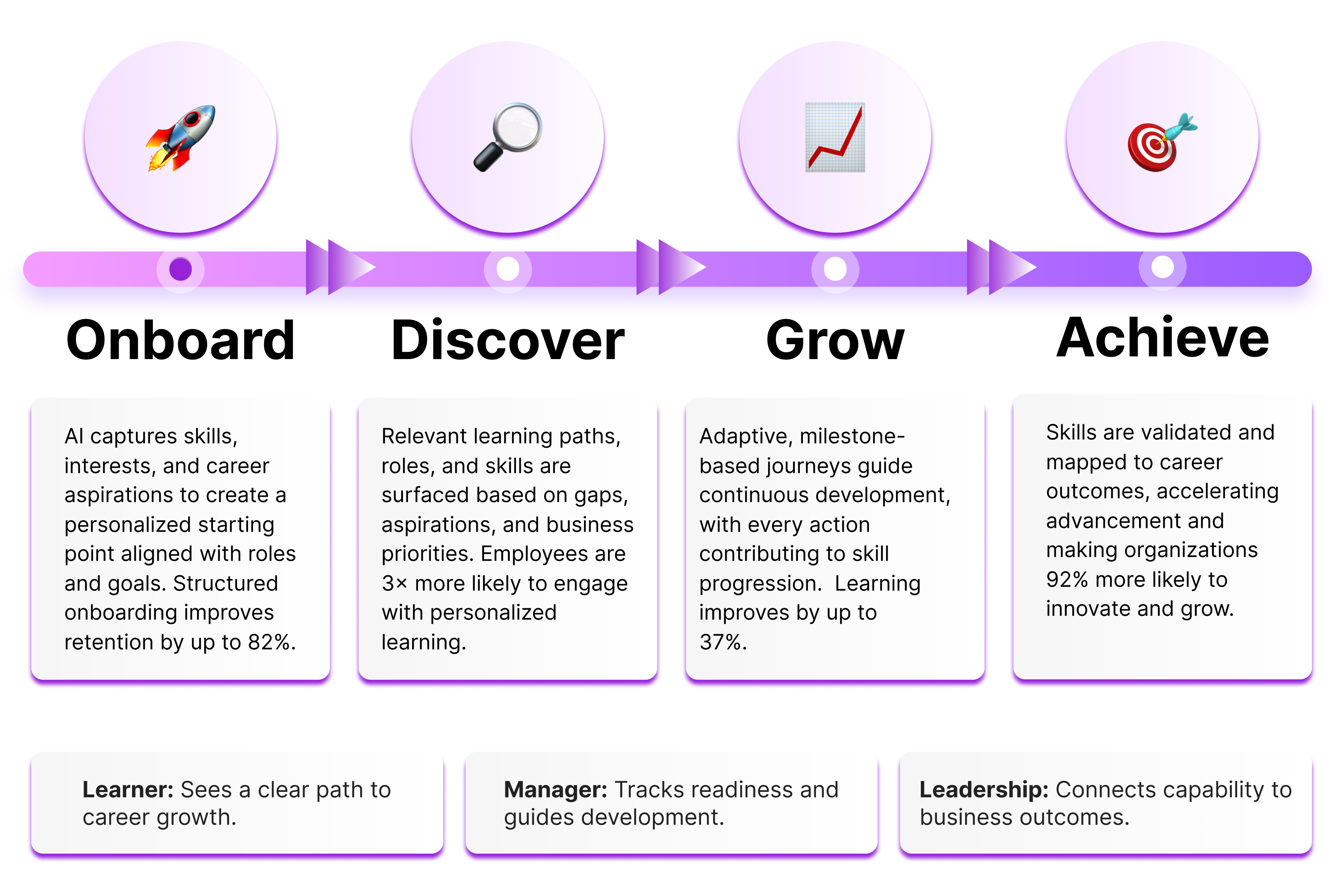
The learner experience in Invince LXP begins with onboarding and continues.That is a design choice, not a feature claim.
When a new employee joins an organization, AI captures their existing skills, interests, and career aspirations to build a personalized starting point aligned to their role and goals. Structured onboarding built this way improves retention by up to 82%.
That is because employees who enter a role with a clear development path visible from week one are meaningfully more likely to stay. The path itself isa retention tool.
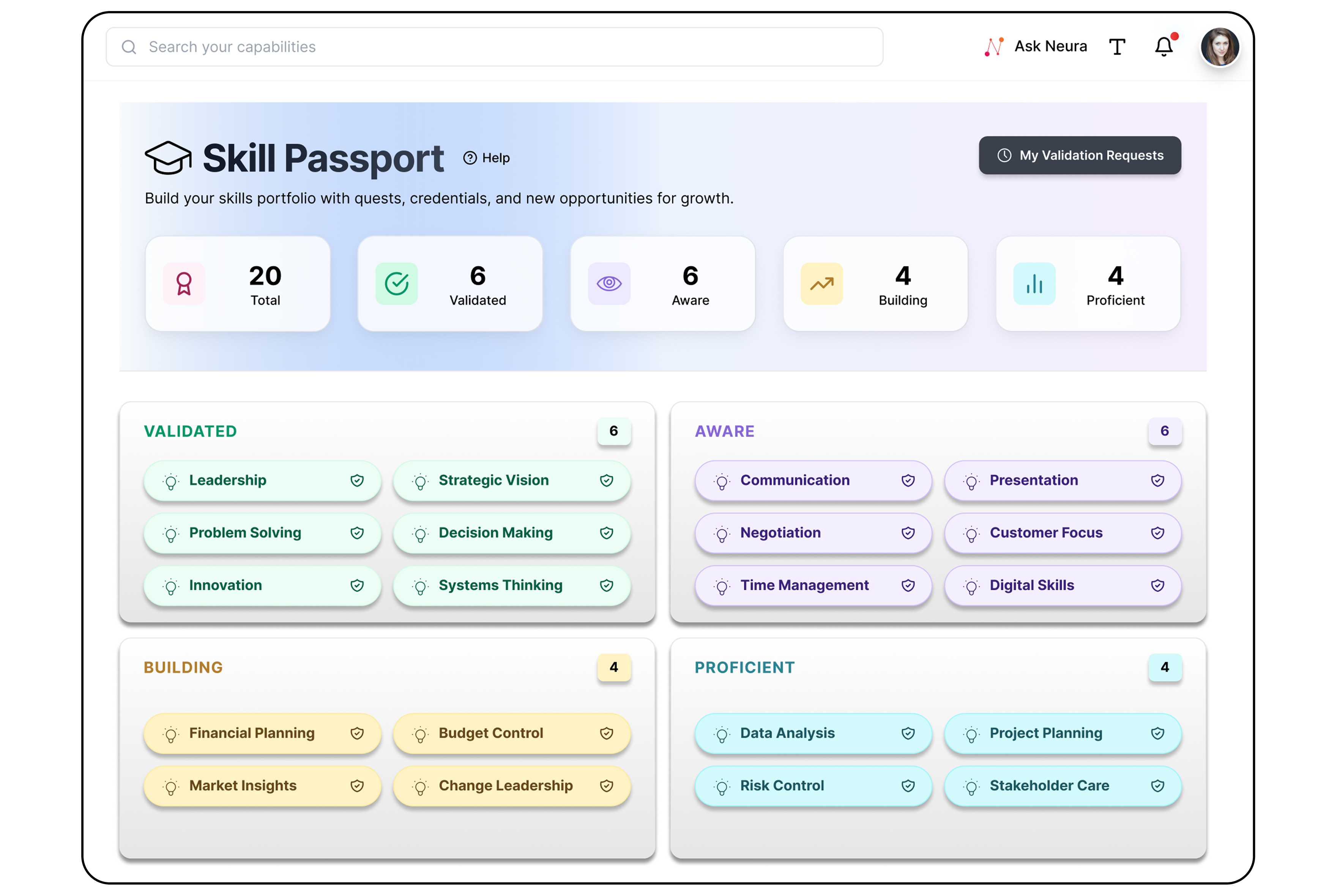
The Passport tab holds the learner's complete skill profile. Every skill has a proficiency level they have reached, a confidence score that distinguishes validated skills from self-declared ones, and an evidence portfolio linking each skill to the courses, assessments, and peer validations that support it.
The Passport can be exported as a PDF for performance.
The Personalized Dashboard organizes everything a learner needs around a single hero card that surfaces the highest-priority learning item,whether it is overdue, manager-assigned, almost complete, or newly relevant dueto a skill gap.
Below it, the dashboard shows the learner's current Career Readiness percentage for their target role, their active learning activity, peer learningsignals, and their deadline calendar. Nothing requires a learner to go lookingfor what they should do next. The system brings it to them.
The Skill Hub/passport is where a learner's capabilities live, grow, and become visible. It is organized across four tabs. e conversations, promotion discussions, and 1:1s with managers. It is also the data source for all other platform features.
The Capability Quadrant is perhaps the most practically useful view a learner has access to. It maps their skills across two axes: proficiency leveland the time since each skill was last validated.
High-proficiency, recently confirmed skills sit in the high-value quadrant. High-proficiency skills that are aging are shown as "latent strengths" and need validation before they stop counting toward the learner's readiness score.
Critical gaps, the role-required skills missing entirely, are separated from developing skills. For a learner preparing for a promotion conversation,the Capability Quadrant tells them exactly which gaps to close and which strengths to confirm before the conversation.
The Skill Map tab lets learners browse the full taxonomy, discover adjacent skills, and add them to their development plan.
This is what enables cross-functional capability building without requiring L&D to design cross-functional programs. A technical specialist interested in product strategy can find the relevant skills, add them to their passport, create Skill Quests to develop them, and self-enroll in content.
The platform supports that initiative without administrative overhead.
The Quests tab holds the learner's active Skill Quests: time-boxed, single-skill micro-goals that move through a Kanban board from Backlog to In Progress to Completed.
Each completed quest triggers an immediate gap analysis refresh, updates the readiness score in real time, and earns XP.
The gamification is not peripheral. Continuous, visible progress sustains development between formal learning events, and the Quest structuremakes that progress specific, trackable, and rewarding.
The Aspirations Feature connects individual development to career trajectory. A learner sets a target role.
The platform immediately calculates their readiness percentage for that role, identifies the gap skills ranked by priority, and generates a learning journey to close them.
They can run the same analysis against multiple target roles. They can see how far each potential career path is from their current capability profile.
This visibility, which most organizations have never been able to provide systematically, changes the relationship employees have with their development.
Employees who can see a credible path to advancement inside the organization are three times more likely to engage with personalized learning. That engagement compounds.
The My Learning Hub consolidates everything: active enrollments with progress indicators,learning paths, assigned content, the personal wishlist of saved items, and AI recommendations filtered by job role, skill gaps, peer trends, and aspiration alignment.
The filter controls let a learner slice by type, status, due date, and source. Finding what to do next takes seconds, not a catalog navigation session.
Manager's Desk: From Passive Observer to Active Developer
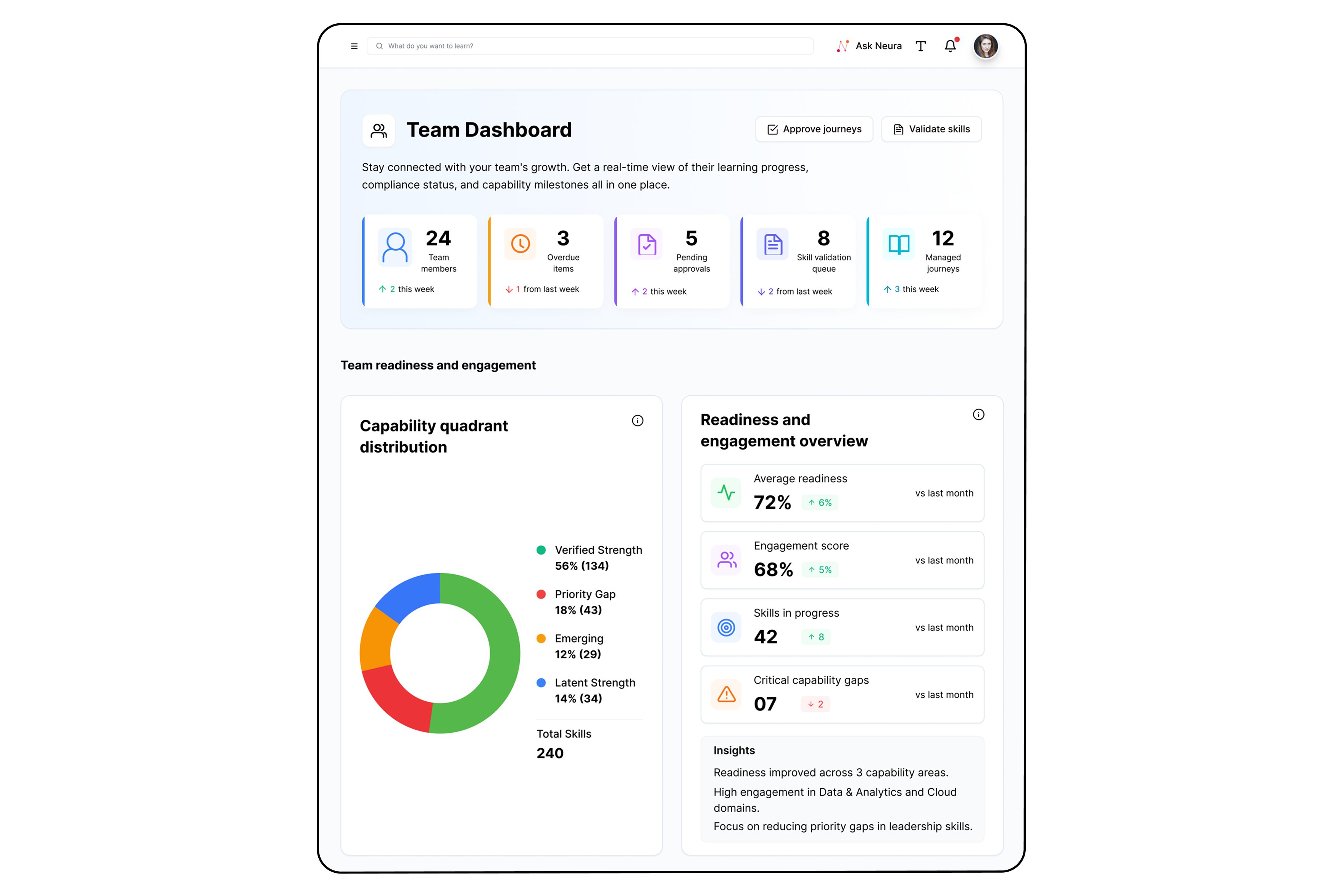
The gap between what managers know about their team's capability and what they need to know to develop it effectively is one of the most persistent and under addressed problems in enterprise talent management.
Invince LXP closes it through the Manager's Desk, a purpose-built viewthat gives every manager access to six capabilities they typically lack.
Team Dashboard Overview shows every direct report at a glance: active journeys, skill health, compliance status, approaching deadlines, and readiness risk signals. A managerdoes not need to request a report or wait for an HR cycle to know whether their team is developing.
Team Member Detail goes deeper. For each direct report, the manager sees their full Passport, open skill gaps ranked by severity, active Skill Quests, journey progress, and their complete development profile. This is what makes a development conversation substantive rather than anecdotal.
Skill Validation gives managers formal authority over proficiency claims. When a learner self-declares a skill in their Passport, it carries a lower confidence score until a manager validates it.
The validation workflow surfaces the claim, displays the evidence the learner has linked, and allows the manager to select the appropriate proficiency level and confirm or decline it.
Every validation is logged with a full audit trail. This matters for organizations where skills data feeds succession planning or compensation decisions. Self-declared data is not reliable enough for those purposes. Manager-validated data, backed by an audit trail, is.
Journey Approvals let managers review and approve AI-generated learning journeys before they activate. This gives managers visibility into the development paths their team members are pursuing, an opportunity to redirect if the path does not align with the team's business priorities, and a record of having engaged with each person's development.
Suggest Quests flips the direction. Rather than waiting for a learner to identify their own development gap, a manager can propose a specific Skill Quest for adirect report. The learner sees the suggestion with a manager badge attached.
They accept or decline, which preserves learner agency, but the proposal itself initiates a development conversation even when no such conversation hasbeen scheduled.
Teams where managers actively validate skills, approve journeys, and suggest quests show 23% higher readiness than teams where the manager role ispassive.
Peer Comparison and Team Analytics round out the view. A manager can see how their team's skill health compares with similar teams across the organization.They can see readiness distribution, the top skill gaps across the team, and learning engagement rates. This is the data that makes workforce planning conversations between a manager and an L&D leader specific instead of impressionistic.
Admin's Desk: The Platform's Learning Architect
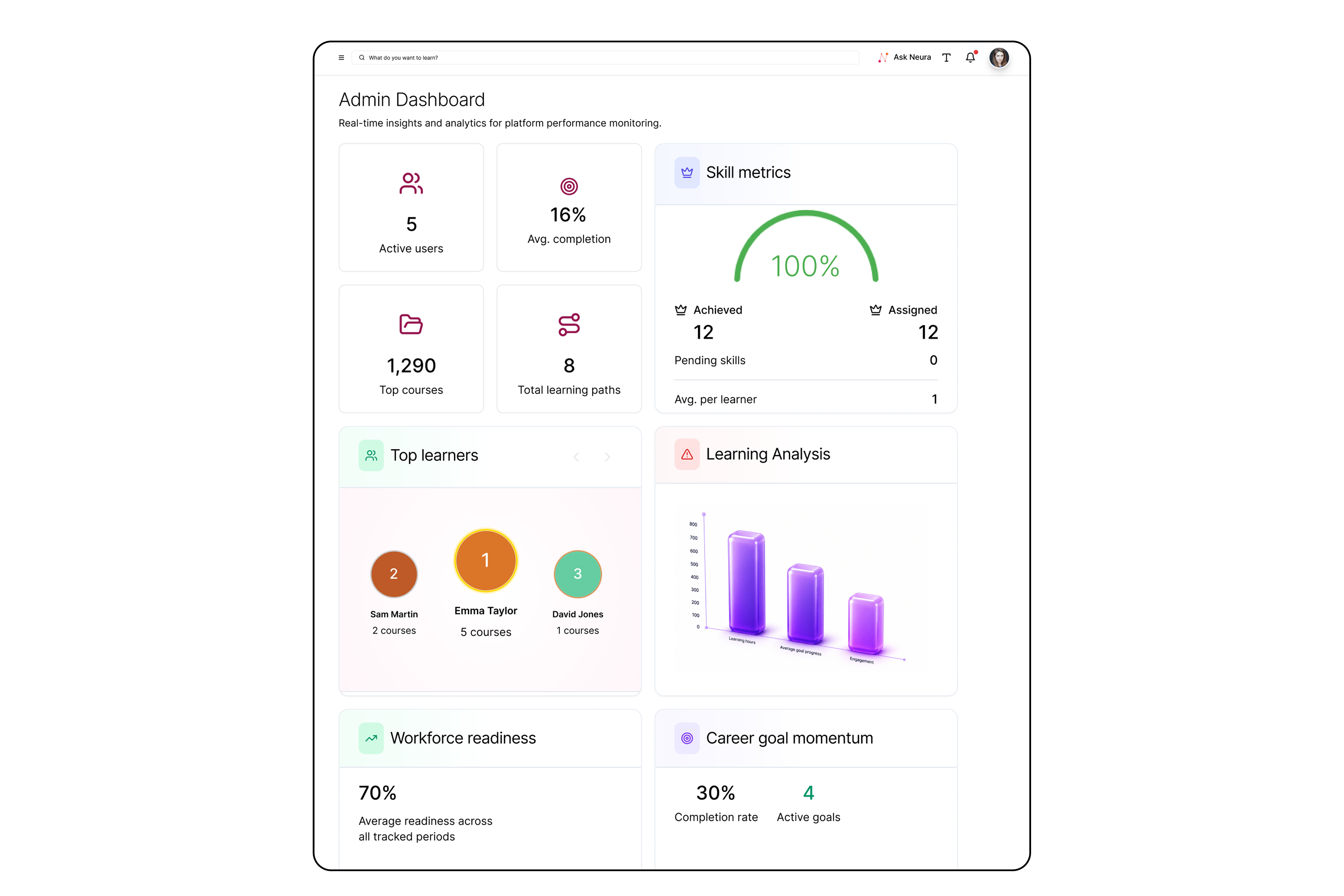
L&D administrators in Invince LXP are not system managers. They arecapability architects.
The Skills Master gives them full control over the taxonomy without requiring engineeringre sources. They create new skills, define the proficiency descriptors for eac level, mark skills as system defaults or custom additions, and archive deprecated skills while preserving their presence in historical passport records.
They can also view skill analytics showing how many learners hold each skill, at what proficiency level, and where the organization-wide gaps are concentrated.
The Job Roles Master allows administrators to build and maintain the full job role catalog.They assign roles to seniority bands, career tracks, and job families. They define which skills each role requires and at which minimum proficiency level.
That mapping directly affects the accuracy of the gap analysis. Withoutit, the system can identify that a learner lacks skills. With it, the system knows exactly which skills matter for which role, at what level, and how urgent the gap is.
Career Goal Governance lets administrators define the career goal frameworks learners use when setting aspirations. They configure approval requirements, ensuring that alearner's career goal submission is reviewed before it is activated within the platform's reporting.
This is what prevents career aspiration data from being noise. When the CHRO sees that 67% of the workforce has an active career aspiration, that number is meaningful because the governance framework ensured each aspiration was reviewed.
The Org-Wide Skill Gap Report is one of the most strategically significant tools in the Admin's Desk. It aggregates skill gap data across the entire organization, filterable by team, role, seniority band, domain, and industry.
An L&D head can see which skills are most critical and most under represented across specific departments, which roles have the highest readiness risk, and where targeted development investment is most needed.
This report is what turns an L&D function from a training-delivery operation into a workforce-intelligence function.
The Admin Dashboard monitors platform health: enrollment trends, completion rates, questadoption, content performance, and platform-wide engagement. It is where program effectiveness becomes visible.
Taxonomy Configuration handles the governance layer: role-based access control, feature flags,journey approval workflows, skill validation policies, and tenant settings.
For multi-tenant deployments, each organizational entity can have itsown branding, taxonomy configuration, and governance rules while sharingplatform infrastructure.
What Learning Leaders Actually See
This is the view that determines whether Invince LXP earns a seat at the strategic table or stays in L&D.
The Workforce Readiness Score is a single percentage that represents the proportion of the workforce that currently meets the skill requirements for their roles. It trends quarterly.
When a CHRO presents this number, they are presenting the health of the talent pipeline as concrete as revenue per employee or customer satisfaction. It goes up when learning investments are working. It goes down when capability gaps are widening faster than the organization is closing them. Either movement is information.
Critical Skill Exposure flags every skill where more than 30% of role holders have a significant gap. This is a risk signal.
An organization where 40% of relevant role holders in a critical technical skill have proficiency levels below the required level has operational exposure, whether the CHRO knows it or not. The platform makes that exposure visible and quantified, not anecdotal.
Over four quarters of active use, organizations see a 23% reduction incritical skill exposure. That reduction is the output of the gap analysis, the AI-generated journeys, and the manager engagement, driving development in the right direction.
The Career Aspiration Index shows the percentage of the workforce with an active career aspiration set on the platform. It is an engagement indicator and a retention signal.
Employees with a visible development path are more likely to stay and develop. The index gives the CHRO a leading metric, something that predicts future retention and capability outcomes rather than reporting on past ones.
The Learning ROI Indicator shows readiness gain per learning hour invested. The platform delivers 3.2 times the improvement in readiness per hour compared to passive catalog access.
That ratio justifies the learning investment in board-level conversations. It answers the question "Are we spending our L&D budget on things that move the workforce forward, or are we paying for content no one uses?"
Journey completion rate sits at 84% for AI-personalized journeys built from actual gap analysis. The figure for generic assigned learning paths is 32%. That difference does not reflect learner motivation.
It reflects relevance. A path built from a learner's actual gaps, intheir actual role, toward their actual career aspiration, gets finished because every course in it matters to the person taking it. A generic path assigned byrole gets abandoned because most of it is not applicable.
The average readiness gain for employees who complete a full AI-generated journey is 14%. That is a meaningful, measurable capability improvement, not an activity metric.
Succession and Talent Intelligence feed directly from the skills data. The CHRO can see high-readiness employees across every role, identify who is developing fastest toward target roles, and build succession decisions on validated capability data rather than tenure and manager opinion.
Internal mobility rates improve 2.5 times year-over-year for organizations using Invince LXP, compared to 1.8 times for traditional systems.That is the output of making career paths visible, closing the gaps between employees and their next role, and giving managers the tools to actively develop rather than passively observe.
The Integration Architecture
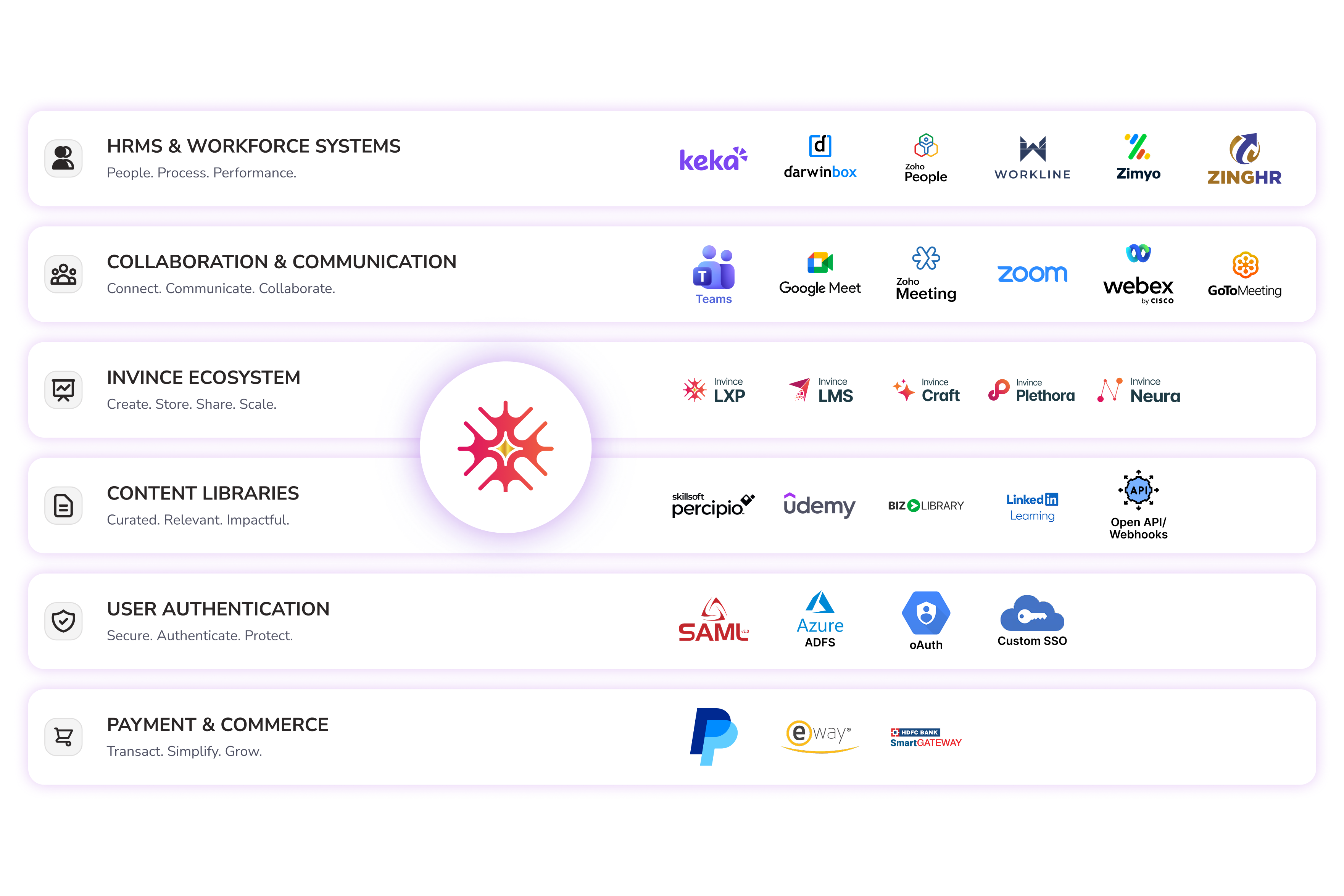
Invince LXP was built to sit inside a complex enterprise technology landscape, not to sit apart from it.
It integrates with HRMS and workforce systems to automatically synchronize employee data, organizational hierarchies, and role structures. When an employee moves to a new role, the platform updates their skill requirements, recalculates their gap, and automatically surfaces a refreshed set of recommendations.
The learning experience stays aligned with the organization without requiring administrative reconciliation.
Content integration works through APIs and real-time webhooks. External content libraries, internal authoring tools, and third-party providers feed into a unified catalog. Content is enriched by Neura upon ingestion,auto-tagged to skills, and immediately available within the platform's recommendation engine.
Organizations do not need to choose between their existing content investments and the platform's intelligence layer. They connect.
Security and authentication meet enterprise standards without exception. Role-based access control manages what administrators, managers, and learners can see and do within the platform. Single Sign-On via SAML and OAuth integrates with existing identity providers.
Multi-factor authentication, API-level data encryption, session management, configurable data retention policies, and multi-region deployment support are all built in, not bolted on.
Full audit trails cover every learning activity for compliance and governance reporting. Five compliance standards are met across the platform.
For organizations already running UpsideLMS, the relationship betweenthe two systems is straight forward. UpsideLMS handles structured training delivery, compliance workflows, instructor-led programs, and certifications.
Invince LXP handles the skills intelligence, personalized development,career pathing, and workforce analytics that the LMS was never designed to provide.
The two platforms share data. The learner sees a connected experience.The administrator manages both without duplicating effort.
Within the broader Invince ecosystem, Craft provides GenAI-powered content authoring for organizations that need to create role-specific microlearning without long production cycles.
Plethora provides a curated content library mapped to the taxonomy for organizations that need to expand their catalog without building courses from scratch. Both connect to the LXP natively.
The Implementation Timeline
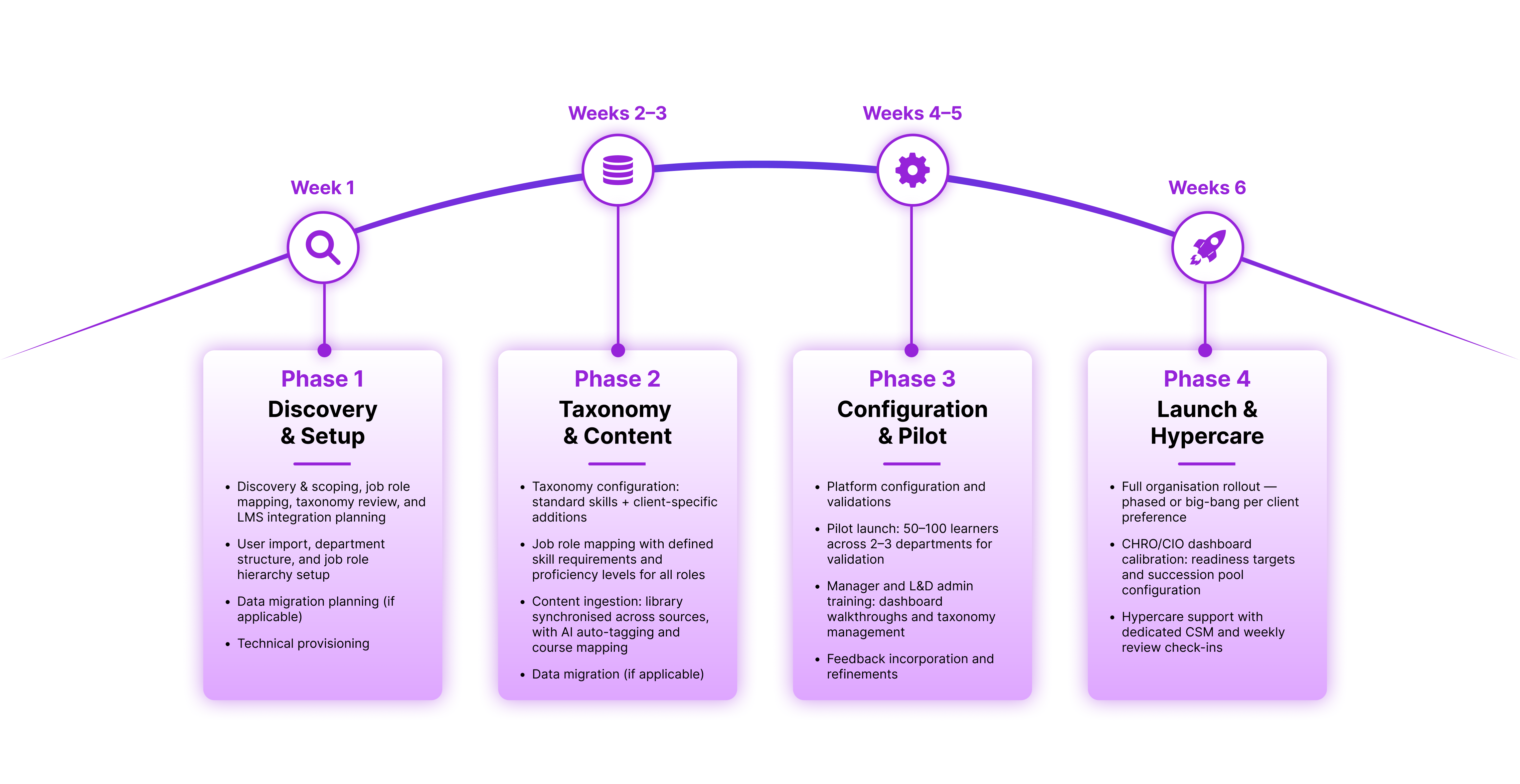
Going live takes four to six weeks. That timeline is not aspirational.It is the actual implementation schedule.
Week one is Discovery and Setup: scoping the deployment, mapping job roles,reviewing taxonomy, planning LMS integration, importing users, configuring the department structure and hierarchy, and provisioning the technical environment.
Weeks two and three are Taxonomy and Content: configuring the taxonomy with standard skills plus any client-specific additions; mapping job role skill requirements to proficiency levels; ingesting the content library across all connected sources, with Neura handling auto-tagging and course mapping; and completing data migration, if applicable.
Weeks four and five are Configuration and Pilot: configuring RBAC,approval workflows, and validation policies, then launching a pilot with 50 to100 learners across two to three departments.
Managers and L&D administrators go through dashboard walkthroughs and taxonomy management training. Feedback from the pilot informs refinements before the full rollout.
Week six is Launch and Hypercare: full organizational rollout, CHRO andCIO dashboard calibration for readiness targets and succession pool configuration,and hypercare support with a dedicated Customer Success Manager and weekly check-in calls.
The organization starts generating skills intelligence data immediately.The first readiness reports are available before the end of the first month.
The Numbers, Plainly Stated
The comparison between Invince LXP and traditional learning systems,pulled directly from the product deck, shows the following:
Time-to-proficiency reduction: 70% with Invince LXP versus 30% with traditional systems. The platform develops competency faster because the path to it is personalized, continuously recalculated, and connected to what each learner specifically needs.
Learning engagement among active users: 85% with Invince LXP versus 15% with traditional systems. When content is relevant to the individual's role, gaps, and career aspirations, people use it.
Average learning improvement achieved in year one: 3 times with Invince LXP versus 1.5 times with traditional systems.
Internal mobility rate improvement year-over-year: 2.5 times with Invince LXP versus 1.8 times with traditional systems.
These are competitive comparisons from the product deck. They sit alongside the engagement data from 400 organizations and 3 million learners using the platform globally, a 4.9 out of 5 customer satisfaction rating across those deployments, and compliance with five regulatory standards.
Why "Capability-First" Is a Design Philosophy, Not a Feature
Every design decision in Invince LXP comes back to the same principle. Capability is the outcome. Everything else is infrastructure.
Course catalogs are infrastructure. Completion dashboards are infrastructure. Enrollment workflows are infrastructure. These are the thingsthe LMS already handles.
Capability means a learner’s skill gaps drive a custom learning path,real-time progress updates, manager validation, and organization-wide visibility for HR leaders.
That chain, from individual learning activity to organizational capability intelligence, is what Invince LXP is built to create. Not as apromise about what the platform could eventually do.
As the product's core function, it runs on day one for every learner in the deployment.
The organizations building competitive advantage through talent development right now are the ones who have stopped measuring learning by the activity it generates and started measuring it by the capability it builds.That shift is what Invince LXP makes possible.
The platform is live in four to six weeks. The intelligence starts immediately.
Invince LXP is the AI-powered Learning Experience Platform from UpsideLMS HRTech, trusted by 400+ organizations and 3 million+ learners worldwide.
To book a demo, click.
Our latest blogs

Ready to Revolutionize Learning at Your Organization?
Join 400+ enterprises using Invince to upskill, reskill, and retain top talent.
Ready to Revolutionize Learning at Your Organization?
Join 400+ enterprises using Invince to upskill, reskill, and retain top talent.

Ready to Revolutionize Learning at Your Organization?
Join 400+ enterprises using Invince to upskill, reskill, and retain top talent.