

How IT Companies Can Identify and Close Employee Skill Gaps Through Competency-Based Learning | 2027
Your cloud migration is six months in. The architecture is sound, the budget is approved, and the vendor is ready. Then the project stalls, not because of the technology, but because only two engineers on a team of forty really understand the new platform. Everyone else completed an online course last year. Nobody checked whether it stuck.
[[toc]]
That is the IT skills gap in a single scene, and it is why an IT skills gap analysis has become one of the most practical tools a technology leader can use. Technology changes faster than job descriptions, certifications go out of date and new tools arrive every quarter. Without a clear picture of what your people can actually do today, upskilling turns into guesswork: generic courses, wasted budget and the same bottlenecks next year.
This guide is for CHROs, CLOs, CIOs, HR directors and L&D leaders in IT and technology companies. It explains how to run an IT skills gap analysis step by step, how to build a competency framework for IT roles, how to assess employee skills fairly, and how to close gaps with competency-based learning and adaptive learning paths that you can track over time.
Quick answer: what is an IT skills gap analysis? An IT skills gap analysis compares the skills your technology teams need to deliver business goals with the skills they have today, role by role. It uses a competency framework, employee skills assessments and manager input to find and prioritise the gaps, then links each gap to a targeted learning path, a hiring decision or a project assignment, and tracks progress over time.
What is an IT skills gap analysis, and why does it matter now?
An IT skills gap analysis is a structured review of the difference between the capabilities your IT organisation needs and the capabilities it currently has. It can be run for one person, one team or the whole technology function. The output is a prioritised list of gaps, with a plan to close each one.
It matters more now because the gap is widening. In the World Economic Forum's Future of Jobs Report 2025, 63% of surveyed employers named skills gaps as the main barrier to business transformation between 2025 and 2030, and employers expect 39% of workers' core skills to change by 2030. In IT specifically, IDC predicted in 2024 that by 2026 more than 90% of organisations worldwide would feel the effects of the IT skills crisis, with an estimated cost of $5.5 trillion in product delays, quality issues and lost business. IDC's survey of IT leaders also linked skills shortages to delays in product development and to product or service quality problems.
A skills gap analysis is different from a training needs analysis, although the two are often confused. The skills gap analysis tells you what capability is missing and how much it matters. The training needs analysis then decides how to build it: training, coaching, project rotation or hiring.
Signs your IT teams have a skills gap
Most technology leaders sense a skills gap before they measure it. Common signals include:
- Projects depend on a few people. The same two or three engineers are pulled into every critical release or incident.
- Delivery slows after a technology change. A move to a new cloud platform, framework or security tool takes longer than planned.
- Training spend rises, but capability doesn't. Course completions go up, yet the same problems keep appearing.
- Hiring becomes the default fix. Roles are filled externally because nobody can say who internally is close to ready.
- Certifications are tracked, skills are not. You know who passed an exam two years ago, but not who can do the work today.
If three or more of these sound familiar, an IT skills gap analysis will usually pay for itself quickly in better training decisions.
Build a competency framework for IT roles
A competency framework is the reference point for the whole analysis and the backbone of good competency management. It describes the skills each role needs and the level of proficiency expected. Without one, every manager judges skills differently and the results can't be compared.
Start from existing frameworks
You don't need to build from a blank page. Two widely used frameworks for IT roles are:
- SFIA (Skills Framework for the Information Age): a global framework, in use since 2000, that describes professional skills for digital and IT work across seven levels of responsibility. Each level is defined by attributes such as autonomy, influence, complexity, knowledge and business skills.
- The European e-Competence Framework (e-CF): published as the European standard EN 16234-1, it groups ICT competences into five areas (Plan, Build, Run, Enable and Manage) with proficiency levels from e-1 to e-5.
Use these as a starting library, then adapt them to your own technology stack, products and ways of working.
Define three types of competency
For each IT role family, such as software engineering, cloud and infrastructure, data, cybersecurity, IT service management and project delivery, define:
- Technical competencies: languages, platforms, tools and methods the role uses, for example container orchestration, secure coding or data pipeline design.
- Professional competencies: problem-solving, solution design, documentation, stakeholder communication and estimation.
- Behavioural competencies: collaboration, learning agility, ownership and customer focus.
Set clear proficiency levels
Use four or five levels with plain descriptions, for example: awareness, working knowledge, independent practitioner, expert and authority. Each level should describe what the person can do, not what courses they have taken.
Keep the framework short enough to use
A framework with 300 skills will never be maintained. Aim for eight to fifteen competencies per role family, focused on what drives delivery today and over the next 12 to 18 months.
How to run an IT skills gap analysis: a step-by-step process
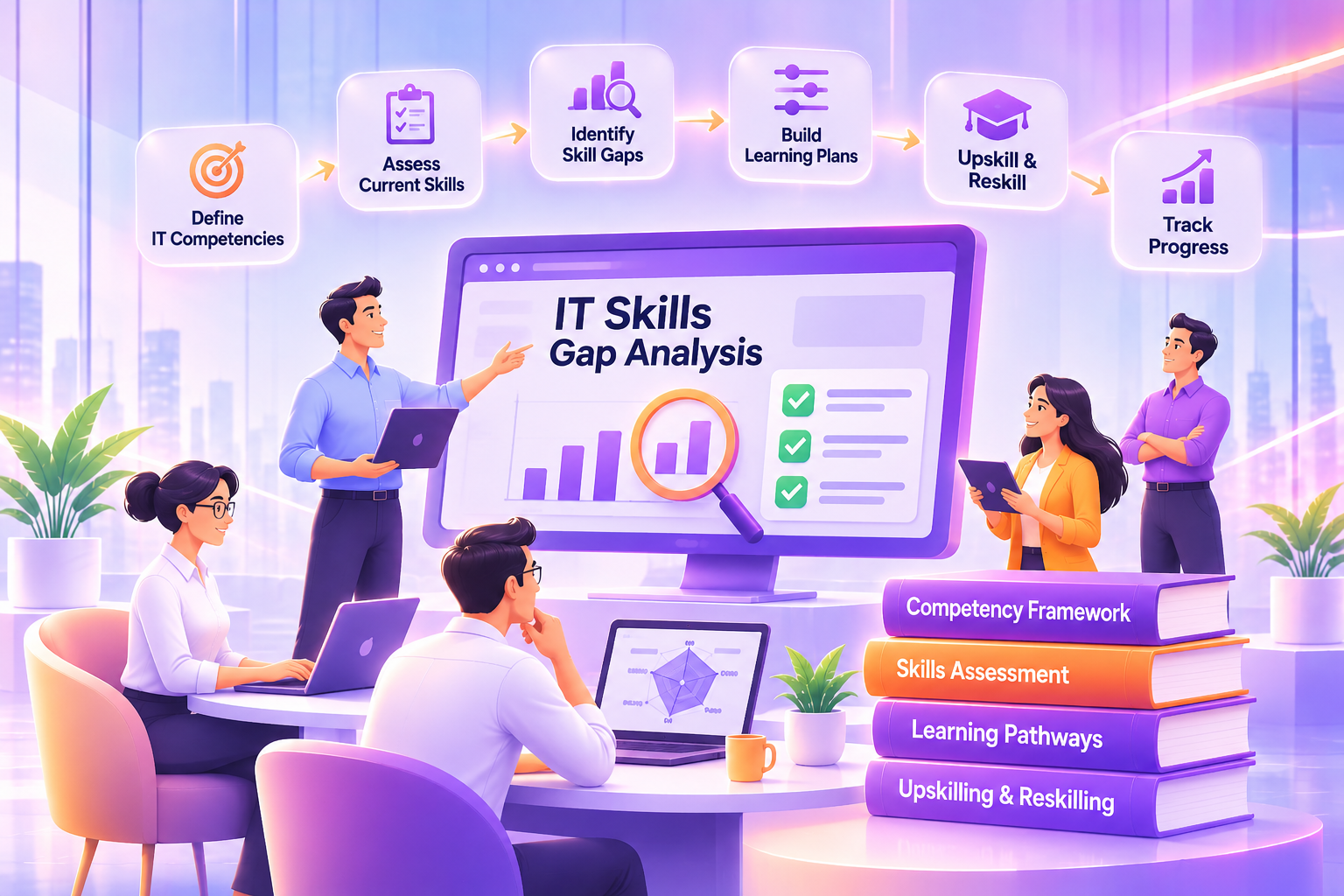
Once the framework is in place, the analysis itself follows six steps.
Step 1: link skills to business goals
Start with the technology roadmap. List the projects, platforms and capabilities the business needs in the next 12 to 18 months: a cloud migration, a new data platform, stronger security operations or an AI rollout. Each one implies a set of skills.
Step 2: set the required level for each role
For each role, record the target proficiency level for each competency. This is the “required” side of the gap.
Step 3: assess current skills
Measure where people are today using more than one method (covered in detail below). This is the “current” side.
Step 4: build a skills matrix
Plot roles or people against competencies, showing required and current levels. A simple skills matrix for one cloud team might look like this:
- Cloud architecture: required level 4, team average 2.5, gap: high
- Infrastructure as code: required level 3, team average 2, gap: medium
- Cloud security: required level 4, team average 2, gap: high
- Cost management: required level 3, team average 2.5, gap: low
- Stakeholder communication: required level 3, team average 3, gap: none
Illustrative example only. Levels are on a 1–5 scale.
Step 5: prioritise the gaps
Not every gap matters equally. Score each one by business impact (how much it affects delivery, risk or revenue) and urgency (how soon the skill is needed). Focus first on gaps that are both high impact and urgent, such as cloud security in the example above.
Step 6: decide how to close each gap
For each priority gap, choose the right response: build the skill through learning, borrow it through contractors or partners, or buy it through hiring. Most gaps are best closed by building through upskilling or reskilling, especially when the skill is adjacent to what people already know.
Employee skills assessment: methods that work for IT teams
The quality of an IT skills gap analysis depends on the quality of the employee skills assessment behind it. No single method is reliable on its own, so combine several.
- Self-assessment: quick and scalable, and useful for engagement. People tend to over- or under-rate themselves, so treat it as a starting point.
- Manager assessment: adds context from day-to-day work. Give managers the same proficiency descriptions so ratings are consistent.
- Knowledge and skills tests: scenario-based questions, coding exercises or practical labs give more objective evidence for technical competencies.
- Work evidence: code reviews, incident records, architecture documents and project outcomes show applied capability.
- Certifications: useful as one signal, but check dates and relevance. A certification earned on an older version of a platform may not reflect current skills.
A practical approach is to combine a self-rating, a manager rating and at least one objective test for each critical competency, then review large differences in a short conversation.
Be clear with employees about why you are assessing skills. Present it as a way to plan development and opportunities, not as a performance rating. People share more honest information when they trust how it will be used.
Close IT skills gaps with competency-based learning
Competency-based learning links every learning activity to a specific competency and proficiency level. Instead of assigning a long course on a broad topic, you assign the learning a person needs to move from their current level to the required one.
Build learning paths by competency and level
For each priority competency, create a short learning path for each level step, for example from “working knowledge” to “independent practitioner” in infrastructure as code. Combine:
- short modules for core concepts
- hands-on labs or practice tasks
- a project assignment that applies the skill at work
- an assessment that confirms the new level
Use adaptive learning to avoid wasted time
Adaptive learning adjusts content to what the learner already knows. A short diagnostic at the start can let experienced engineers skip material they have mastered and focus on their real gaps. For busy IT teams, saving time on familiar content is often what makes learning stick.
Blend learning with work
Technical skills grow fastest through practice. Pair formal learning with code reviews, shadowing on incidents, internal tech talks and rotation onto projects that use the new skill. Record these experiences against the competency so they count as evidence.
Use ready-made content for common skills
For widely used topics such as cloud fundamentals, security awareness, agile methods and communication skills, off-the-shelf content saves time. Build custom content only for skills that are specific to your stack, products or processes.
Track progress and report on IT workforce upskilling
An IT skills gap analysis is not a one-time project. Re-assess priority competencies every six to twelve months, and whenever the technology roadmap changes. Track a small set of indicators:
- Gap closure: the change in average proficiency against the required level for priority competencies.
- Bench strength: the number of people at independent practitioner level or above for each critical skill.
- Time to proficiency: how long it takes someone to move up one level.
- Internal mobility: the share of open roles filled by internal candidates who closed a skills gap.
- Delivery impact: project delays, incident resolution times or quality issues linked to skills.
Report these to technology and HR leadership quarterly. Over time they show whether IT workforce upskilling is actually changing what the organisation can deliver.
Common mistakes in IT skills gap analysis
- Starting with courses, not goals. Buying a content library before defining the skills you need leads to activity without direction.
- Relying only on self-assessment. It is a useful signal but not enough evidence on its own.
- Making the framework too detailed. Hundreds of skills make the analysis slow and the framework impossible to maintain.
- Treating it as a one-off. Skills move quickly in IT. An analysis from two years ago is already out of date.
- Ignoring professional and behavioural skills. Many IT projects fail on communication, estimation and collaboration rather than technical ability.
- Not sharing results. Employees and managers need to see their own gaps and paths, or the analysis won't change behaviour.
How corporate learning technology supports competency-based learning
Running an IT skills gap analysis and ongoing competency management at scale is much easier with the right corporate learning platform. When you evaluate options, look for the ability to:
- map learning content to competencies and proficiency levels
- run skills assessments and record results by role and person
- assign learning paths automatically based on assessed gaps
- personalise learning so experienced staff can skip what they know
- deliver short modules and practical tasks on any device
- report gap closure and progress by team, role and competency
The Invince AI-powered corporate learning ecosystem supports learning for technology teams in several ways:
- Invince LMS (formerly UpsideLMS) is an AI-powered enterprise learning platform for onboarding, compliance, upskilling and workforce development, giving HR, L&D and technology leaders one place to assign, deliver and track IT workforce upskilling.
- Invince LXP is an AI-driven learning experience platform that delivers personalised, role-based and skills-focused learning journeys, which suits competency-based learning paths for IT roles.
- Craft is a GenAI-powered multilingual course builder with support for more than 150 languages and over 25 ready-to-use instructional design templates. It helps teams turn internal technical knowledge, such as architecture standards or runbooks, into short learning modules, with subject experts reviewing every output.
- Plethora is a curated library of more than 80,000 ready-to-use learning resources, useful for widely applicable topics so internal experts can focus on stack-specific content.
To understand how a skills-first approach works in practice, read our overview of the skills-first learning experience platform.
Frequently asked questions about IT skills gap analysis
What is an IT skills gap analysis?
An IT skills gap analysis is a structured comparison of the skills your technology teams need and the skills they currently have, role by role. It uses a competency framework, employee skills assessments and manager input to identify and prioritise gaps, then links each gap to a learning, hiring or project decision.
How do you identify skill gaps in IT teams?
Define the competencies each IT role needs and the expected proficiency level, then assess current skills using a mix of self-assessment, manager ratings, practical tests and work evidence. Plot the results in a skills matrix and prioritise the gaps by business impact and urgency.
What is competency-based learning?
Competency-based learning links every learning activity to a specific competency and proficiency level. Learners follow a path that moves them from their current level to the required level, and an assessment or piece of work evidence confirms when they have reached it.
How often should IT companies assess employee skills?
Most IT organisations should re-assess priority competencies every six to twelve months, and whenever the technology roadmap changes significantly, such as a platform migration or a new security requirement. Fast-moving areas like cloud, data and AI may need more frequent checks.
What is the difference between a skills gap analysis and a training needs analysis?
A skills gap analysis identifies which capabilities are missing and how much each gap matters. A training needs analysis decides how to close the gaps, for example through training, coaching, project rotation or hiring.
How can an LMS support IT workforce upskilling?
An LMS can map learning to competencies, run skills assessments, assign learning paths based on assessed gaps, deliver short modules on any device and report progress by team and role. This turns an IT skills gap analysis from a spreadsheet exercise into a repeatable process.
Conclusion: from guesswork to a skills plan
The IT skills gap won't close by buying more courses. It closes when you know which skills matter for your roadmap, measure where your people stand today and give each person a clear path to the next level. An IT skills gap analysis built on a practical competency framework, fair employee skills assessments and competency-based learning paths turns upskilling from guesswork into a plan you can track.
Start small. Pick one critical role family, define eight to fifteen competencies, assess the team and close the top three gaps this quarter. The lessons from that first cycle will shape the rest of your IT workforce upskilling programme.
Which skills gap is slowing your technology roadmap most right now? Share your view in the comments, or pass this guide to the leader who owns your next upskilling cycle.
Ready to turn your skills gap analysis into action? Map one IT role's competencies this quarter and compare them with current assessment results. Then book an Invince LMS demo to see how competency-based learning paths can help close the gaps.
Our latest blogs
Ready to Revolutionize Learning at Your Organization?
Join 400+ enterprises using Invince to upskill, reskill, and retain top talent.
Ready to Revolutionize Learning at Your Organization?
Join 400+ enterprises using Invince to upskill, reskill, and retain top talent.

Ready to Revolutionize Learning at Your Organization?
Join 400+ enterprises using Invince to upskill, reskill, and retain top talent.