

Personalized Learning Paths: Turning Individual Development into Organizational Performance
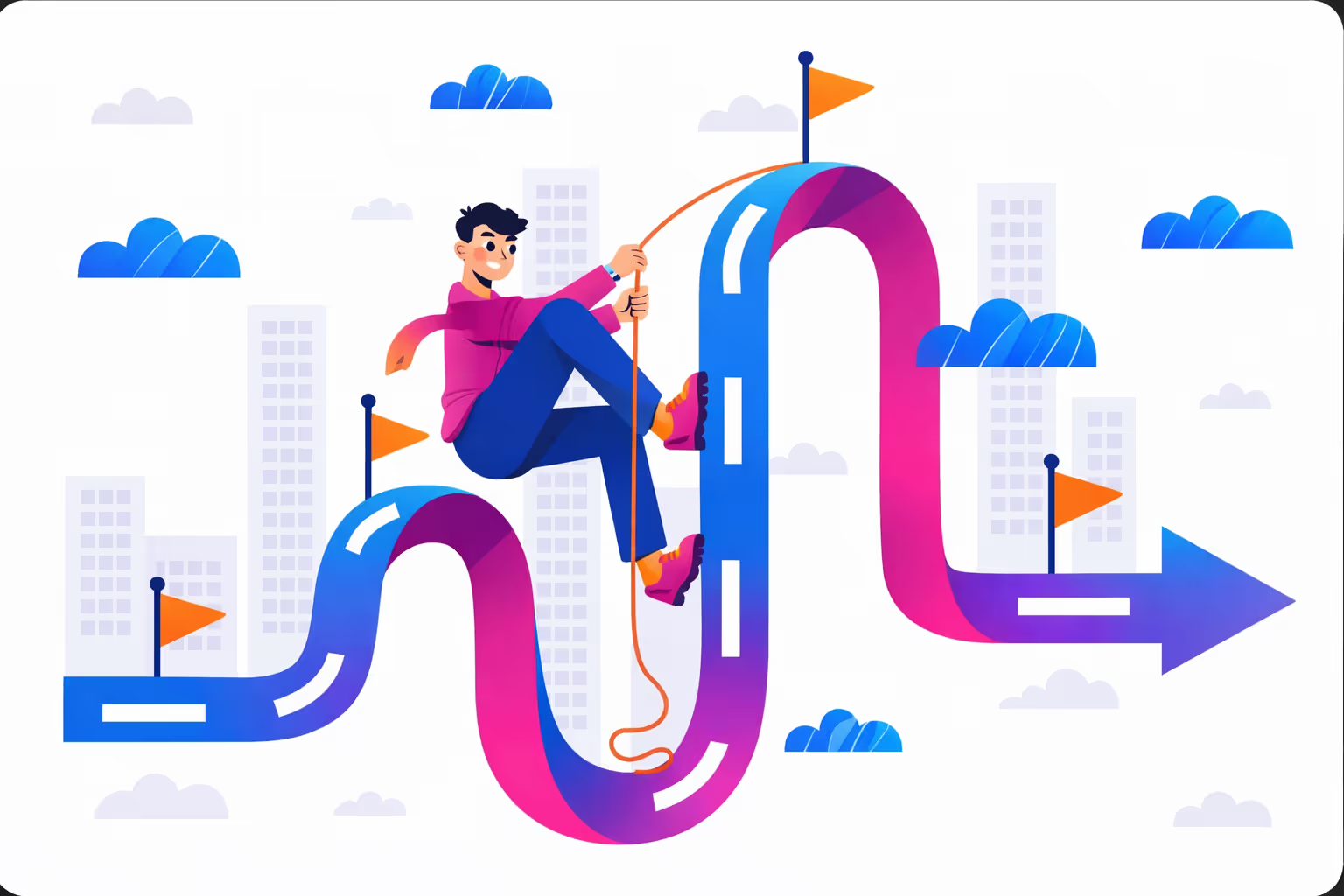
The modern workforce is not uniform. It is layered.
Different roles require different competencies. Employees enter with varying skill levels. Career trajectories diverge quickly. Digital transformation and automation reshape job expectations.
Generic training creates friction. High performers disengage when content feels remedial. New hires struggle when material assumes prior knowledge. Mandatory learning that ignores proficiency wastes time and money.
Internal modeling using synthesized, illustrative data suggests that up to 30 percent of enterprise learning spend is misaligned with actual role needs. While the figures are illustrative, the pattern is familiar to most CLOs and CHROs.
Skills decay faster than ever. Performance expectations rise. Attention spans shrink. In this environment, relevance is currency.
Personalization is no longer about learner satisfaction. It is about protecting capability velocity.
What Personalized Learning Paths Actually Mean
Personalization is often confused with customization, but the distinction matters.
Customization typically means manually assigning content based on broad categories. Personalization adapts learning based on role, skill gaps, performance signals, and progression over time.
It also differs from simple recommendation engines. Suggesting related content is helpful, but it is not a structured path aligned to business priorities.
Career pathing focuses on long-term mobility. Personalized learning paths are narrower and more dynamic. They respond to immediate capability needs while supporting broader progression.
A truly personalized learning path aligns learning to four dimensions:
- Role requirements
- Identified skill gaps
- Individual performance goals
- Organizational priorities
Personalization is about relevance and timing, not volume.
Why Traditional Learning Structures Fail Modern Workforces
Most legacy learning structures were built for stability, not agility.
Static curricula assume roles remain consistent. Mandatory courses apply uniformly regardless of proficiency. Performance data rarely feeds back into learning decisions. Managers are expected to guide development manually, often without enough insight or time.
Uniform learning produces uneven capability. Some employees are overtrained. Others are underprepared. Both outcomes carry a cost.
In dynamic industries, static learning becomes obsolete quickly. Organizations that do not adapt learning pathways to evolving roles experience widening skill gaps and increased reliance on reactive training.
The Business Case for Personalized Learning Paths
Personalization delivers measurable business outcomes when executed properly.
Time-to-competence improves because new hires focus only on relevant skills. Internal mobility strengthens as employees understand the capabilities required for advancement. Skill gaps close more efficiently when learning targets precise deficiencies rather than broad categories.
Engagement increases when learning is directly connected to performance and growth.
Illustrative modeling suggests that organizations implementing structured personalization can reduce onboarding time by 20-35%. These figures are synthesized for explanation, but they reflect patterns seen across industries.
From a leadership perspective, personalized learning reduces capability risk and talent attrition risk. Employees who see clear development pathways are more likely to stay. Organizations with visible skill maps are better positioned for succession planning.
What Makes a Learning Path Truly Personalized
Personalization is not a fixed sequence assigned once and for all. It is dynamic by nature.
A robust personalized learning path includes:
- Role-based baseline requirements that define essential competencies
- Diagnostic assessments that identify current proficiency
- Adaptive sequencing that adjusts based on progress
- Ongoing reinforcement aligned with real-world performance
Without these elements, personalization remains superficial.
Dynamic pathways evolve as individuals grow. As proficiency increases, content complexity shifts. As roles change, learning updates.
Personalization is a system, not a playlist.
The Role of Skills Intelligence in Personalization
You cannot personalize what you cannot measure.
Skills intelligence provides the foundation. Competencies must be mapped clearly to roles. Proficiency levels need definition. Learning must connect to skill validation rather than just completion.
Performance signals such as project outcomes, peer feedback, and productivity metrics can refine learning paths further. When data flows bidirectionally between learning and performance systems, personalization becomes precise rather than approximate.
Without measurable skill frameworks, personalization remains guesswork.
From Theory to Practice: Designing Personalized Learning Paths
Moving from concept to implementation needs structure.
A practical framework includes:
- Define critical roles and competencies. Identify which roles drive the greatest business impact and which skills are essential.
- Map skills to business outcomes. Clarify how each competency supports measurable results.
- Assess current capability levels. Use diagnostics or performance data to establish baselines.
- Design tiered learning sequences. Build progressive pathways aligned to proficiency stages.
- Implement adaptive triggers and refreshers. Ensure learning evolves in line with progress and role changes.
This approach avoids overengineering and maintains scalability.
Technology’s Role in Scaling Personalization
Manual personalization cannot scale across large enterprises.
AI-driven recommendations, behavioral learning data, and automated sequencing enable systems to adjust without constant human intervention. Integration with HR and performance platforms ensures learning aligns with workforce planning and development.
Automation reduces administrative burden while increasing precision.
Organizations evaluating the best learning management software increasingly prioritize adaptive capabilities and analytics integration over content volume. Similarly, the Best LMS for companies is no longer defined by course catalogs, but by its ability to deliver dynamic, role-aligned pathways.
Common Mistakes Organizations Make with Personalized Learning
Some organizations mistake personalization for content overload, flooding learners with options instead of structured progression. Others fail to update learning paths as roles evolve, leaving pathways outdated.
Skill validation is often ignored, so proficiency is assumed rather than measured. Most critically, personalization is sometimes treated as optional, an enhancement rather than a structural shift.
Without leadership commitment, personalization remains cosmetic.
What Personalized Learning Looks Like in a Mature Organization
In mature organizations, personalization becomes visible in daily operations.
Employees see clear progression pathways aligned to roles and ambitions. Learning adapts as proficiency grows. Leaders gain real-time visibility into team readiness. Skills data informs workforce planning andsuccession.
Development conversations become grounded in measurable capabilities rather than subjective impressions.
This is not aspirational. It is operational clarity.
Measuring the Impact of Personalized Learning Paths
Personalization must translate into measurable outcomes.
Metrics may include:
- Reduced time-to-productivity
- Increased internal promotion rates
- Demonstrable skill proficiency improvements
- Stronger alignment between learning engagement and performance metrics
If learning systems generate activity without business movement, personalization has failed.
Impact, not engagement alone, defines success.
How Invince Enables Personalized Learning at Scale
Invince approaches personalization as an ecosystem challenge rather than a feature enhancement.
UpsideLMS provides the structural backbone of this ecosystem. It enables role-based learning that reflects the realities corporate work, distinguishing clearly between staff, administrative teams, support roles, and external personnel.
Training paths align directly with regulatory responsibilities, ensuring that individuals are trained on what they are accountable for, not overwhelmed with generic content.
Automation for certifications, recertifications, and compliance deadlines reduces manual effort and improves audit readiness. For learning leaders evaluating the Best LMS for any business, this combination of structure and visibility is essential to maintaining consistent standards across shifts, departments, and locations.
Craft addresses the gap between policy change and workforce understanding.
Guidelines, safety protocols, and regulatory requirements evolve constantly, often in response to new evidence or external mandates. Craft enables rapid creation and updating of learning directly from policies, protocols, and internal expertise.
When a skill requirement changes, learning can be refreshed immediately and distributed consistently, reducing the lag that often introduces confusion and variation in practice. This capability is particularly critical in environments where outdated knowledge can directly impact patient safety.
Plethora completes the ecosystem by accelerating coverage of common and dedicated competencies through an AI-powered, off-the-shelf content library.
How Leaders Can Start Implementing Personalized Learning Today
ImplementNation begins with clarity.
Identify roles with the highest skill volatility. Audit whether the current learning aligns with real performance requirements. Transition from broad course catalogs to defined skill pathways.
Most importantly, invest in systems that automate adaptation. Personalization is not a cosmetic enhancement to an LMS. It is a structural choice that reshapes development.
Leadership commitment determines whether personalization remains rhetoric or becomes reality.
Personalized Learning as a Competitive Advantage
Skills are dynamic. Learning must be adaptive.
Organizations that personalize effectively increase capability velocity. They respond faster to market changes, promote from within more confidently, and deploy talent with greater precision.
The companies that win are not those that train more. They are the ones who train smarter.
For enterprises evaluating the best learning management software and the Best LMS for companies, the question is no longer about content quantity. It is about whether learning paths align tightly with performance and scale intelligently as the organization grows.
Personalization is not about individual preferences. It is about organizational performance.
Our latest blogs

Ready to Revolutionize Learning at Your Organization?
Join 400+ enterprises using Invince to upskill, reskill, and retain top talent.
Ready to Revolutionize Learning at Your Organization?
Join 400+ enterprises using Invince to upskill, reskill, and retain top talent.

Ready to Revolutionize Learning at Your Organization?
Join 400+ enterprises using Invince to upskill, reskill, and retain top talent.