


Predictive Workforce Analytics: A Practical Guide for HR and L&D Leaders
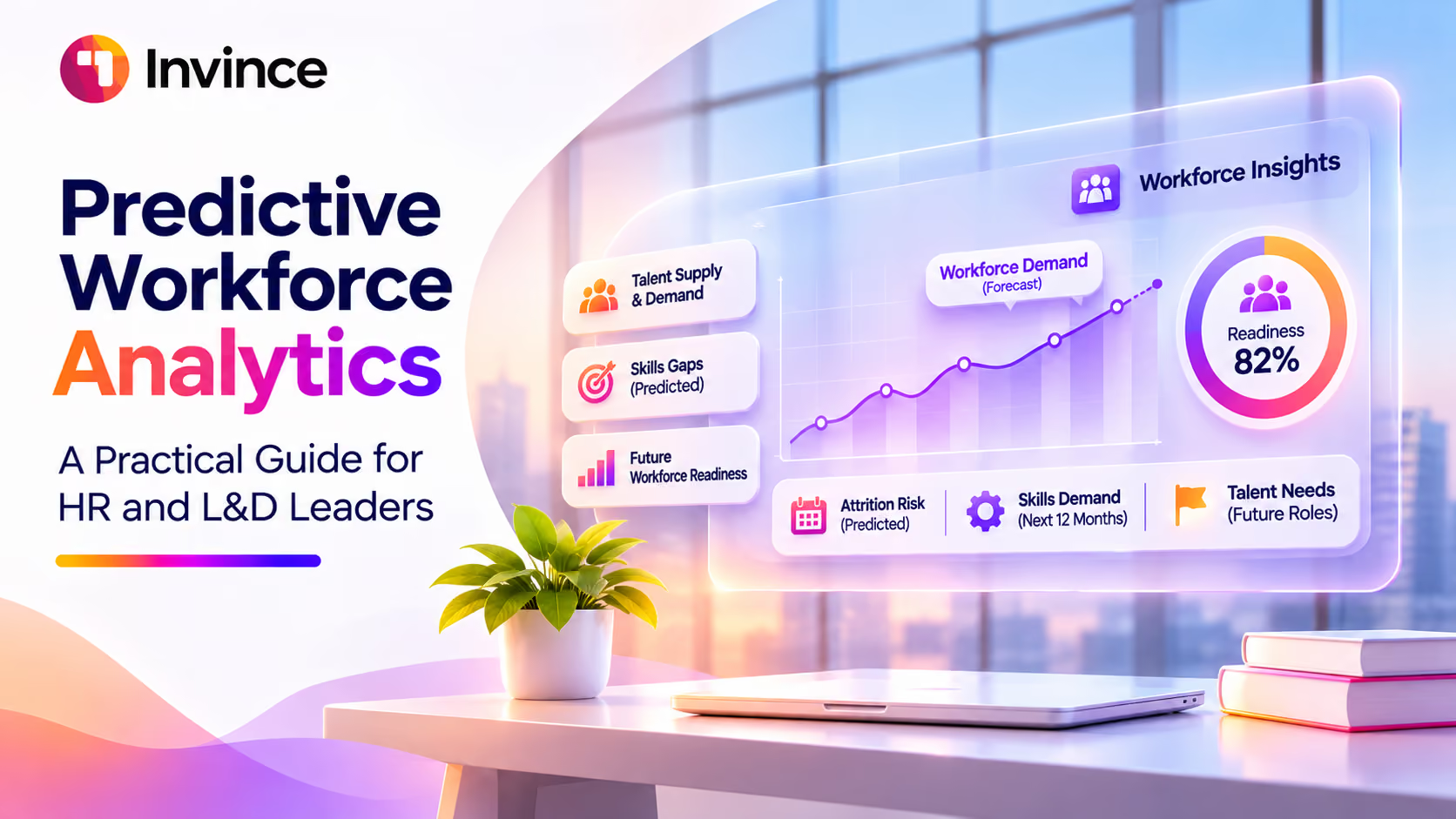
Most HR reports look backwards. They show last quarter's headcount, attrition, training completions and engagement scores. These reports are useful, but by the time they arrive, the people who were likely to leave have often gone and the skills gap has already slowed a project.
[[toc]]
Predictive workforce analytics aims to see problems earlier. Yet most organisations are still at the start. In a Korn Ferry survey of 750 global HR leaders, reported by SHRM, 74% of CHROs said their HR analytics capabilities were basic or descriptive only, and only 18% believed their organisations consistently use data analytics to drive better business decisions.
This guide explains what predictive workforce analytics is, how it differs from descriptive reporting, the most useful use cases, the data you need, a step-by-step way to start, and the ethical guardrails to put in place. It is written for CHROs, HR directors, people analytics leads and L&D leaders.
Quick answer: what is predictive workforce analytics? Predictive workforce analytics uses historical and current people data, often with statistical models or machine learning, to estimate what is likely to happen in the workforce, such as who may leave, where skills gaps will appear, which teams are at risk of missing targets or who is likely to be ready for a new role. The aim is to act earlier, with human judgement deciding what to do.
From descriptive to predictive analytics
- Descriptive: what happened? For example, attrition was 14% last year.
- Diagnostic: why did it happen? For example, attrition was highest among new hires in one region.
- Predictive: what is likely to happen? For example, which current employees show patterns linked to leaving.
- Prescriptive: what should we do? For example, which actions have reduced attrition in similar groups.
Predictive analytics builds on the first two. If your descriptive reporting is unreliable, predictions will be too.
Use cases for predictive workforce analytics
Attrition risk
Identify groups or individuals whose patterns, such as tenure, engagement, career progress or manager changes, are linked to higher turnover, so managers can have earlier career conversations.
Future skills gaps
Combine strategy, role changes and current skills data to estimate which skills will be short in 12 to 36 months. This links directly to strategic workforce planning.
Readiness and succession
Estimate who is likely to be ready for critical roles and when, based on skills growth, learning progress and performance. See our guide to workforce readiness.
Learning impact
Identify which learning programmes are associated with better performance, faster time to productivity or stronger retention, and which learners are at risk of missing compliance or certification deadlines.
Hiring and onboarding
Estimate time to fill critical roles and spot new hires who may need extra onboarding support in their first months.
Capacity and demand
Forecast workload and staffing needs for seasonal peaks, project pipelines or new locations.
The data predictive workforce analytics needs
- Core HR data: roles, tenure, location, grade, manager and movement history.
- Performance and potential data: ratings, goals and calibration outcomes.
- Skills data: skills profiles, proficiency levels and gaps, ideally from a shared taxonomy.
- Learning data: enrolments, completions, assessment results, certifications and time to proficiency.
- Engagement data: survey results and feedback.
- Business data: sales, quality, productivity or customer measures linked to teams.
Learning and skills data are often the most underused. They show how capability is changing over time, which makes them strong signals for readiness, mobility and future gaps.
How to get started: step by step
- Pick one business question. For example: “Which early-career employees in our customer teams are most likely to leave in the next six months?” Start narrow.
- Check data quality. Make sure the relevant data is accurate, consistent and connected across systems.
- Get descriptive reporting right first. Understand past patterns before predicting future ones.
- Build a simple model. Start with straightforward statistical methods and clear drivers that people can understand.
- Test against reality. Check whether predictions match what actually happens before relying on them.
- Decide the actions. Agree in advance what managers and HR will do with each type of insight.
- Put guardrails in place. Define who sees predictions, how they are used and how employees are informed.
- Measure the impact. Track whether actions based on predictions improve the outcome.
Ethics and guardrails
Predictions about people carry real risk if handled badly. Good practice includes:
- Use predictions to support people, not penalise them. An attrition risk score should prompt a career conversation, not limit opportunities.
- Keep humans in charge. Models inform decisions; managers and HR make them.
- Check for bias. Test whether predictions differ unfairly across groups and correct the model if they do.
- Be transparent. Explain to employees what data is used and why.
- Follow data protection law. Apply the privacy requirements of each country you operate in, and collect only the data you need.
- Limit access. Share individual-level predictions only with those who need them to act.
Common mistakes
- Starting with the tool, not the question. Analytics without a clear business question rarely changes anything.
- Poor data foundations. Inconsistent job titles, missing skills data and disconnected systems undermine predictions.
- Black-box models. Predictions that nobody can explain are hard to trust or act on.
- No action plan. Insights without agreed actions become another report.
- Ignoring learning and skills data. Without it, predictions miss how capability is changing.
How Invince supports predictive workforce analytics
Invince is not a people analytics platform. It provides trusted learning and skills data, and the learning that acts on insights:
- Invince LXP provides a configurable skills taxonomy, skills passports, continuous skill gap analysis and organisation-wide skill gap and readiness reporting, giving analytics teams structured skills data to work with.
- Invince LMS (formerly UpsideLMS) provides learning, assessment, certification and competency data, along with reporting and dashboards, and integrates with HR systems.
- Catalyst adds practice data, such as scores, pass rates and skill breakdowns from AI roleplay sessions, as evidence of conversation skills.
- Aura provides enterprise AI agents that automate learning, HR and workforce workflows while delivering personalised experiences and actionable insights.
- Craft and Plethora supply the learning content that closes the gaps analytics reveals.
Frequently asked questions about predictive workforce analytics
What is predictive workforce analytics?
Predictive workforce analytics uses people data, often with statistical models or machine learning, to estimate future workforce outcomes such as attrition, skills gaps, readiness and capacity needs, so organisations can act earlier.
What is the difference between descriptive and predictive analytics?
Descriptive analytics reports what has happened. Predictive analytics estimates what is likely to happen next, based on patterns in past and current data.
What are common use cases?
Common use cases include attrition risk, future skills gaps, succession and readiness, learning impact, hiring and onboarding, and capacity forecasting.
What data do you need?
Core HR, performance, skills, learning, engagement and business data. The quality and consistency of the data matter more than the volume.
Is predictive workforce analytics ethical?
It can be, with the right guardrails: use predictions to support people, keep humans in charge of decisions, test for bias, be transparent and follow data protection law.
How does learning data help predictive analytics?
Learning and skills data show how capability is changing over time, which makes them strong signals for readiness, mobility and future skills gaps.
Conclusion: see earlier, act sooner
Predictive workforce analytics helps HR move from explaining what happened to preparing for what is coming. Start with one clear business question, fix the data foundations, include learning and skills data, keep humans in charge and agree what you will do with each insight.
Choose one workforce risk for 2027, such as early-career attrition or a future skills gap, and build a simple, explainable model around it. Test it, act on it and measure the result.
Which workforce outcome would your organisation most like to predict? Share it in the comments, or pass this guide to your people analytics lead.
Ready to connect learning and skills data to workforce decisions? Explore Invince LXP or book a demo.
Ready to Revolutionize Learning at Your Organization?
Join 400+ enterprises using Invince to upskill, reskill, and retain top talent.
Ready to Revolutionize Learning at Your Organization?
Join 400+ enterprises using Invince to upskill, reskill, and retain top talent.

Ready to Revolutionize Learning at Your Organization?
Join 400+ enterprises using Invince to upskill, reskill, and retain top talent.