


Internal Mobility: How Skills Data Powers Career Moves in 2027
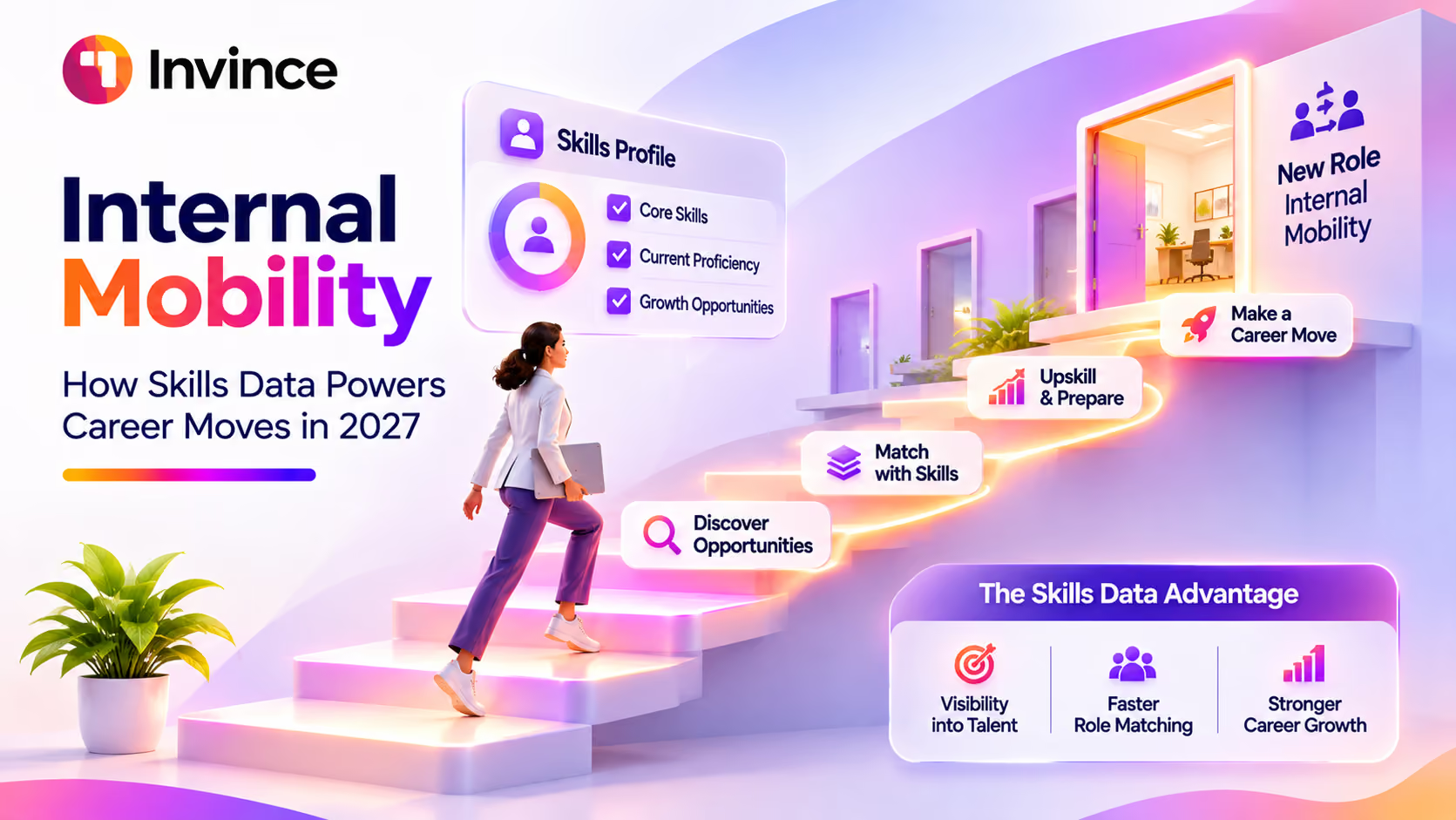
Many organisations spend heavily to hire people from outside while capable employees leave to find their next role elsewhere. Often the skills the business needs are already on the payroll, in another team or another country. The problem is that nobody can see them, and the employees cannot see the opportunities.
[[toc]]
Internal mobility fixes that, and it pays off in retention. LinkedIn data shows that employees who made an internal move have a 75% chance of staying at their company after two years, compared with 56% for employees who have not. In Asia-Pacific, a LinkedIn report published in October 2025 found that internal mobility increases employee retention by up to 72%.
This guide explains what internal mobility is, the types of internal moves, why it matters in 2027, what gets in the way and how skills data and learning make it work at scale. It is written for CHROs, HR directors, talent leaders and L&D leaders.
Quick answer: what is internal mobility? Internal mobility is the movement of employees into new roles, projects or responsibilities within the same organisation, through promotions, lateral moves, project assignments or reskilling into new roles. Skills-based internal mobility uses skills data, rather than job titles alone, to match people to opportunities and uses targeted learning to close any gaps before or after the move.
What is internal mobility?
Internal mobility covers any move that keeps a person's skills and experience inside the organisation. It is sometimes called talent mobility. It includes:
- Vertical moves: promotions to roles with more responsibility.
- Lateral moves: moves to a role at a similar level in a different team, function or location.
- Project and gig assignments: short-term work on projects outside a person's usual role, while they stay in their job.
- Reskilling moves: moves into a new type of role after targeted learning, often from a declining role into a growing one.
- Mentoring and stretch roles: temporary responsibilities that build skills for a future move.
For more on the retention and engagement case, see our earlier article on how talent mobility boosts engagement and retention.
Why internal mobility matters in 2027
- Retention. People are more likely to stay when they can see a future in the organisation.
- Speed. Internal candidates already know the business, its systems and its culture, so they usually become productive faster.
- Cost. Filling roles internally reduces recruitment fees and time spent hiring.
- Skills shifts. As AI changes roles, organisations can redeploy people from declining tasks into growing ones rather than letting them go and hiring again.
- Knowledge retention. Moving people keeps institutional knowledge in the business.
- Fairer access to opportunity. A visible, skills-based process gives more people a chance, not only those with the strongest networks.
The barriers to internal mobility
- Low visibility of skills. HR and managers cannot see who has the skills for an open role, especially across teams and regions.
- Low visibility of opportunities. Employees do not know which roles or projects are open, or what they would need to qualify.
- Manager hoarding. Managers may be reluctant to release strong performers.
- Rigid job requirements. Roles that demand specific titles or years of experience rule out people with the right skills from different backgrounds.
- No path to close the gap. When an internal candidate is close but not quite ready, there is no structured way to help them get there.
- Cultural signals. In some organisations, looking for an internal move is seen as disloyalty to the current team.
How skills data powers internal mobility
Skills data turns internal mobility from a networking exercise into a matching process:
- Roles are described as skills. Each open role or project lists the skills and proficiency levels it needs, using a shared competency framework.
- People have skills profiles. Each employee has an up-to-date record of their skills, based on assessments, manager validation, learning and work evidence.
- Matches include adjacent skills. The organisation can find people who meet most of a role's requirements and are close on the rest, not only exact matches.
- Gaps become learning paths. For a near-match, the remaining gap becomes a targeted learning path, before or after the move.
- Employees see their options. People can see which roles fit their skills and what they would need to develop for the ones they want.
This is skills intelligence in action, and it is a defining feature of a skills-based organisation.
How to build an internal mobility programme: step by step
- Set clear goals. For example: raise the share of critical roles filled internally, reduce regretted attrition or redeploy people from roles affected by AI.
- Agree a skills framework. Describe priority roles in terms of skills and proficiency levels.
- Build skills profiles. Combine self-assessment, manager input, assessments and learning data.
- Make opportunities visible. Publish open roles, projects and stretch assignments internally, with their skills requirements.
- Set fair rules. Agree how long people should stay in a role before moving, how managers are notified and how quickly a move can happen.
- Support managers. Recognise managers who develop and release talent, and include internal moves in their goals.
- Close gaps with learning. Give near-match candidates a targeted learning path and, where helpful, a mentor.
- Measure and improve. Track internal fill rates, time to fill, retention of movers and performance after the move.
Examples of skills-based internal mobility
The examples below are illustrative.
- Operations to data: an operations coordinator with strong spreadsheet and process skills is matched to a junior data analyst role and given a three-month learning path on data visualisation and SQL.
- Support to customer success: a senior support specialist with strong product knowledge and customer empathy moves into customer success after roleplay practice on renewal conversations.
- Project-based growth: a finance analyst joins a cross-functional pricing project for six months, building commercial skills that later support a move into business partnering.
- Leadership pipeline: high-performing individual contributors complete a first-time manager path and are prioritised for team leader vacancies.
Metrics for internal mobility
- Internal fill rate: the share of open roles filled by internal candidates, especially for critical roles.
- Internal mobility rate: the share of employees who make an internal move each year.
- Time to fill: how quickly internal moves happen compared with external hires.
- Retention of movers: whether employees who moved internally stay longer.
- Performance after the move: how quickly movers reach full productivity.
- Access: whether moves are spread fairly across teams, locations and groups.
Common mistakes
- Relying on job titles. Titles hide adjacent skills and rule out strong candidates.
- Posting roles without a path. If near-match candidates have no way to close gaps, they give up.
- Ignoring managers. Without support and recognition, managers block moves.
- Weak skills data. Outdated or self-reported-only profiles produce poor matches.
- Measuring only promotions. Lateral and project moves build skills and retention too.
How Invince supports skills-based internal mobility
- Invince LXP is an AI-driven learning experience platform that delivers personalised, role-based and skills-focused learning journeys. Its configurable skills taxonomy, skills passports, manager validation of skills and skill gap and readiness reporting help show who is ready, or nearly ready, for new roles.
- Invince LMS (formerly UpsideLMS) supports competency management, assessments and individual development plans, so near-match candidates have a structured plan to close gaps.
- Catalyst lets people practise the conversations a new role will demand, such as sales, customer or leadership conversations, with structured performance feedback.
- Craft and Plethora provide the learning content, from custom multilingual courses to a library of more than 80,000 ready-to-use resources.
- Aura provides enterprise AI agents that automate learning, HR and workforce workflows while delivering personalised experiences and actionable insights.
Frequently asked questions about internal mobility
What is internal mobility?
Internal mobility is the movement of employees into new roles, projects or responsibilities within the same organisation, including promotions, lateral moves, project assignments and reskilling into new roles.
Why is internal mobility important?
It improves retention, fills roles faster and at lower cost, keeps knowledge in the business, helps redeploy people as roles change and gives employees visible growth.
What is skills-based internal mobility?
Skills-based internal mobility matches people to roles and projects using skills data rather than job titles alone, and uses targeted learning to close any remaining gaps.
What are the main barriers to internal mobility?
Common barriers include poor visibility of skills and opportunities, managers reluctant to release talent, rigid job requirements and no structured way to help near-match candidates close gaps.
How do you measure internal mobility?
Track internal fill rate, internal mobility rate, time to fill, retention and performance of movers, and whether moves are spread fairly across the organisation.
What is the difference between internal mobility and succession planning?
Succession planning prepares specific people for specific critical roles, usually senior ones. Internal mobility is broader and covers all kinds of moves across the organisation.
Conclusion: let skills find opportunities
The skills your business needs are often already inside it. Internal mobility puts them to work. Describe roles as skills, build trusted skills profiles, make opportunities visible, support managers and give near-match candidates a clear path to close the gap.
Start with one critical role family in 2027. Fill its next three vacancies with a skills-based internal search before advertising externally, and measure the result.
Which role in your organisation could you fill from within next quarter? Share it in the comments, or pass this guide to the person who owns your talent strategy.
Ready to power internal mobility with skills data? Explore Invince LXP or book a demo.
Ready to Revolutionize Learning at Your Organization?
Join 400+ enterprises using Invince to upskill, reskill, and retain top talent.
Ready to Revolutionize Learning at Your Organization?
Join 400+ enterprises using Invince to upskill, reskill, and retain top talent.

Ready to Revolutionize Learning at Your Organization?
Join 400+ enterprises using Invince to upskill, reskill, and retain top talent.