


How to Build a Competency Framework: Steps, Template and Examples for 2027
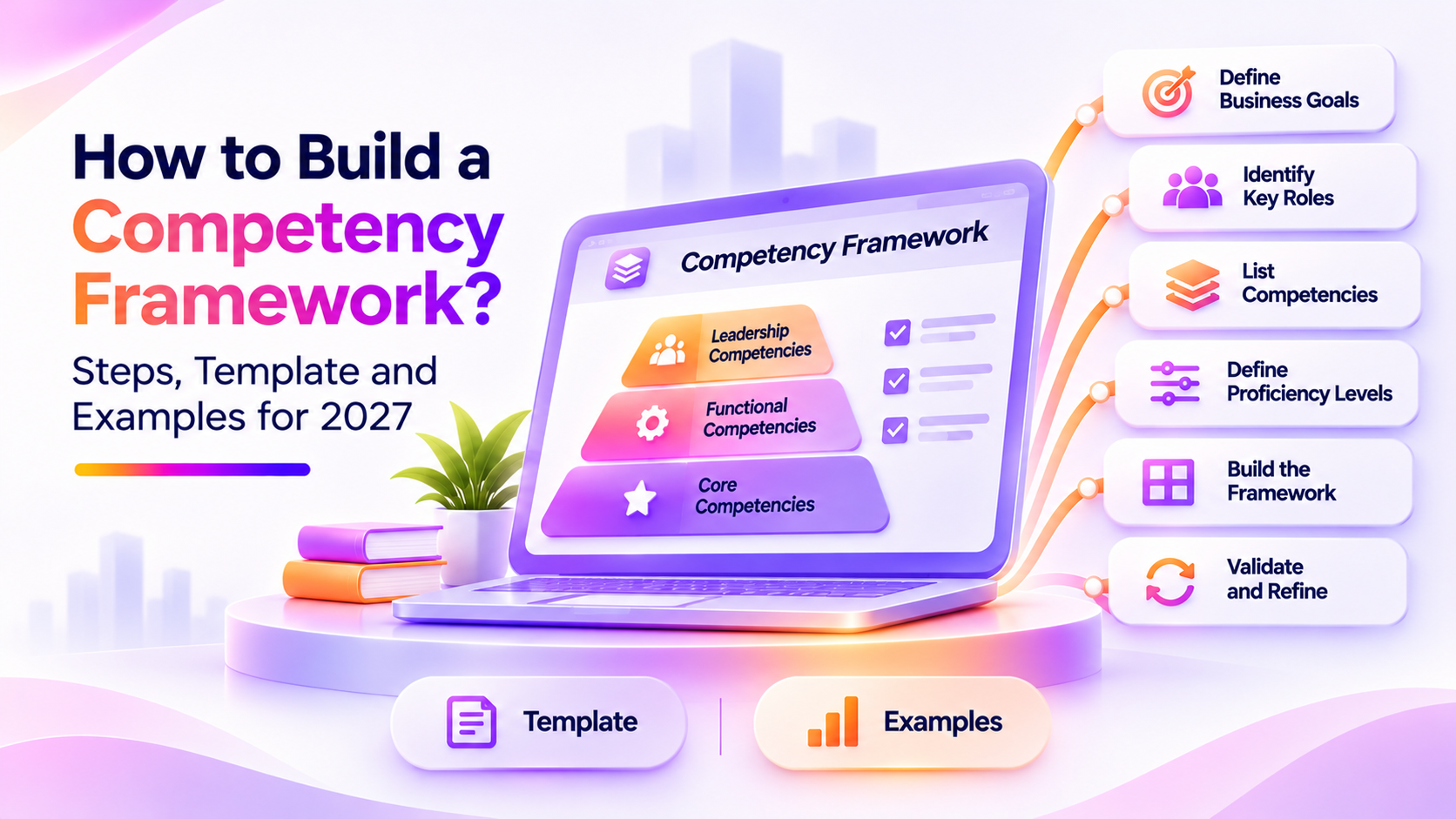
Every people decision depends on a shared answer to one question: what does good look like in this role? Without that answer, managers rate the same skill in different ways, learning programmes miss the real gaps and hiring relies on gut feel. A competency framework provides the answer.
[[toc]]
Many organisations know they need one but stall at the start. Frameworks become too long, too abstract or too hard to maintain. In Deloitte's skills-based organisation research, only 10% of HR executives said they effectively classify skills into a taxonomy or framework. The good news is that a useful framework does not need to be complicated.
This guide walks through how to build a competency framework step by step: the types of competencies to include, how to write proficiency levels, a simple template, examples and how to keep it current. It is written for HR directors, L&D leaders, talent managers and business leaders. For the wider process of comparing roles with current capability, read our guide to competency mapping.
Quick answer: how do you build a competency framework? Start with business goals and a few critical roles. Identify the technical, behavioural and leadership competencies those roles need, write clear definitions and four or five proficiency levels for each, set the required level per role, validate the framework with managers and top performers, then connect it to assessment, learning and career paths and review it at least once a year.
What is a competency framework?
A competency framework is a structured list of the competencies an organisation needs, with a definition, observable behaviours and proficiency levels for each, linked to the roles that require them. A competency is a combination of knowledge, skills and behaviours that shows up in how work is done.
A competency framework is the reference point. Competency mapping uses it to compare what each role requires with what each person can do today, and a skills gap analysis uses the results to prioritise action.
Why organisations need a competency framework in 2027
- Consistent decisions. Managers, HR and employees use the same language and the same standards.
- Targeted learning. Learning is aimed at the competencies a role needs rather than at generic topics.
- Fairer assessment and hiring. Candidates and employees are judged against clear, observable criteria.
- Visible career paths. Employees can see what they need to develop for the next role.
- A foundation for skills-based talent practices. A framework is a core building block of a skills-based organisation.
- Readiness for AI-driven change. When roles change, a framework makes it clear which competencies are new, which are growing and which are fading.
Types of competencies to include
- Core competencies: the few behaviours expected of everyone, linked to the organisation's values, such as customer focus, integrity and collaboration.
- Functional or technical competencies: the knowledge and skills specific to a function or role, such as financial analysis, cloud administration or regulatory knowledge.
- Behavioural competencies: how people work, such as communication, problem-solving and adaptability.
- Leadership competencies: the capabilities needed to lead people and decisions, such as coaching, delegation and strategic thinking.
- Future or emerging competencies: capabilities the business will need soon, such as AI literacy or data interpretation, even if few roles require them today.
How to build a competency framework: step by step
Step 1: start with business goals
List the strategic priorities for the next one to three years, such as growth in a new market, a technology change or a shift in customer model. Ask which capabilities each priority depends on.
Step 2: choose the roles to start with
Do not try to cover every role at once. Pick three to five business-critical roles or role families where clarity will make the biggest difference.
Step 3: gather evidence on what good looks like
Review job descriptions, interview top performers and their managers, look at performance data and check external frameworks for your function, such as SFIA for digital and IT roles. The aim is to describe the behaviours that separate strong performance from average performance.
Step 4: draft the competency list
For each role family, list eight to fifteen competencies across the types above. Merge duplicates and remove anything that does not clearly affect performance.
Step 5: write clear definitions and behaviours
Give each competency a short name, a one-sentence definition and three to five observable behaviours. Use plain language that a manager could recognise in daily work.
Step 6: define proficiency levels
Describe four or five levels for each competency, each one stating what a person can do at that level. A common scale is:
- Awareness: understands the basics and needs guidance to apply them.
- Working knowledge: applies the competency in routine situations with some support.
- Proficient: applies it independently in most situations.
- Advanced: handles complex situations and helps others develop.
- Expert: sets standards and is a reference point for the organisation.
Step 7: set the required level for each role
For each role, record the level expected for each competency. This turns the framework into a role profile that can be assessed against.
Step 8: validate with the business
Test the draft with managers, top performers and HR business partners. Ask whether each competency and level is clear, relevant and observable. Adjust before rolling out.
Step 9: connect it to people processes
Use the framework in assessments, learning paths, individual development plans, hiring criteria and career paths. A framework that sits in a document and is not used in decisions quickly loses credibility.
Step 10: review and update
Review the framework at least once a year, and whenever roles change significantly. Add emerging competencies, retire outdated ones and update levels as expectations rise.
A simple competency framework template
For each competency, record:
- Competency name
- Type: core, functional, behavioural, leadership or emerging
- Definition: one sentence
- Observable behaviours: three to five examples
- Proficiency levels: a short description for each of levels 1 to 5
- Roles that need it, and the required level for each
- How it is assessed: for example, manager rating, test, roleplay or work evidence
- Linked learning: the learning paths or resources that build it
- Owner and last review date
Competency framework examples
The examples below are illustrative.
Example: consultative selling (functional competency for sales roles)
- Definition: understands a customer's business problem and positions solutions around the value they create.
- Behaviours: asks open discovery questions, links needs to business outcomes, handles pricing objections with value evidence.
- Level 2: runs a structured discovery call with a script and support.
- Level 4: leads complex, multi-stakeholder conversations and coaches junior colleagues.
- Required level: account executive, level 3; key account manager, level 4.
Example: AI literacy (emerging competency for all knowledge workers)
- Definition: uses AI tools safely and effectively in daily work and judges the quality of their output.
- Behaviours: writes clear prompts, checks AI output for accuracy, follows data and privacy policies, knows when not to use AI.
- Level 1: understands what AI tools can and cannot do.
- Level 3: uses AI tools independently to improve the quality and speed of their own work.
- Required level: most professional roles, level 2 or 3; analytics and content roles, level 4.
Example: coaching others (leadership competency)
- Definition: helps team members improve performance and grow through regular, specific feedback and development.
- Behaviours: holds regular one-to-ones, gives specific feedback, agrees development goals, recognises progress.
- Required level: team leader, level 3; senior manager, level 4.
Common competency framework mistakes
- Too many competencies. A framework with hundreds of items is never maintained or used.
- Vague definitions. Words like “excellent communicator” mean different things to different managers. Describe observable behaviours.
- Levels based on courses, not capability. Proficiency should describe what people can do, not what they have completed.
- Built by HR alone. Without managers and top performers, the framework will not reflect real work.
- Not connected to decisions. If assessments, learning and promotions do not use it, nobody will.
- Never updated. Roles change. An out-of-date framework guides people to the wrong skills.
How technology keeps a competency framework alive
A framework in a spreadsheet is a good start, but it becomes hard to maintain and connect to learning as it grows. A learning platform can hold the framework, link it to roles, run assessments, assign learning by gap and report progress.
- Invince LMS (formerly UpsideLMS) supports competency management alongside learning delivery, assessments and individual development plans, so the framework connects directly to learning.
- Invince LXP includes a pre-built skills taxonomy that links skills, proficiency levels and job roles, which administrators can configure and extend, and delivers personalised, skills-focused learning journeys.
- Craft is a GenAI-powered multilingual course builder that helps L&D teams create learning for specific competencies quickly, with subject experts reviewing every output.
- Plethora is a curated library of more than 80,000 ready-to-use learning resources for common competencies.
- Catalyst is an AI-powered roleplay platform where employees practise real-world conversations and receive structured performance feedback, useful for assessing and building conversation-based competencies.
Frequently asked questions about competency frameworks
What is a competency framework?
A competency framework is a structured list of the competencies an organisation needs, with definitions, observable behaviours and proficiency levels, linked to the roles that require them.
How do you build a competency framework?
Start with business goals and a few critical roles, gather evidence on what good performance looks like, draft eight to fifteen competencies per role family, write definitions and proficiency levels, set required levels, validate with the business, connect the framework to people processes and review it regularly.
What is the difference between a competency framework and competency mapping?
A competency framework defines the competencies and levels. Competency mapping uses the framework to compare what each role requires with what each person can do today.
How many competencies should a framework have?
Eight to fifteen per role family is usually enough. Keep core competencies shared across the organisation to a handful.
How often should a competency framework be updated?
Review it at least once a year, and whenever roles, technology or strategy change significantly.
What is the difference between a skill and a competency?
A skill is a specific ability, such as building a financial model. A competency is broader and combines knowledge, skills and behaviours, such as financial analysis, including how a person applies and communicates the work.
Conclusion: a framework people actually use
A good competency framework is short, clear and connected to real decisions. Start with your most important roles, describe what good looks like in observable terms, set clear levels and link the framework to assessment, learning and career paths. Then keep it current.
Choose three critical roles this quarter and build their competency profiles. Use them in one talent process, such as development planning, and learn from the results before extending further.
Which role in your organisation would benefit most from a clear competency profile? Share it in the comments, or pass this guide to the person who owns your talent framework.
Ready to connect competencies to learning? Explore competency management with Invince LMS or book a demo.
Ready to Revolutionize Learning at Your Organization?
Join 400+ enterprises using Invince to upskill, reskill, and retain top talent.
Ready to Revolutionize Learning at Your Organization?
Join 400+ enterprises using Invince to upskill, reskill, and retain top talent.

Ready to Revolutionize Learning at Your Organization?
Join 400+ enterprises using Invince to upskill, reskill, and retain top talent.