


Skills Gap Analysis: A Step-by-Step Guide for Enterprises in 2027
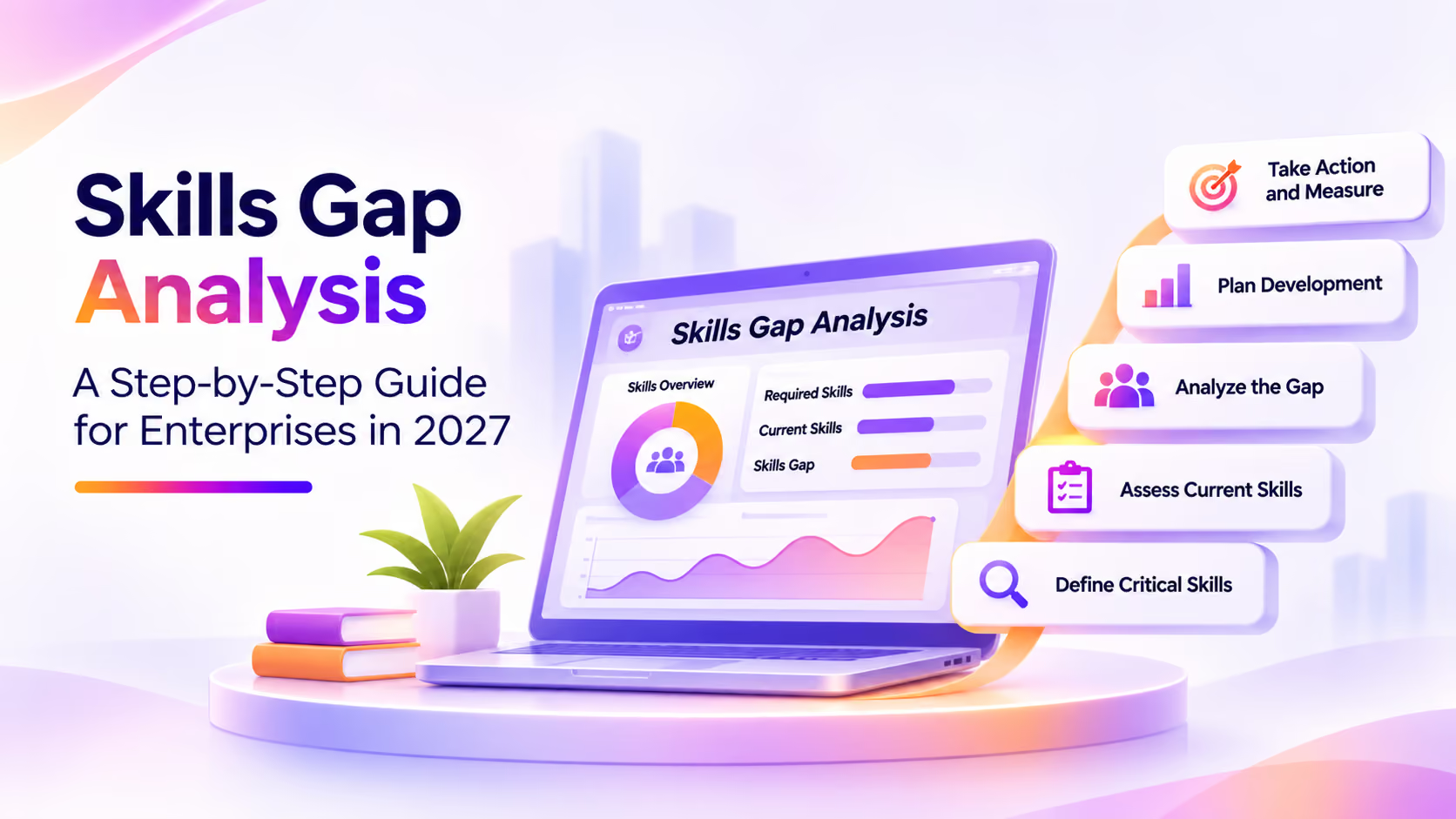
Most organisations know they have skills gaps. Fewer can say exactly where those gaps are, how big they are, which ones matter most and what will close them. Without that clarity, learning budgets are spread thinly, hiring becomes the default answer and the same gaps reappear the following year.
[[toc]]
The scale of the challenge is large. The World Economic Forum's Future of Jobs Report 2025 estimates that if the global workforce were 100 people, 59 would need reskilling or upskilling by 2030, and 11 of them are unlikely to receive it. Employers in the same report see skills gaps as a major barrier to business transformation, more than any other barrier. A skills gap analysis is the starting point for doing something about it.
This guide explains what a skills gap analysis is, the different levels at which you can run one, a step-by-step process, the assessment methods that work, a simple template, examples and how to turn the results into action. It is written for CHROs, CLOs, HR directors, L&D leaders and business managers.
Quick answer: what is a skills gap analysis? A skills gap analysis compares the skills an organisation, team or person needs to meet its goals with the skills they have today. It identifies the gaps, ranks them by business impact and urgency, and links each one to an action, such as a learning path, a project, internal mobility or hiring. Repeated regularly, it shows whether gaps are closing.
What is a skills gap analysis?
A skills gap analysis is a structured way to answer three questions:
- What skills do we need? The skills required by the business strategy, roles and upcoming changes.
- What skills do we have? The current skills and proficiency of the workforce, based on evidence.
- What is the difference, and what will we do about it? The prioritised gaps and the plan to close them.
It differs from a training needs analysis. A skills gap analysis tells you which capabilities are missing and how much each gap matters. A training needs analysis then decides how to close each gap, which may or may not be training.
Three levels of skills gap analysis
- Individual: compares one person's skills with the requirements of their role or the role they want next. The output feeds an individual development plan.
- Team or role: compares the combined skills of a team or role group with what the team needs to deliver its goals. The output shows shared gaps and single points of failure.
- Organisation: compares the skills of the whole workforce with the capabilities the business strategy requires. The output feeds workforce planning, learning budgets and hiring plans.
Most organisations start at the team or role level for a few critical areas, then build up to an organisation-wide view.
Signs your organisation needs a skills gap analysis
- projects slow down or depend on the same few people
- a new technology, product or regulation is coming and nobody is sure who is ready for it
- learning spend is rising but performance is not improving
- most open roles are filled externally because internal readiness is unclear
- managers rate the same skill in different ways across teams
- leaders ask for workforce skills data that HR cannot provide
How to conduct a skills gap analysis: step by step
Step 1: define the scope and the business goal
Decide what you are analysing and why. For example: “assess customer service teams in India and the UAE ahead of a new AI-assisted support model”. A clear scope keeps the analysis focused and makes the results easier to act on.
Step 2: identify the skills that matter
List the skills the goal requires. Include technical skills, such as tools and methods, professional skills, such as problem-solving and communication, and behavioural skills, such as collaboration and adaptability. Keep the list short: eight to fifteen skills per role family is usually enough.
Step 3: define proficiency levels
For each skill, describe four or five levels in plain language, from awareness to expert. Each level should describe what a person can do, not which courses they have completed. A clear competency mapping process gives everyone the same reference point.
Step 4: set the required level for each role
Record the target level of each skill for each role in scope. This is the “needed” side of the analysis.
Step 5: assess current skills
Measure where people are today, using more than one method (see below). This is the “have” side.
Step 6: calculate and visualise the gaps
For each person, team or role, compare the current level with the required level. A skills matrix or heat map makes patterns easy to see: which skills are weak across the board, which teams are most exposed and which people are close to ready for a new role.
Step 7: prioritise
Score each gap by business impact and urgency. Focus first on gaps that are high in both, such as a skill needed for a launch in the next quarter.
Step 8: decide how to close each gap
Choose the right response: upskill or reskill people, give them project experience, move people with the skill from elsewhere in the organisation, or hire. Our guide to upskilling vs reskilling vs cross-skilling explains which approach fits each need.
Step 9: act, track and repeat
Assign learning paths and experiences, set a date to reassess and track progress. Repeat the analysis every six to twelve months, or sooner when strategy changes.
Skills assessment methods
No single method is reliable on its own. Combine several:
- Self-assessment: quick, scalable and good for engagement, but people often over- or under-rate themselves.
- Manager assessment: adds context from daily work. Give managers the same level descriptions so ratings are consistent.
- Knowledge and skills tests: scenario questions, practical tasks and simulations give more objective evidence.
- Roleplay and simulation: useful for conversation-heavy skills such as sales, leadership and customer service, where knowing is not the same as doing.
- Work evidence: project outcomes, quality data, customer feedback and peer reviews show applied skill.
- Certifications: one useful signal, but check that they are recent and relevant.
- Assessment centres: for leadership and critical roles, a structured assessment centre combines several exercises and observers.
Be open with employees about why you are assessing skills. Position it as a way to plan development and opportunities, not as a performance rating. People share more honest information when they trust how it will be used.
A simple skills gap analysis template
You can start with a spreadsheet. For each person or role in scope, record:
- Role or person
- Skill
- Skill type: technical, professional or behavioural
- Required level (for example, 1 to 5)
- Current level, with the evidence source
- Gap: required level minus current level
- Business impact: high, medium or low
- Urgency: needed now, within 6 months or within 12 months
- Action: learning path, project, mentoring, mobility or hire
- Owner and review date
As the analysis grows across teams and regions, a spreadsheet becomes hard to maintain. That is the point at which a learning platform with skills data becomes useful.
Skills gap analysis examples
The examples below are illustrative.
- Sales: a sales team moving to value-based selling finds strong product knowledge but gaps in discovery questioning and handling pricing objections. The action is a short learning path plus weekly roleplay practice.
- Customer service: a support team adopting AI-assisted tools finds gaps in tool use and in judging when to escalate. The action is hands-on modules, scenario practice and a buddy system for the first month.
- Finance: a finance team finds that only two people can build automated reports. The action is cross-skilling three analysts and documenting the process to reduce dependence on a few experts.
- New managers: recently promoted managers score well on technical skills but low on feedback and delegation. The action is a leadership path with practice conversations and mentor check-ins.
- IT: a technology team preparing for a cloud migration finds high-impact gaps in cloud security. See our detailed guide to IT skills gap analysis.
From analysis to action: closing skills gaps
- Personalised learning paths. Assign each person learning that moves them from their current level to the required one, rather than a generic course.
- Practice and application. Add projects, simulations and roleplay so people use the new skill at work.
- Ready-made and custom content. Use libraries for common skills and create content only for skills specific to your business.
- Internal mobility. Move people whose skills are close to a role's needs before hiring externally.
- Manager involvement. Managers coach, release time for learning and confirm when a new level is reached.
- Regular reassessment. Measure again to confirm the gap is closing and update priorities.
How to measure progress
- Gap closure: movement in average proficiency against the required level for priority skills.
- Bench strength: the number of people at the required level or above for each critical skill.
- Time to proficiency: how long it takes to move up one level.
- Internal fill rate: the share of roles filled by internal candidates.
- Business results: the outcomes the analysis was meant to improve, such as delivery speed, quality, sales or service scores.
Common skills gap analysis mistakes
- Starting without a business goal. The analysis becomes a long list with no clear priorities.
- Too many skills. Hundreds of skills make the analysis slow and impossible to maintain.
- Relying on one data source. Self-assessment alone is not enough evidence.
- Analysis without action. Results that are not linked to learning, projects or mobility change nothing.
- Treating it as a one-off. Skills change quickly. An analysis from two years ago is already out of date.
The role of skills intelligence
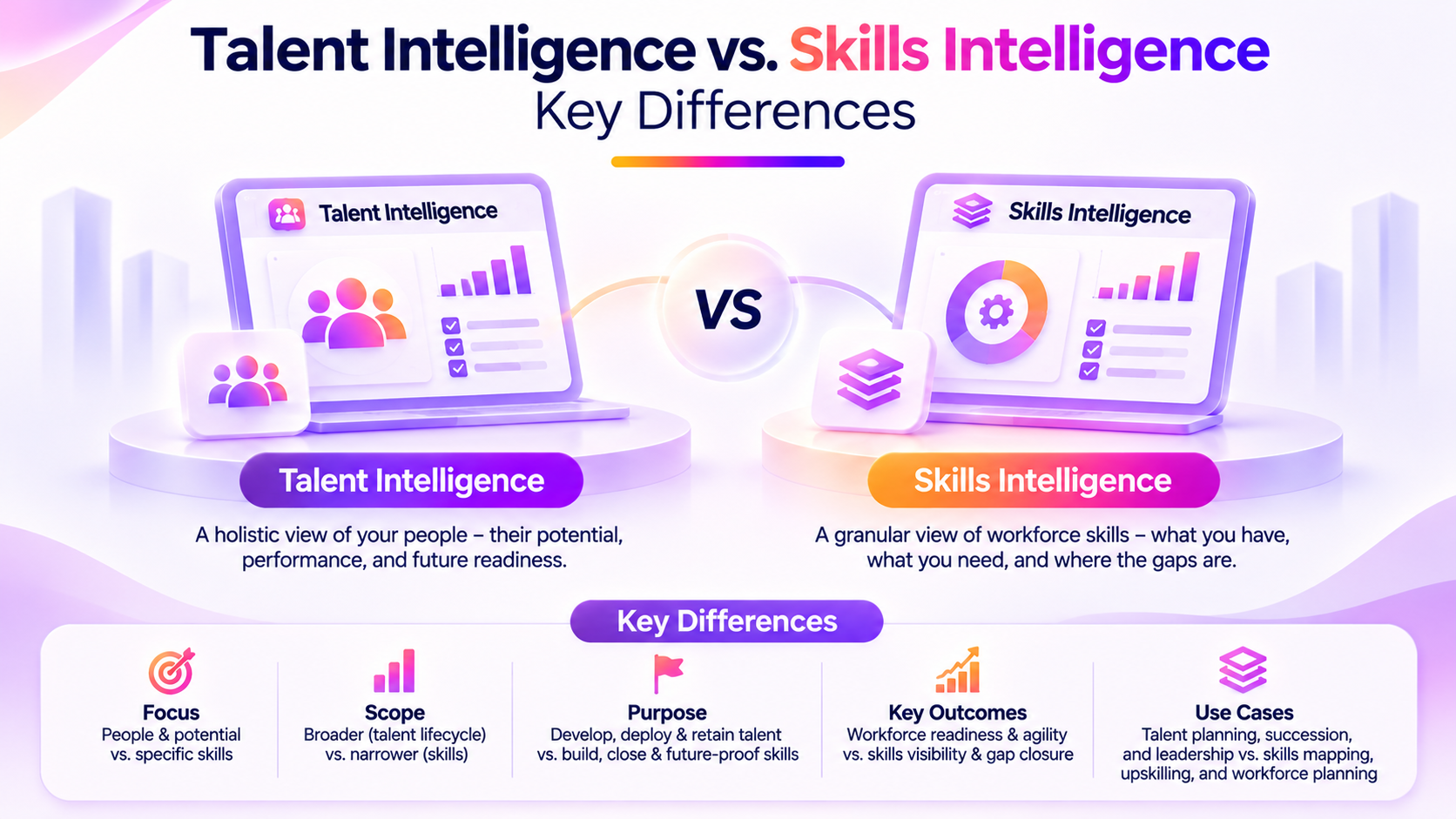
A one-off skills gap analysis is a snapshot. Skills intelligence turns it into a continuous view by keeping skills data current as people learn, complete projects and change roles. AI helps by mapping content and roles to skills, updating gap analysis automatically and recommending learning for each person. This is a core building block of a skills-based organisation.
How Invince helps you run and act on skills gap analysis
- Invince LXP is an AI-driven learning experience platform that delivers personalised, role-based and skills-focused learning journeys. It includes a configurable skills taxonomy, a skills passport for each learner, continuous skill gap analysis and organisation-wide skill gap and readiness reporting.
- Invince LMS (formerly UpsideLMS) is an AI-powered enterprise learning platform for onboarding, compliance, upskilling and workforce development, with competency management, assessments and individual development plans.
- Catalyst is an AI-powered roleplay platform that helps employees practise real-world conversations, with lifelike AI simulations and structured performance feedback that show where conversation skills need work.
- Craft is a GenAI-powered multilingual course builder with support for more than 150 languages, for creating content on business-specific skills, with subject experts reviewing every output.
- Plethora is a curated library of more than 80,000 ready-to-use learning resources for common skills.
- Aura provides enterprise AI agents that automate learning, HR and workforce workflows while delivering personalised experiences and actionable insights.
Frequently asked questions about skills gap analysis
What is a skills gap analysis?
A skills gap analysis compares the skills an organisation, team or person needs with the skills they have today, ranks the gaps by impact and urgency, and links each gap to an action such as learning, a project, internal mobility or hiring.
How do you conduct a skills gap analysis?
Define the scope and goal, list the skills that matter, set proficiency levels and required levels, assess current skills with several methods, calculate the gaps, prioritise them, choose actions, then track progress and repeat.
What is the difference between a skills gap analysis and a training needs analysis?
A skills gap analysis identifies which capabilities are missing and how much they matter. A training needs analysis decides how to close each gap, which may include training, coaching, projects or hiring.
How often should you do a skills gap analysis?
Most organisations should reassess priority skills every six to twelve months, and whenever strategy, technology or regulation changes significantly.
What tools can you use for skills gap analysis?
Small analyses can start in a spreadsheet. At scale, a learning platform with a skills taxonomy, assessments, skills profiles and gap reporting keeps data current and links gaps directly to learning.
Who should be involved in a skills gap analysis?
HR and L&D lead the process, business leaders set priorities, managers assess and coach their teams, and employees take part in assessments and own their development plans.
Conclusion: know your gaps, then close them
A skills gap analysis turns a general worry about skills into a clear, prioritised plan. Define what the business needs, measure what people have with more than one method, focus on the gaps that matter most and link each one to an action you can track.
Start with one critical team and one business goal this quarter. Run the analysis, close the top three gaps and measure the result. Then extend the approach across the organisation.
Which skills gap would make the biggest difference to your business if it closed this year? Share it in the comments, or pass this guide to the person planning your 2027 learning priorities.
Ready to see skills gaps across your workforce? Explore Invince LXP or book a demo.
Ready to Revolutionize Learning at Your Organization?
Join 400+ enterprises using Invince to upskill, reskill, and retain top talent.
Ready to Revolutionize Learning at Your Organization?
Join 400+ enterprises using Invince to upskill, reskill, and retain top talent.

Ready to Revolutionize Learning at Your Organization?
Join 400+ enterprises using Invince to upskill, reskill, and retain top talent.