


Upskilling vs Reskilling vs Cross-Skilling: What's the Difference?
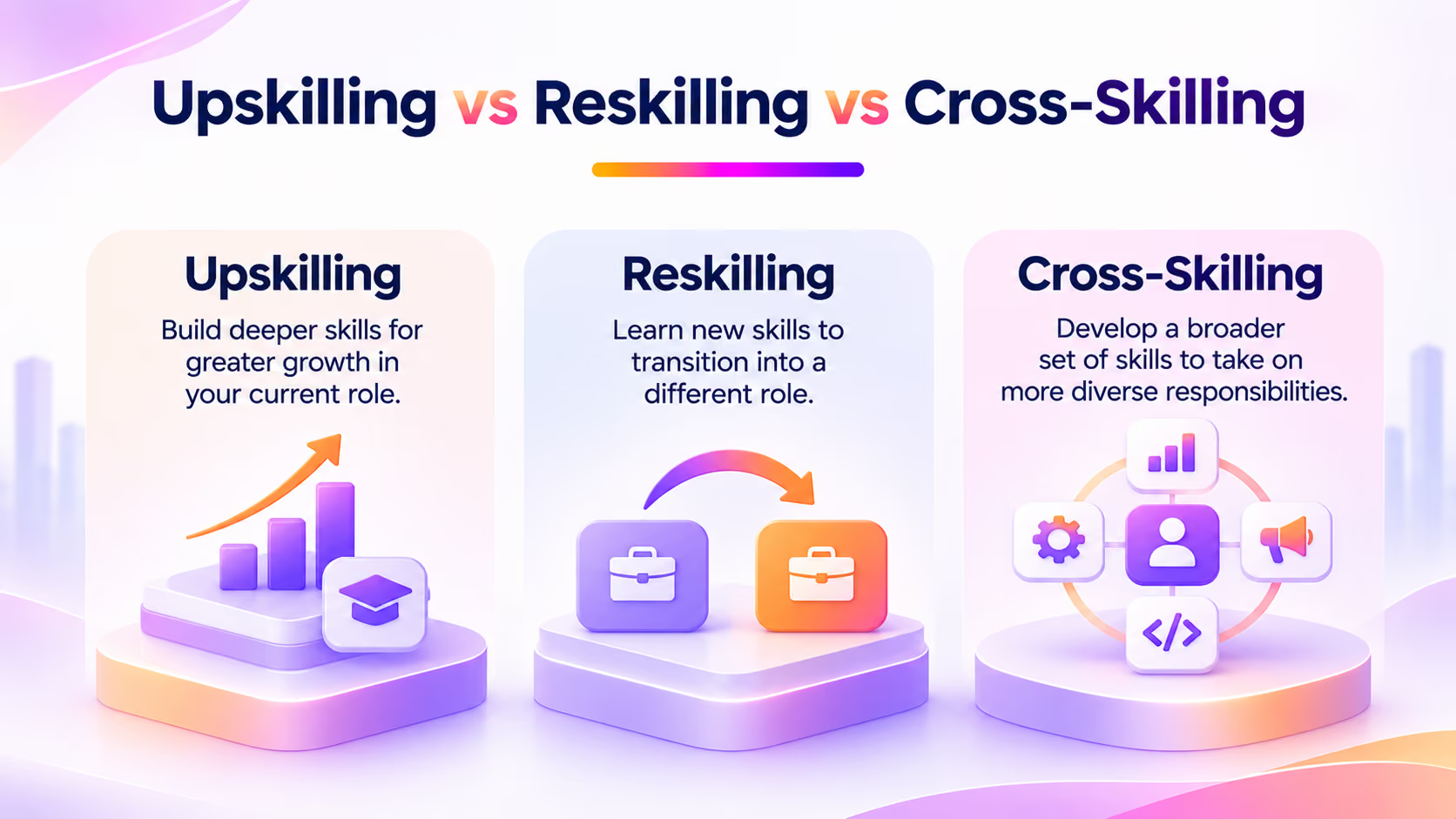
Upskilling builds deeper or newer skills for a person's current role. Reskilling teaches new skills so someone can move into a different role. Cross-skilling trains employees in skills from adjacent roles or functions so they can work flexibly across teams. The right choice depends on the business need.
[[toc]]
These three terms are often used interchangeably, which leads to learning programmes that do not match the problem they are meant to solve. A team that needs deeper expertise does not need the same programme as a team whose role is changing, or one that needs more flexible cover.
This guide is for HR leaders, L&D leaders and business managers. It explains the difference between upskilling, reskilling and cross-skilling, when to use each, examples by role and how learning paths support all three.
What is upskilling?
Upskilling is learning new or deeper skills to perform better in a current role, or to keep pace as that role changes. The employee stays in the same job family but becomes more capable in it.
Examples include a customer service agent learning to use a new support platform, a marketing executive learning data analysis, or an engineer learning a new version of a framework.
Use upskilling when the role is staying broadly the same but the skills it needs are growing or changing.
What is reskilling?
Reskilling is learning a different set of skills so an employee can move into a new role, often because the current role is changing significantly or is no longer needed in the same form.
Examples include a data entry specialist being trained as a data analyst, or an operations coordinator moving into a customer success role.
Use reskilling when roles are shifting and you want to redeploy people into new areas rather than hire externally.
What is cross-skilling?
Cross-skilling is training employees in skills from adjacent roles or functions, while they stay in their current role. It widens what a person can do and helps teams share work more flexibly.
Examples include a sales representative learning basic customer onboarding, or a support specialist learning to write knowledge-base content.
Use cross-skilling when you want more flexible teams, better cover for peaks and absences, or smoother handovers between functions.
Upskilling vs reskilling vs cross-skilling: key differences
- Upskilling: deepens or updates skills for the current role. The employee stays in the same role. Best when the role is evolving.
- Reskilling: builds a different skill set for a new role. The employee moves into a different role. Best when roles change or are redeployed.
- Cross-skilling: adds skills from nearby roles or functions. The employee keeps their role but can support other areas. Best for flexibility and cover.
A quick test: ask what happens to the employee's role after the learning. If it stays the same but improves, it is upskilling. If it changes, it is reskilling. If it stays the same but extends sideways, it is cross-skilling.
When should you use each approach?
- Choose upskilling when technology, tools or standards are changing the way a role is done, or when you want to prepare people for the next level in the same career path.
- Choose reskilling when a business shift creates demand for new roles and you would rather build those capabilities from within than hire for all of them.
- Choose cross-skilling when you want teams to cover each other, reduce bottlenecks on a few experts, or help people understand how adjacent functions work.
Most organisations use all three. The mix depends on strategy, role changes and the skills already available.
Examples by role
The examples below are illustrative.
- Sales: upskilling in consultative selling; cross-skilling in customer onboarding; reskilling a field sales executive into an inside sales or account management role.
- Customer support: upskilling on a new support platform and AI-assisted tools; cross-skilling in technical troubleshooting; reskilling into customer success.
- HR: upskilling in people analytics; cross-skilling in learning administration; reskilling a payroll specialist into an HR operations or analytics role.
- IT and engineering: upskilling on a new cloud platform; cross-skilling between development and operations practices; reskilling a support engineer into a security or data role.
- Finance: upskilling in data interpretation and automation tools; cross-skilling in business partnering; reskilling toward analytics-focused roles.
How do you decide which employees need which type of learning?
Start with the skills the business needs and the skills people have today. A simple sequence works:
- Identify the capabilities needed
- List the skills the business will need over the next 12 to 18 months.
- Assess current skills
- Use assessments, manager input and work evidence. A skills intelligence view can show where skills sit across the organisation.
- Find the gaps and the adjacencies
- Gaps within a role point to upskilling. Skills that sit close to a future role point to reskilling or cross-skilling.
- Match the learning approach to the need
- Assign upskilling, reskilling or cross-skilling paths by role and employee goals.
- Track progress and adjust
- Review whether gaps are closing and update plans as roles evolve.
For the full process behind this, see our guide on what talent development is and how competency mapping defines the skills each role needs.
How do learning paths support upskilling, reskilling and cross-skilling?
A learning path is a planned sequence of learning activities aimed at a specific capability. Paths make all three approaches practical:
- For upskilling: a path from the current proficiency level to the next one within the role.
- For reskilling: a longer path that combines foundation learning, practice and a transition into the new role.
- For cross-skilling: a shorter path covering the core of an adjacent function, with practice tasks that apply it.
Effective paths mix short modules, hands-on practice, manager coaching and an assessment that confirms the new skill. Learning delivered alongside real work usually sticks better than a stand-alone course.
How can technology support workforce skilling?
Managing three types of skilling across many roles gets difficult without a platform. Look for the ability to map content to skills and roles, assign learning paths, run assessments, personalise learning and report progress.
- Invince LMS supports competency management alongside learning delivery, assessments and reporting, so learning paths can be tied to the skills each role needs.
- Invince LXP offers personalised, role-based learning journeys that help employees find learning relevant to their goals.
- Craft helps L&D teams create learning content and assessments with generative AI, with subject experts reviewing the output.
- Plethora gives access to a curated library of more than 80,000 ready-to-use learning resources for common skills.
Common mistakes when planning skilling programmes
- Using one term for everything. Without a clear need, programmes are broad and hard to measure.
- Starting with courses, not business needs. Learning should follow the skills the business will need.
- Skipping practice. Courses alone rarely build lasting skill. Add projects and coaching.
- Ignoring employee goals. Reskilling and cross-skilling work better when employees see a clear benefit.
- Not measuring results. Track skill levels, role movement and business outcomes, not only completions.
Frequently asked questions about upskilling, reskilling and cross-skilling
What is upskilling?
Upskilling is learning new or deeper skills to perform better in a current role or keep pace as that role changes.
What is reskilling?
Reskilling is learning a different set of skills so an employee can move into a new role, often when the current role is changing significantly.
What is cross-skilling?
Cross-skilling is training employees in skills from adjacent roles or functions while they stay in their current role, so teams can work more flexibly.
What is the difference between upskilling and reskilling?
Upskilling improves skills within the same role. Reskilling builds new skills for a different role.
When should a company use cross-skilling?
Use it when you want teams to cover each other, reduce reliance on a few experts or improve collaboration between functions.
Conclusion: match the learning to the need
Upskilling, reskilling and cross-skilling are three tools for building workforce capability. Upskilling deepens current skills, reskilling prepares people for new roles and cross-skilling adds flexibility. Start from the business need, assess where your people are today and build learning paths to match.
Ready to build workforce capability with the right mix of skilling? Build workforce capability with Invince using role-based learning paths and competency management.
Our latest blogs
Ready to Revolutionize Learning at Your Organization?
Join 400+ enterprises using Invince to upskill, reskill, and retain top talent.
Ready to Revolutionize Learning at Your Organization?
Join 400+ enterprises using Invince to upskill, reskill, and retain top talent.

Ready to Revolutionize Learning at Your Organization?
Join 400+ enterprises using Invince to upskill, reskill, and retain top talent.