


Compliance Training LMS in 2027: 12 Essential Features for Certification Tracking and Audit-Ready Compliance
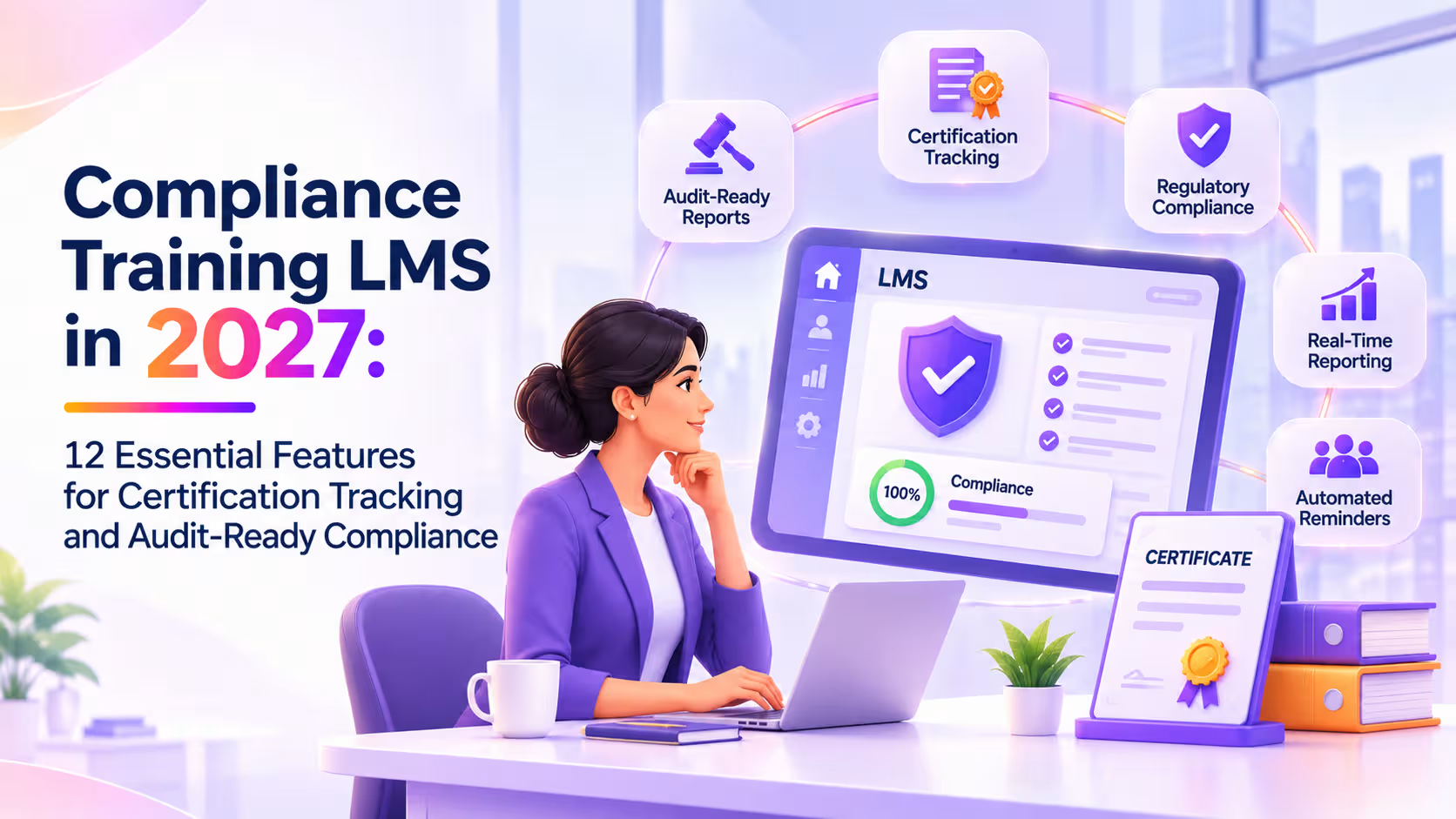
Every year, the same cycle repeats. Policies change, regulations are updated, certifications expire, auditors ask for evidence, and the compliance and L&D teams spend weeks chasing completions and pulling reports together from spreadsheets. In regulated industries such as financial services, healthcare, pharmaceuticals and manufacturing, a gap in that cycle is not just an admin problem. It is a regulatory, safety and reputational risk.
[[toc]]
It is also a top priority for HR. Capterra's 2026 review of compliance training software opens with the finding that 28% of HR leaders cite compliance as their top challenge this year. As organisations plan for 2027, more rules, more frequent updates and closer scrutiny will make manual compliance training harder to sustain.
This guide explains what a compliance training LMS is, why enterprises need automated compliance training in 2027, the 12 essential features to look for, how each feature maps to a business requirement, and how compliance training works in different industries. It is written for CHROs, CLOs, compliance heads, risk officers and L&D leaders.
Quick answer: what is a compliance training LMS? A compliance training LMS is a learning management system set up to deliver, track and prove mandatory training. It assigns compliance courses to the right people automatically, tracks completions, scores and certification expiry dates, sends reminders and manager escalations, and produces audit-ready records showing who was trained, on what, when and on which version of the content.
What is a compliance training LMS?
A compliance training LMS is a learning management system, or a set of features within one, that manages the full cycle of mandatory training: assignment, delivery, assessment, certification, renewal and reporting. It replaces spreadsheets, email reminders and paper sign-off sheets with one system of record.
Compliance training software typically covers:
- regulatory training, such as anti-money laundering, data protection, health and safety, good manufacturing practice or anti-bribery
- policy training, such as code of conduct, information security and anti-harassment
- role-specific certifications, such as equipment operation, clinical competencies or professional licences
The difference between a general LMS and an LMS for compliance training is proof. A compliance training LMS is built to show, at any moment and for any person, whether they are compliant, and to keep the evidence ready for an audit.
Why enterprises need automated compliance training in 2027
More rules, changing more often
Several major regulatory changes land in or around 2027, and each brings new procedures and training:
- the EU Anti-Money Laundering Regulation applies from 10 July 2027
- the core obligations of India's Digital Personal Data Protection Rules take effect in May 2027
- India's four labour codes, including the Occupational Safety, Health and Working Conditions Code, came into force on 21 November 2025, making 2027 the first full year under the new codes
- the EU Digital Operational Resilience Act already makes ICT security awareness and operational resilience training compulsory for staff and senior management in financial entities
Training must be ongoing, not one-off
Many standards expect continuous training rather than a single course. FATF Recommendation 18 expects AML/CFT programmes to include an ongoing employee training programme, and in pharmaceutical manufacturing, US rule 21 CFR 211.25 requires good manufacturing practice training on a continuing basis and with sufficient frequency.
Manual tracking does not scale
With thousands of employees, many roles, several regions and certificates that expire on different dates, spreadsheets and email reminders break down. The usual result is the familiar list of pitfalls of bad learning and development practices: wrong assignments, missed renewals, reminder fatigue, new joiners who start work untrained and audit scrambles.
Auditors want evidence, not estimates
Regulators, auditors and clients increasingly ask for detailed proof: who was required to complete what, by when, whether they did, with what score and on which content version. Only an automated system can produce that reliably, on demand.
AI raises the bar for speed
In 2027, AI makes it possible to turn a new regulation or policy into a short update module in days, translate it for every region and adapt refreshers to what each employee already knows. Organisations still running compliance training manually will fall further behind.
12 essential compliance training LMS features for 2027
- Rule-based automatic assignment. Assign courses by role, department, grade, location and business unit, using data synced from your HR system, so joiners, movers and leavers are handled without manual work.
- Certification and recertification tracking. Give every certificate a validity period, expiry date and renewal rule, with full history for each cycle.
- Automated reminders and escalations. Send notices before due dates and expiry dates, then escalate overdue training to managers and department heads.
- Retraining and re-enrolment workflows. Re-enrol employees automatically before certificates lapse or when a policy changes, and assign short update modules only to the affected roles.
- Assessments and proctored evaluation. Test understanding with scenario-based questions, pass marks and attempt limits, and use proctoring or invigilation for high-stakes certifications.
- Content version control. Keep a record of which version of a course each person completed, so you can show that training was updated after a regulatory change.
- Audit-ready records. Time-stamped completion, score and certificate records for every employee, retained for the period your regulators require.
- Compliance dashboards and analytics. Real-time views of compliance status, overdue training and upcoming expiries by team, site and region.
- Scheduled and exportable reports. Standard reports for compliance committees, internal audit and regulators, delivered on a schedule or exported on demand.
- Mobile, multilingual and offline access. Training that frontline, field and shift-based staff can complete on their phones, in their language, even with limited connectivity.
- Multi-entity and extended enterprise support. Separate spaces for business units, regions, contractors or partners, with central control and reporting.
- AI-assisted content updates. Generative AI that turns new regulations and policies into draft modules quickly, with expert review before publishing.
Compliance LMS features mapped to business requirements
Each feature below is linked to the business requirement it meets and the evidence it produces for compliance documentation.
- Rule-based automatic assignment: meets the requirement that the right people receive the right mandatory training, including new joiners and role changes. Evidence: assignment history by person, role and date.
- Certification and recertification tracking: keeps certifications valid and renewals on time. Evidence: certificate records with issue date, expiry date and renewal history.
- Automated reminders and escalations: gets training completed before deadlines without manual chasing. Evidence: reminder and escalation logs.
- Retraining and re-enrolment workflows: retrains staff when policies change or certificates near expiry. Evidence: re-enrolment records linked to the trigger.
- Assessments and proctored evaluation: lets employees prove understanding, not just attendance. Evidence: scores, attempts, pass/fail status and invigilation records.
- Content version control: keeps training in line with current regulations and policies. Evidence: a record of which version each person completed.
- Audit-ready records: provides proof of training on demand for auditors and regulators. Evidence: time-stamped completion and certificate records.
- Compliance dashboards and analytics: lets leaders see and act on compliance gaps early. Evidence: compliance status by team, site and region.
- Scheduled and exportable reports: gives committees, internal audit and regulators regular evidence. Evidence: standard compliance reports and exports.
- Mobile, multilingual and offline access: helps frontline and global teams complete training on time. Evidence: completion data across all locations and languages.
- Multi-entity and extended enterprise support: holds contractors, partners and business units to the same standards. Evidence: separate records per entity with central reporting.
- AI-assisted content updates: gets new rules to employees quickly after they change. Evidence: dated update modules and approval records.
Certification and recertification tracking
Certification tracking is the feature that most often separates a compliance training LMS from a basic course platform, because each certificate has its own clock. A strong set-up includes:
- validity periods per course, for example 12 months for an anti-money laundering refresher or 24 months for a lower-risk policy module, set from your compliance matrix
- automatic re-enrolment a set number of days before a certificate lapses, so employees have time to renew
- shorter recertification paths that focus on what has changed, plus an assessment, instead of repeating the full original course
- automatic status change on lapse, so anyone whose certificate expires shows as non-compliant on dashboards immediately
- complete history for every cycle, so you can show an unbroken record during an audit
Where appropriate, some organisations also link certification status to system access or customer-facing permissions, so a lapsed certificate is flagged before an employee handles higher-risk work. Agree this with HR, compliance and legal teams first.
Automated reminders and escalation
Reminders are only useful if they lead to action. A good employee compliance tracking workflow runs in stages:
- Assignment notice when the training is assigned, with the due date and a direct link.
- Reminders as the due date or certificate expiry approaches.
- Final notice on the due date.
- Manager escalation when training becomes overdue, with a view of the whole team's status.
- Senior escalation to the department or business head if it stays overdue.
Managers should be able to see overdue and upcoming items for their own team without asking L&D for a report. For a detailed example of reminders, escalations and renewals in a regulated sector, read our guide to banking compliance training in 2027.
Proctored assessments and evaluation
Completion alone does not prove that someone understands a rule or can apply it. Assessments close that gap, and for high-stakes certifications, proctoring adds confidence that the person who passed is the person who was certified.
What to look for:
- scenario-based questions that test judgement in realistic situations, not just recall of policy text
- pass marks, attempt limits and question banks so each attempt is fair and consistent
- proctored or invigilated assessments for certifications where the stakes are high, such as licences, safety-critical roles or regulated sales
- remediation paths that send people who fail back to the specific sections they missed
- results by role, team and region, so you can see where understanding is weak and improve the content
Assessment data also strengthens your audit trail: it shows not only that training happened, but that employees reached the required standard.
Audit-ready reports and compliance analytics
When an auditor, inspector or regulator asks about training, you should be able to answer in minutes, not weeks. Audit-ready training records cover:
- who was required to complete each course, and when it was assigned
- who completed it, on what date and with what score
- which version of the content they completed
- who is overdue or has a lapsed certification, and what escalation happened
- how quickly new joiners completed mandatory training
- how training was updated after a regulatory change or incident
Compliance analytics turns those records into decisions. Useful views include completion and overdue rates by business unit, site and region; certifications due in the next 30, 60 and 90 days; assessment results for high-risk topics; and trends over time. Schedule standard reports for the compliance committee and internal audit, and agree retention periods for training records with your legal team.
This is how an LMS supports compliance documentation, training completion and certification records together: one system of record that holds the assignment, the training, the assessment, the certificate and the report.
Industry-specific compliance training examples
Banking, financial services and insurance
Anti-money laundering, know your customer, sanctions, fraud, conduct, information security and data protection training, assigned by role and renewed on schedule. Key LMS needs: role-based assignment across branches, certification renewals, fast update modules when rules change and audit-ready records.
Healthcare and pharmaceuticals
Good manufacturing practice, SOP training, clinical competencies, patient safety and data privacy. Key LMS needs: SOP-linked retraining when procedures change, certification and CPD tracking, assessments that confirm understanding and inspection-ready training histories.
Manufacturing
Workplace safety, equipment operation, chemical handling, quality standards and contractor induction. Key LMS needs: plant-wise assignment, operator certifications, mobile and multilingual training on the shop floor, and consistent records across sites.
IT and technology services
Information security, data protection, client-specific security rules and vendor certifications. Key LMS needs: separate spaces for practices and client accounts, certification tracking and central reporting. See our guide to IT training management with a multi-domain LMS.
Retail
Food safety, health and safety, data protection and store policies for high-volume, often seasonal staff. Key LMS needs: fast onboarding, short mobile modules and store-wise compliance tracking.
For more on how these industries use an LMS, read our guide to the 5 industries that benefit most from a learning management system in 2027. Whatever the sector, local requirements differ, so confirm the training rules for each jurisdiction with your compliance and legal teams.
How to choose a compliance training LMS
Use these questions when comparing compliance training software:
- Can it assign training automatically from HR data, including joiners, movers and leavers?
- Does it manage certification expiry, renewal rules and re-enrolment automatically?
- Can it escalate overdue training to managers and senior leaders?
- Does it support assessments strong enough for your highest-risk certifications?
- Can it show which content version each person completed?
- Can it produce the reports your auditors and regulators ask for, on demand?
- Does it work on mobile, offline and in the languages your workforce speaks?
- Can it separate business units, regions or partners while keeping central reporting?
- How does it use AI to speed up content updates, and how is AI output reviewed?
For the most common traps to avoid once the platform is live, see our guide to why compliance training fails.
How Invince supports compliance training
Invince was awarded Silver in the 2025 Brandon Hall Group Excellence in Technology Awards, in the category Best Advance in Learning Management Technology for Compliance Training.
- Invince LMS (formerly UpsideLMS) is an AI-powered enterprise learning platform for onboarding, compliance, upskilling and workforce development. It automates compliance assignments, reminders and retraining cycles, includes certificate expiration notifications and certification expiration management, and provides escalation alerts, advanced reporting and real-time dashboards for audit readiness. Multilingual content, mobile learning and offline access help distributed and frontline teams stay compliant, and a multi-domain set-up supports business units, regions and partners with central reporting.
- Craft is a GenAI-powered multilingual course builder with support for more than 150 languages and over 25 ready-to-use instructional design templates, so new regulations and policies become short update modules quickly, with subject experts reviewing every output.
- Plethora is a curated library of more than 80,000 ready-to-use learning resources, including content for common compliance topics.
- Invince Catalyst is an AI-powered roleplay platform for every business role, currently open for early access, with compliance readiness scenarios where employees practise spotting risks, making decisions and handling incidents.
Frequently asked questions about compliance training LMS
What is a compliance training LMS?
A compliance training LMS is a learning management system that assigns, delivers, tracks and proves mandatory training. It manages certifications and renewals, sends reminders and escalations, and keeps audit-ready records of who was trained, on what, when and with what result.
What features should a compliance training LMS have?
The essential features are automatic rule-based assignment, certification and recertification tracking, automated reminders and escalations, retraining workflows, assessments with proctoring for high-stakes certifications, content version control, audit-ready records, dashboards, scheduled reports, mobile and multilingual access, multi-entity support and AI-assisted content updates.
What is the difference between compliance training software and a compliance management system?
Compliance training software focuses on the people side of compliance: training, assessments, certifications and training records. A compliance management system usually covers wider governance, such as policies, risk registers, controls and incidents. Many organisations connect the two, using the LMS as the system of record for training evidence.
How does an LMS help with audits?
An LMS keeps time-stamped records of assignments, completions, scores, certificates and content versions for every employee, and produces standard reports on demand. This lets compliance teams answer auditor questions in minutes instead of compiling data by hand.
How often should compliance training be renewed?
It depends on the topic, the role and the regulator. Many organisations renew high-risk training such as anti-money laundering every year and lower-risk policy training less often. Set renewal cycles in your compliance matrix and confirm them with your legal team for each jurisdiction.
How will AI change compliance training in 2027?
In 2027, AI helps turn new regulations into draft training modules quickly, translates them for global teams, adapts refreshers to what each employee already knows and flags teams at risk of missing deadlines. Expert review of AI-generated compliance content remains essential.
Conclusion: make compliance training provable, not just complete
In 2027, a compliance training LMS has to do more than deliver courses. It has to assign the right training automatically, keep every certification current, escalate gaps before they become findings, test real understanding and produce evidence on demand. Those are the 12 features that separate a compliance training LMS from a basic course platform.
Start by listing every recurring compliance course and certification your organisation tracks today, and where the records live. That list will show you which features matter most.
Which part of compliance training takes your team the most time today? Share it in the comments, or pass this guide to the person who owns your 2027 compliance calendar.
Ready to make compliance training audit-ready? Book an Invince LMS demo to see automated assignment, certification tracking, escalations and compliance reporting in action.
This article is for general information and is not legal advice. Check the requirements that apply to your organisation with your compliance and legal advisers.
Our latest blogs
Ready to Revolutionize Learning at Your Organization?
Join 400+ enterprises using Invince to upskill, reskill, and retain top talent.
Ready to Revolutionize Learning at Your Organization?
Join 400+ enterprises using Invince to upskill, reskill, and retain top talent.

Ready to Revolutionize Learning at Your Organization?
Join 400+ enterprises using Invince to upskill, reskill, and retain top talent.