


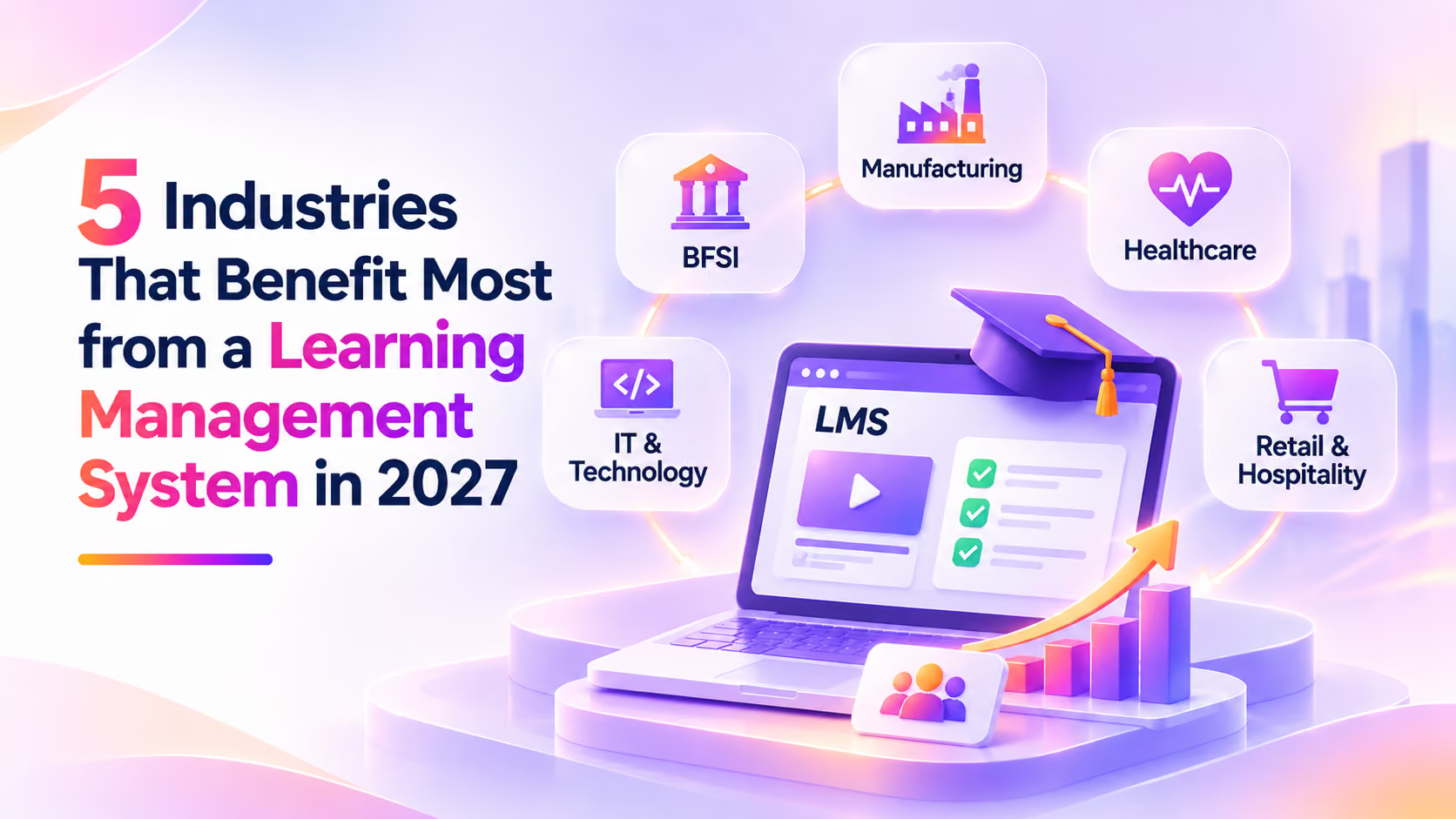
5 Industries That Benefit Most from a Learning Management System in 2027
Every large organisation trains its people. What changes from one industry to the next is why. A bank trains to stay compliant. A pharmaceutical plant trains to pass inspections. A factory trains to keep people safe. A retailer trains to get new store staff productive in days. An IT company trains to keep up with technology that changes every quarter.
[[toc]]
A learning management system (LMS) is the platform that makes this training manageable at scale. It assigns the right courses to the right people, delivers them on any device, tracks completions and certifications, and produces the reports leaders and auditors ask for. As organisations plan for 2027, the case for an LMS is getting stronger in every sector: the World Economic Forum's Future of Jobs Report 2025 found that 85% of employers plan to prioritise upskilling their workforce, and employers expect 39% of workers' core skills to change by 2030.
This guide looks at the five industries that benefit most from a learning management system in 2027, what each one uses it for, and what to look for when choosing an LMS for your industry. It is written for CHROs, CLOs, HR directors and L&D leaders in enterprise organisations.
Quick answer: which industries benefit most from a learning management system? The industries that benefit most from an LMS in 2027 are banking and financial services (BFSI), healthcare and pharmaceuticals, manufacturing, retail, and IT and technology services. They share three needs: large or distributed workforces, mandatory training with regulatory or safety consequences, and skills that change quickly. An LMS meets these needs by automating assignment, tracking certifications, delivering mobile and multilingual training, and keeping audit-ready records.
What a learning management system does for enterprises in 2027
Before looking at each industry, it helps to be clear about what an enterprise LMS actually does. At its core, a corporate learning management system:
- Assigns training automatically by role, department, location or grade, using data from your HR system.
- Delivers learning anywhere, on desktop and mobile, as e-learning, video, documents, live sessions or blended programmes.
- Tracks progress and certifications, including expiry dates and renewals.
- Sends reminders and escalations so mandatory training is completed on time.
- Reports on completion, assessment results and compliance status for managers, leaders and auditors.
- Scales across business units, regions and partners, often with separate portals or domains for different groups.
In 2027, AI adds a further layer. Generative AI helps teams turn policies and procedures into short courses quickly, adaptive learning lets experienced employees skip what they already know, and analytics show which teams are falling behind before deadlines are missed. The five industries below get the most value from these capabilities because their training is high-volume, high-stakes or fast-changing, and often all three.
1. Banking, financial services and insurance (BFSI)
Why BFSI needs an LMS: banks, insurers and NBFCs run some of the heaviest compliance training programmes of any industry. Anti-money laundering (AML), know your customer (KYC), sanctions, fraud, conduct, information security and data protection training must be assigned to the right roles, completed on time and renewed on schedule. International standards expect it: FATF Recommendation 18 calls for AML/CFT programmes to include an ongoing employee training programme.
What changes in 2027: new rules raise the bar. The EU Anti-Money Laundering Regulation applies from 10 July 2027, and the core obligations of India's Digital Personal Data Protection Rules take effect in May 2027. Both mean updated procedures and updated training.
How an LMS helps BFSI:
- role-based assignment of AML, KYC and conduct training across branches and regions
- certification tracking with expiry dates, automatic re-enrolment and renewal reminders
- manager escalations for overdue training
- audit-ready records showing who completed what, when and on which content version
- fast publication of short update modules when regulations change
Read more in our guide to banking compliance training in 2027.
2. Healthcare and pharmaceuticals
Why healthcare and pharma need an LMS: in healthcare and life sciences, training is part of patient safety and product quality. Clinical staff need ongoing competency and certification training. Pharmaceutical manufacturers face strict rules on training records: in the US, for example, 21 CFR 211.25 requires good manufacturing practice training to be given by qualified individuals on a continuing basis and with sufficient frequency so employees stay familiar with the requirements that apply to them.
What changes in 2027: clinical guidelines, standard operating procedures (SOPs) and quality rules change often, and inspectors expect training records to keep up. Teams also work in shifts across hospitals, labs and plants, which makes classroom-only training hard to schedule.
How an LMS helps healthcare and pharma:
- SOP-linked training, so a new SOP version triggers re-training for the affected roles
- certification and continuing professional development (CPD) tracking with expiry alerts
- assessments that confirm understanding, not just completion
- mobile and microlearning for shift-based staff
- complete, searchable training histories for inspections and audits
3. Manufacturing
Why manufacturing needs an LMS: factories depend on safety, quality and equipment training for large, often shift-based workforces across several plants. Many workers are on the shop floor, not at a desk, and training records matter for safety audits and quality certifications.
What changes in 2027: in India, all four labour codes, including the Occupational Safety, Health and Working Conditions Code, came into force on 21 November 2025, consolidating 29 older laws. Manufacturers are updating safety procedures, contractor processes and training records to match, and 2027 is the first full year of operating under the new codes.
How an LMS helps manufacturing:
- plant-wise and role-wise safety, quality and machine-operation training
- mobile and microlearning that workers can complete on the shop floor
- multilingual content for workforces that speak different languages
- certification tracking for equipment operators and safety-critical roles
- consistent records across plants for audits and certifications
4. Retail
Why retail needs an LMS: retailers hire at high volume, often seasonally, across many stores. New staff need to learn products, service standards, store processes and safety rules quickly, and head office needs every store to deliver the same customer experience.
What changes in 2027: product ranges, promotions and store processes change faster than ever, and store teams rarely have time for long training sessions. Training has to fit into a shift.
How an LMS helps retail:
- fast, standardised onboarding for new and seasonal staff
- short mobile modules on new products, promotions and processes
- store-wise and region-wise tracking so area managers can see who is ready
- compliance training on food safety, health and safety or data protection, where relevant
- consistent brand and service standards across every store
5. IT and technology services
Why IT companies need an LMS: IT organisations face constant change in tools, platforms and client requirements. They need to keep certifications current, onboard engineers quickly, train teams on client-specific processes and show clients and leaders who is skilled in what.
What changes in 2027: AI, cloud, data and security skills keep shifting. Among the fastest-growing skills in the Future of Jobs Report 2025 are AI and big data, networks and cybersecurity, and technology literacy. IT services firms also need separate training spaces for different practices and client accounts.
How an LMS helps IT and technology services:
- competency-based learning paths linked to skills gap analysis
- certification tracking for cloud, security and vendor certifications
- separate domains or portals for practices, business units and client accounts, with central reporting
- fast onboarding to client projects and internal tools
- reports that show skills coverage across teams
Read more in our guides to IT skills gap analysis and IT training management with a multi-domain LMS.
LMS benefits by industry at a glance
- BFSI: main training need is AML, KYC, conduct and data protection compliance. Most valuable LMS capability: role-based assignment, certification renewals and audit-ready records.
- Healthcare and pharma: main training need is clinical competency, SOP and GMP training. Most valuable LMS capability: SOP-linked re-training, CPD tracking and inspection-ready histories.
- Manufacturing: main training need is safety, quality and equipment training. Most valuable LMS capability: plant-wise assignment, mobile and multilingual delivery and operator certifications.
- Retail: main training need is onboarding, product and service training. Most valuable LMS capability: fast onboarding, short mobile modules and store-wise tracking.
- IT and technology services: main training need is technical upskilling and certifications. Most valuable LMS capability: competency-based paths, multi-domain management and skills reporting.
What all five industries have in common
Although the content differs, these industries share the same underlying challenges, and they are the same pitfalls of bad learning and development practices that show up in any large organisation:
- Scale: thousands of employees across sites, regions and sometimes partners.
- Mandatory training: courses that must be completed, recorded and renewed, with real consequences if they are not.
- Frequent change: regulations, procedures, products and technologies that change during the year.
- Proof: leaders, auditors, inspectors and clients who want evidence, not estimates.
That is why spreadsheets and email reminders stop working as organisations grow, and why an enterprise LMS becomes core infrastructure rather than a nice-to-have. For a wider view of compliance programmes, see our HR leader's toolkit for compliance training and our guide to why compliance training fails.
How to choose an LMS for your industry in 2027
Use these questions when you compare learning management systems:
- Can it assign training automatically from HR data by role, department, grade and location?
- Does it manage certifications with expiry dates, renewal rules and alerts?
- Can it report what auditors and regulators in your industry ask for, at the level of individual, team, site and region?
- Does it work on mobile for frontline, field and shift-based staff?
- Can it deliver content in the languages your workforce speaks?
- Can it separate business units, regions or partners while keeping central control and reporting?
- How does it use AI to create content, personalise learning and surface risks, and how is AI output reviewed?
- Is ready-made content available for common topics, so your team can focus on what is specific to your business?
How Invince supports learning across industries
The Invince AI-powered corporate learning ecosystem supports enterprises in BFSI, healthcare and pharma, manufacturing, retail and IT:
- Invince LMS (formerly UpsideLMS) is an AI-powered enterprise learning platform for onboarding, compliance, upskilling and workforce development. It includes certificate expiration notifications and certification expiration management, and supports a multi-domain set-up, so business units, regions or partners can each have their own space with central reporting. See our guide to why a multi-tenant LMS is essential for extended enterprise learning.
- Invince LXP is an AI-driven learning experience platform that delivers personalised, role-based and skills-focused learning journeys.
- Craft is a GenAI-powered multilingual course builder with support for more than 150 languages and over 25 ready-to-use instructional design templates, with subject experts reviewing every output.
- Plethora is a curated library of more than 80,000 ready-to-use learning resources for common topics.
- Invince Catalyst is an AI-powered roleplay platform for every business role, currently open for early access, where employees practise realistic conversations with AI personas in text or voice.
Frequently asked questions about learning management systems by industry
Which industries use learning management systems the most?
Learning management systems are used most heavily in industries with large workforces, mandatory training and fast-changing skills. These include banking and financial services, healthcare and pharmaceuticals, manufacturing, retail, and IT and technology services, as well as many other enterprise sectors.
What are the main benefits of an LMS for enterprises?
An LMS automates training assignment, delivers learning on any device, tracks completions and certifications, sends reminders, and produces reports for managers and auditors. This saves administration time, keeps mandatory training on schedule and gives leaders a clear view of workforce skills.
Why is an LMS important for compliance training?
Compliance training must be assigned to the right people, completed on time, renewed regularly and proven during audits. An LMS handles all four automatically, with certification tracking, reminders, escalations and time-stamped records.
What is the difference between an LMS and an LXP?
An LMS manages structured, assigned and mandatory training and records. An LXP focuses on personalised, skills-based learning journeys and discovery. Many enterprises use both: the LMS for compliance and core programmes, the LXP for development and upskilling.
How do I choose the right LMS for my industry?
Check whether it can assign training from HR data, manage certifications and renewals, report what your regulators and auditors require, work on mobile, deliver content in your workforce's languages and separate business units or partners with central reporting.
How will AI change learning management systems in 2027?
In 2027, AI helps create courses from existing documents, personalise learning paths, adapt refreshers to what each person already knows and flag teams at risk of missing deadlines. Human review of AI-generated content remains essential, especially for compliance topics.
Conclusion: the right LMS fits your industry's realities
Every industry trains for different reasons, but the industries that benefit most from a learning management system share the same pressures: scale, mandatory training, constant change and the need for proof. In 2027, an enterprise LMS that automates assignment, tracks certifications, delivers on mobile and in local languages, and keeps audit-ready records is a core part of how these organisations operate.
Start by listing the training your organisation must deliver and prove every year. Then compare platforms against the questions above.
Which industry challenge is hardest for your training team right now? Share it in the comments, or pass this guide to the person planning your 2027 learning technology.
Ready to see how an LMS fits your industry? Book an Invince LMS demo to see automated assignment, certification tracking and reporting in action.
Ready to Revolutionize Learning at Your Organization?
Join 400+ enterprises using Invince to upskill, reskill, and retain top talent.
Ready to Revolutionize Learning at Your Organization?
Join 400+ enterprises using Invince to upskill, reskill, and retain top talent.

Ready to Revolutionize Learning at Your Organization?
Join 400+ enterprises using Invince to upskill, reskill, and retain top talent.