

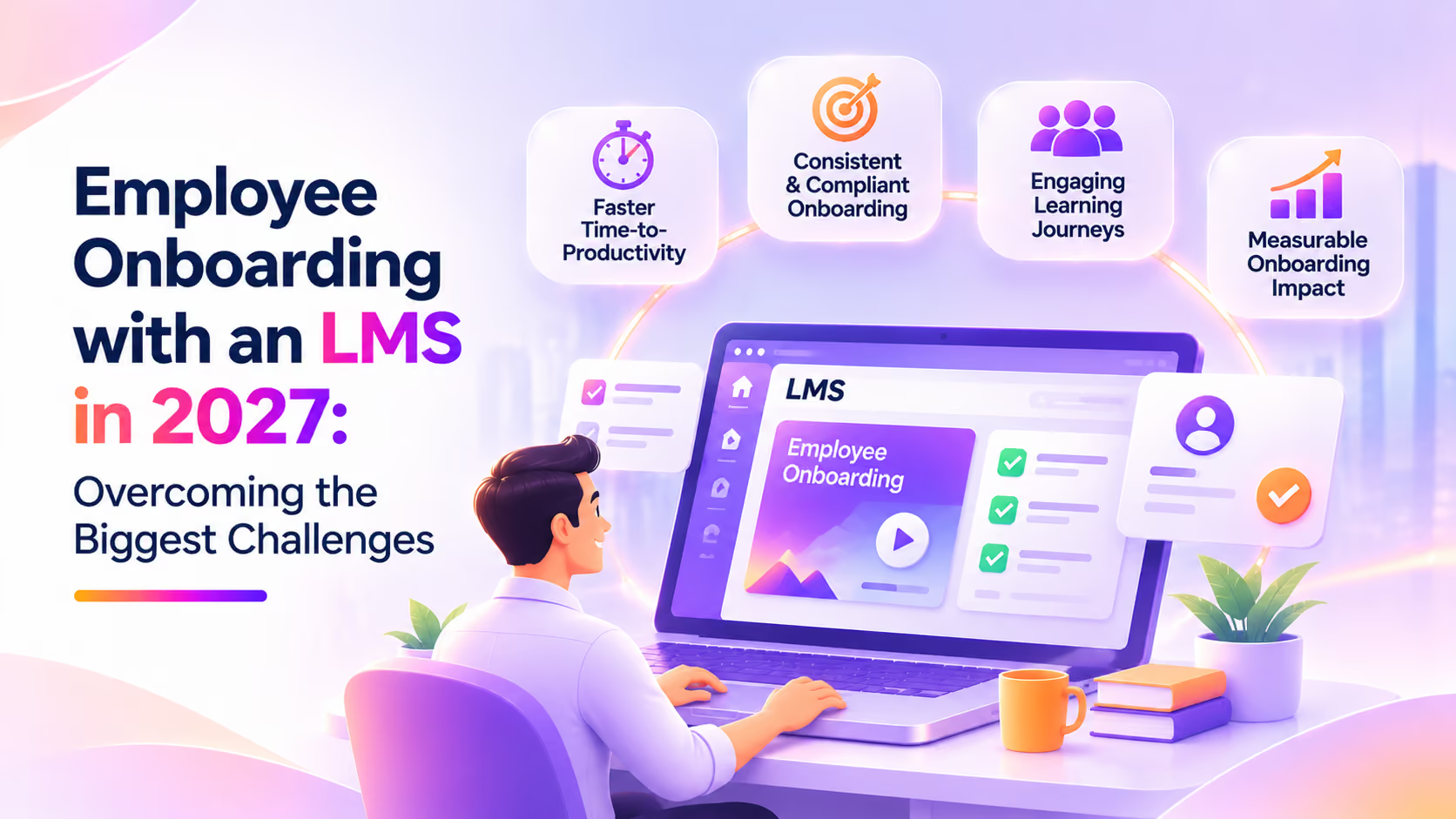
Employee Onboarding with an LMS in 2027: Overcoming the Biggest Challenges
A new hire's first weeks shape how they feel about the job, how quickly they become productive and whether they stay. Yet most organisations still find onboarding hard to get right. Gallup research found that only 12% of employees strongly agree their organisation does a great job of onboarding, and that after onboarding just 29% of new hires feel fully prepared and supported to excel in their new role.
[[toc]]
The problem is rarely a lack of effort. It is scale and consistency. New hires join on different days, in different locations and roles, often remotely, and each needs the right information at the right time. Spreadsheets, shared drives and email chains cannot keep up. A learning management system (LMS) can.
This guide explains the seven biggest employee onboarding challenges in 2027, how an employee onboarding LMS solves each one, how to build a 30-60-90 day onboarding plan in your LMS and which metrics to track. It is written for CHROs, HR directors, talent acquisition leaders and L&D teams.
Quick answer: how does an LMS improve employee onboarding? An LMS improves employee onboarding by giving every new hire the same up-to-date core content, assigning role-specific learning paths automatically, delivering training on any device and in local languages, tracking progress and compliance, and showing HR and managers who is on track. The result is faster time to productivity, consistent messaging and less manual work for HR.
7 employee onboarding challenges and how an LMS solves them
1. Inconsistent onboarding content
The challenge: new hires join on different days, and different HR team members or managers share different versions of the material. Some people see outdated policies; others miss key topics. The result is mixed messages about the organisation's goals, values and ways of working.
How an LMS solves it: store one approved version of core onboarding content in the LMS and assign it to every new hire. When something changes, update it once and everyone sees the current version. Version history shows who completed which version.
2. One-size-fits-all training
The challenge: a salesperson, an engineer and a branch operations officer need very different onboarding beyond the basics. Generic programmes waste time and leave role-specific gaps.
How an LMS solves it: combine a shared core path with role-based learning paths. Assignment rules can enrol each new hire in the right path automatically, using role, department, grade or location from your HR system.
3. No visibility into progress or readiness
The challenge: without data, HR and managers cannot tell whether a new hire has completed onboarding, understood it or is ready for live work.
How an LMS solves it: quizzes, assessments and completion tracking show who is on track and who needs help. Dashboards give managers a view of their new joiners, and reports highlight content that many people find difficult so it can be improved.
4. Compliance and policy training missed in the rush
The challenge: code of conduct, information security, data protection, anti-harassment and industry-specific compliance training often slips while new hires focus on their main tasks. In regulated industries, that is a real risk.
How an LMS solves it: make compliance modules part of the mandatory onboarding path, with due dates, reminders and manager escalations, and keep time-stamped records ready for audits. For a sector example, see our guide to banking compliance training in 2027.
5. Remote, hybrid and multi-location joiners
The challenge: classroom induction does not work when new hires join from different cities or countries, or work shifts and in the field.
How an LMS solves it: deliver onboarding online and on mobile, so people can start learning before day one and continue from anywhere. Combine self-paced modules with live virtual sessions for welcome talks and team introductions.
6. Multilingual workforces
The challenge: organisations working across India, the Middle East and Southeast Asia often hire people who learn best in different languages. Translating every update by hand is slow.
How an LMS solves it: host onboarding content in several languages and assign the right version automatically. AI-assisted course creation and translation, reviewed by local specialists, makes it practical to update every language at once. Our guide to integrating AI course creators into your LMS explains how.
7. High cost and slow time to productivity
The challenge: repeated classroom sessions, travel and trainer time add up for every intake, and new hires take months to reach full performance. Gallup notes that new employees typically take around 12 months to reach their full performance potential.
How an LMS solves it: reusable online modules cut repeat delivery costs, microlearning fits training into the working day, and role-based paths focus new hires on what they need first. Branded portals, welcome messages and your organisation's look and feel also help new hires feel part of the company from the start.
How to build a 30-60-90 day onboarding plan as an IDP in your LMS
A structured plan turns onboarding from a single induction day into a guided journey. The most effective way to run it is as an individual development plan (IDP) for each new hire: one personal plan that sets out what they need to learn, do and achieve in their first 90 days, which the new hire, their manager and HR can all see. Here is a simple structure you can set up in your LMS:
Before day one (pre-boarding)
- welcome message from leadership and the hiring manager
- company overview, mission and values
- practical information: first-day schedule, tools and who to contact
First 30 days: learn the organisation
- mandatory policies and compliance modules, with due dates
- products, services and customers
- core systems and tools training
- short quizzes to confirm understanding
Days 31–60: learn the role
- role-specific learning path, assigned automatically
- shadowing, practice tasks and manager check-ins logged in the LMS
- scenario-based assessments for key skills
Days 61–90: perform and grow
- advanced role content and first goals
- feedback survey on the onboarding experience
- extend the onboarding IDP into a longer-term development plan for the months ahead
Use the LMS to create each new hire's IDP from the joining date, assign the learning for each stage automatically, remind new hires and managers of what is due, and show HR who has completed each stage. Because the plan belongs to the individual, it can reflect their role, location and prior experience, and it carries on naturally into their ongoing development after onboarding ends.
Onboarding metrics to track in your LMS
- Completion rate of mandatory onboarding modules, and how many are completed on time
- Assessment scores for key topics and skills
- Time to productivity, as agreed with managers for each role
- New hire feedback on the onboarding experience
- Early attrition, such as leavers in the first 90 days, compared with previous intakes
Tracking these over several intakes shows which parts of the programme work and where to improve. Our guide to the 5 key LMS features that boost business ROI in 2027 shows how to link this data to business results.
Employee onboarding trends for 2027
- AI-generated onboarding content. Teams turn existing handbooks and SOPs into short modules quickly, with expert review.
- Personalised paths. Onboarding adapts to role, location and prior experience, so experienced hires skip what they already know.
- Practice before the real thing. AI roleplay lets new hires rehearse customer, sales or compliance conversations safely.
- Mobile-first and multilingual by default. Frontline and distributed workforces expect onboarding on their phones, in their language.
- Data-led improvement. HR teams use LMS data to compare intakes and fix weak points quickly.
These are also the answers to the most common pitfalls of bad learning and development practices in onboarding: inconsistency, information overload and no follow-up after the first week.
How Invince supports employee onboarding
The Invince AI-powered corporate learning ecosystem helps HR and L&D teams onboard new hires at scale:
- Invince LMS (formerly UpsideLMS) is an AI-powered enterprise learning platform for onboarding, compliance, upskilling and workforce development, where onboarding paths are assigned, tracked and reported on. It includes an Individual Development Plan (IDP) feature, so each new hire's 30-60-90 day onboarding can be set up as their own development plan. It supports a multi-domain set-up, so business units, regions or partners can each have their own onboarding space with central reporting.
- Craft is a GenAI-powered multilingual course builder with support for more than 150 languages and over 25 ready-to-use instructional design templates, so handbooks and SOPs become short onboarding modules quickly, with subject experts reviewing every output.
- Plethora is a curated library of more than 80,000 ready-to-use learning resources for common onboarding topics such as communication, workplace skills and tools.
- Invince Catalyst is an AI-powered roleplay platform for every business role, currently open for early access, where new hires can practise realistic conversations with AI personas in text or voice.
To see how onboarding needs differ by sector, read our guide to the 5 industries that benefit most from a learning management system in 2027.
Frequently asked questions about employee onboarding with an LMS
What is an employee onboarding LMS?
An employee onboarding LMS is a learning management system used to deliver, track and report on new hire training. It gives every new employee consistent core content, assigns role-specific learning paths and shows HR and managers who is on track.
What are the biggest challenges in employee onboarding?
The most common challenges are inconsistent content, one-size-fits-all training, no visibility into progress, missed compliance training, remote and multi-location joiners, multilingual workforces, and high costs with slow time to productivity.
How does an LMS improve the onboarding process?
An LMS automates assignment, delivers training on any device and in local languages, tracks completion and assessments, keeps compliance records and gives managers a clear view of each new hire's progress, so onboarding is faster, more consistent and easier to manage.
How long should employee onboarding last?
Many organisations use a 30-60-90 day plan, and some extend onboarding through the first year, because new hires take months to reach full performance. The right length depends on the role's complexity.
What is an individual development plan (IDP) in onboarding?
An individual development plan (IDP) is a personal plan that sets out the learning, tasks and goals for one employee. In onboarding, an IDP turns the 30-60-90 day plan into a tailored roadmap for each new hire, shared with their manager and HR, and it continues into their ongoing development once onboarding ends.
What should be included in an onboarding programme?
Include pre-boarding information, company mission and values, policies and compliance training, systems and tools training, a role-specific learning path, practice tasks, manager check-ins, assessments and a feedback survey.
How will AI change employee onboarding in 2027?
In 2027, AI helps create onboarding content from existing documents, personalises paths by role and experience, translates content for multilingual teams and lets new hires practise real conversations through AI roleplay, with human review of content still essential.
Conclusion: make every new hire's start count
Onboarding is your first chance to deliver on the promises made during hiring. An employee onboarding LMS helps you do that consistently, for every new hire, in every role, location and language. In 2027, with AI-assisted content, personalised paths and clear data, there is no reason for onboarding to depend on spreadsheets and luck.
Start by mapping your current onboarding against the seven challenges above. Pick the two that cost you most, and fix those first in your LMS.
Which onboarding challenge is hardest for your team right now? Share it in the comments, or pass this guide to the person who owns your new hire experience.
Ready to improve employee onboarding in 2027? Book an Invince LMS demo to see onboarding paths, tracking and reporting in action.
Ready to Revolutionize Learning at Your Organization?
Join 400+ enterprises using Invince to upskill, reskill, and retain top talent.
Ready to Revolutionize Learning at Your Organization?
Join 400+ enterprises using Invince to upskill, reskill, and retain top talent.

Ready to Revolutionize Learning at Your Organization?
Join 400+ enterprises using Invince to upskill, reskill, and retain top talent.