


What Is an LXP and Why Do You Need One in 2027?
Most organisations already have a learning management system (LMS). It assigns mandatory training, tracks compliance and keeps records. But ask employees where they go to build the skills for their next role, and many will say a search engine, a video site or a colleague. Ask leaders which skills the workforce has today, and the data is often scattered or missing.
[[toc]]
That gap is what a learning experience platform (LXP) is designed to close. The need is growing: in the World Economic Forum's Future of Jobs Report 2025, employers expect 39% of workers' core skills to change by 2030, and 63% named skills gaps as the biggest barrier to business transformation. Keeping up requires learning that is personal, continuous and tied to skills, not just courses assigned once a year.
This guide explains what an LXP is, how it differs from an LMS, why organisations need one in 2027, the features to look for and how an LXP works alongside your LMS. It is written for CHROs, CLOs, L&D leaders and talent development heads.
Quick answer: what is an LXP? A learning experience platform (LXP) is AI-driven learning software that personalises learning for each employee. It brings content from many sources into one place, recommends what each person should learn next based on their role, skills and goals, and helps organisations track skill development across the workforce. An LMS manages assigned and mandatory training; an LXP drives self-directed, skills-based development. Many enterprises use both.
What is an LXP?
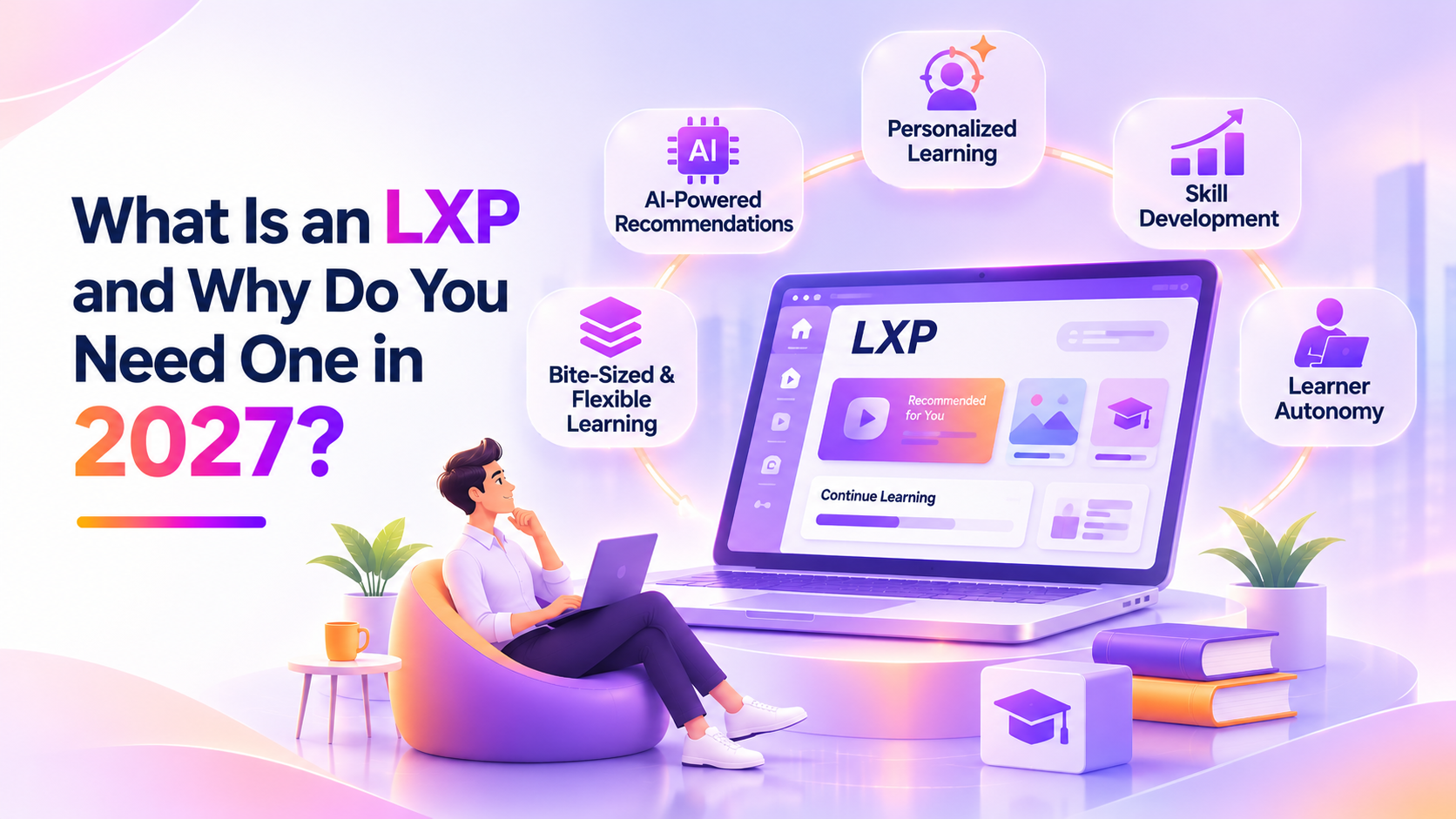
A learning experience platform (LXP) is a learner-centred platform that helps employees discover, follow and track learning that fits their role and ambitions. Where an LMS is built around courses and administration, an LXP is built around the learner and their skills.
A modern LXP typically:
- brings internal and external content into one searchable catalogue
- recommends content based on role, skill gaps, learning history and career goals
- creates personalised learning journeys automatically
- maps learning to a skills framework, so progress shows up as skills gained, not just courses completed
- gives managers and leaders a view of team and organisation-wide skills
- works on mobile and supports social and collaborative learning
In 2027, the best LXPs are skills-first: every recommendation, journey and report connects back to a defined set of skills and proficiency levels.
LXP vs LMS: what is the difference?
- Main purpose: an LMS manages, assigns and tracks training. An LXP helps employees discover learning and build skills.
- Who drives it: in an LMS, L&D and managers decide what people learn. In an LXP, learners drive much of their own development, guided by AI recommendations and manager input.
- Typical use: an LMS is best for compliance, onboarding, certifications and mandatory programmes. An LXP is best for upskilling, reskilling, career development and continuous learning.
- Content: an LMS mainly hosts courses that L&D uploads. An LXP brings together internal content, external libraries and user-shared resources.
- Measurement: an LMS reports completions, scores and compliance status. An LXP reports skills, proficiency, gaps and readiness for roles.
- Experience: an LMS is often structured and administrator-led. An LXP feels closer to a consumer app, with personalised feeds, search and recommendations.
An LXP is not a replacement for an LMS. Compliance, onboarding and certifications still need structured assignment, deadlines and audit-ready records. The two platforms do different jobs, and they work best together.
Why you need an LXP in 2027
Skills are changing faster than course catalogues
Technology, AI adoption and new regulations are reshaping roles every year. An annual training calendar cannot keep pace. An LXP updates each person's recommendations as their role, skills and goals change.
Content is everywhere, but hard to find
Most organisations have content spread across an LMS, external libraries, internal documents and videos. Employees give up when they cannot find what they need. An LXP brings it into one place with search and recommendations, so existing content investments are actually used.
Leaders need skills data, not just completion data
Boards and CHROs increasingly ask which critical skills the workforce has and where the gaps are. Completion reports cannot answer that. A skills-first LXP maps learning to skills and proficiency, so leaders can see readiness for roles and plan accordingly.
Our guide to IT skills gap analysis shows how this works for technology teams.
Employees want visible career paths
People are more likely to engage with learning, and to stay, when they can see how it leads to their next role. An LXP connects learning to career goals and shows each employee what they need to develop to get there.
AI makes personalisation practical at scale
In 2027, AI can tag content to skills automatically, analyse each person's gaps and generate personalised journeys for every employee, something no L&D team could do by hand.
Signs your organisation needs an LXP
- employees say they cannot find relevant learning, or rely on external searches
- you own large content libraries that few people use
- leadership asks for skills data that your LMS cannot provide
- upskilling and reskilling programmes are generic rather than personal
- internal mobility is low because people cannot see paths to other roles
- managers have little visibility into their team's skills
If three or more apply, an LXP is likely to add real value. These are also common pitfalls of bad learning and development practices: plenty of activity, little visible capability.
Key LXP features to look for in 2027
- A skills framework (taxonomy). A structured set of skills and proficiency levels linked to job roles, which you can adapt to your organisation. Without it, recommendations and reports have nothing to anchor to.
- AI content tagging. New content is mapped to skills automatically when it enters the platform, so it can be recommended straight away.
- Skill gap analysis. Each employee's current skills are compared with the requirements of their role and career goals, and the gaps update as they learn.
- Personalised recommendations and journeys. A feed and learning paths built for each person from their role, gaps, history and aspirations.
- A skills profile for every learner. A record of skills, proficiency and supporting evidence that employees and managers can see.
- Manager tools. Team views of skills and progress, and the ability to validate skills and guide development.
- Leadership analytics. Organisation-wide views of skill gaps and readiness by team, role and region.
- Engaging, mobile-friendly experience. Search, recommendations, social sharing and mobile access, so learning fits into the working day.
- Integrations. Connections to HR systems, your LMS, content libraries and single sign-on.
How an LXP and LMS work together
The strongest set-up in 2027 is not LMS or LXP, but LMS and LXP:
- the LMS handles assigned training: compliance, onboarding, certifications, instructor-led programmes and audit-ready records
- the LXP handles development: skills, personalised journeys, career paths and skills analytics
- shared data means completions in the LMS count towards skills in the LXP, and learners see one connected experience
For example, a new hire completes mandatory onboarding in the LMS, guided by an individual development plan. Once onboarding ends, the LXP takes over with a personalised journey towards their next role.
Our guide to employee onboarding with an LMS in 2027 covers that first stage.
How to get started with an LXP
- Define your goals. Decide what the LXP must achieve: faster upskilling, better internal mobility, skills visibility or higher engagement.
- Agree your skills framework. Start from a ready-made taxonomy where possible, then adapt it to your roles.
- Connect your systems and content. Link HR data, your LMS and content libraries so the LXP starts with current information.
- Pilot with a few teams. Choose teams with clear skills needs, involve their managers and gather feedback.
- Measure skills, not just activity. Track skill gaps closed, readiness for roles and internal moves, alongside engagement.
How Invince LXP helps
Invince LXP is an AI-driven learning experience platform that delivers personalised, role-based and skills-focused learning journeys. It is built skills-first:
- a pre-built skills taxonomy that links skills, proficiency levels and job roles, which administrators can configure and extend
- Invince Neura, the AI engine underneath, which tags new content to skills on arrival, runs continuous skill gap analysis and generates personalised learning journeys
- a skills passport for each learner, with proficiency levels and supporting evidence
- manager tools to view team skills, validate skill claims and approve learning journeys
- organisation-wide skill gap and readiness reporting for L&D and HR leaders
- integration with HR systems and single sign-on, and data sharing with Invince LMS (formerly UpsideLMS), so structured training and skills development form one connected experience
Content can come from Craft, a GenAI-powered multilingual course builder with support for more than 150 languages, and Plethora, a curated library of more than 80,000 ready-to-use learning resources.
For a full walkthrough of the platform, read Invince LXP: the skills-first learning experience platform, powered by AI.
Frequently asked questions about LXPs
What is an LXP in simple terms?
An LXP, or learning experience platform, is software that personalises learning for each employee. It brings content together in one place, recommends what to learn next and tracks how people build skills over time.
What is the difference between an LXP and an LMS?
An LMS manages assigned training such as compliance, onboarding and certifications, and keeps records. An LXP focuses on self-directed, skills-based development with personalised recommendations and career paths. Many organisations use both.
Do I need an LXP if I already have an LMS?
If your goal is only compliance and mandatory training, an LMS may be enough. If you also need upskilling, skills data, career development and better use of content, an LXP adds capabilities an LMS was not designed for.
What are the main benefits of an LXP?
The main benefits are personalised learning at scale, better use of existing content, visible skills and gaps across the workforce, clearer career paths for employees and stronger engagement with learning.
What is a skills-first LXP?
A skills-first LXP organises everything around a skills framework. Content, recommendations, learning journeys and reports all map to defined skills and proficiency levels, so organisations can measure capability rather than just activity.
How does AI improve an LXP in 2027?
AI tags content to skills automatically, analyses each employee's skill gaps, generates personalised learning journeys and answers learners' questions in natural language, making personalisation practical for every employee rather than a few.
Conclusion: from training activity to workforce capability
An LMS keeps your organisation compliant and organised. An LXP helps your people grow. In 2027, with skills changing quickly and leaders asking for capability data, the organisations that move ahead will be those that use both: an LMS for structured training and a skills-first LXP for continuous, personalised development.
Start by asking three questions: can our employees find the learning they need, can our leaders see our workforce's skills, and can our people see a path to their next role? If the answer to any is no, it is time to look at an LXP.
What is the biggest gap in your current learning platform? Share it in the comments, or pass this guide to the person planning your 2027 learning technology.
Ready to see a skills-first LXP in action? Explore Invince LXP or book a demo.
Ready to Revolutionize Learning at Your Organization?
Join 400+ enterprises using Invince to upskill, reskill, and retain top talent.
Ready to Revolutionize Learning at Your Organization?
Join 400+ enterprises using Invince to upskill, reskill, and retain top talent.

Ready to Revolutionize Learning at Your Organization?
Join 400+ enterprises using Invince to upskill, reskill, and retain top talent.