


The Smartest Way to Scale in 2027: Integrating AI Course Creators into Your LMS
A new product launches next month. Compliance has issued an updated policy. A region needs onboarding in three languages. And the L&D team has the same two instructional designers it had last year. For most organisations, the bottleneck in corporate training is not the learning platform. It is the time it takes to create the content that goes into it.
[[toc]]
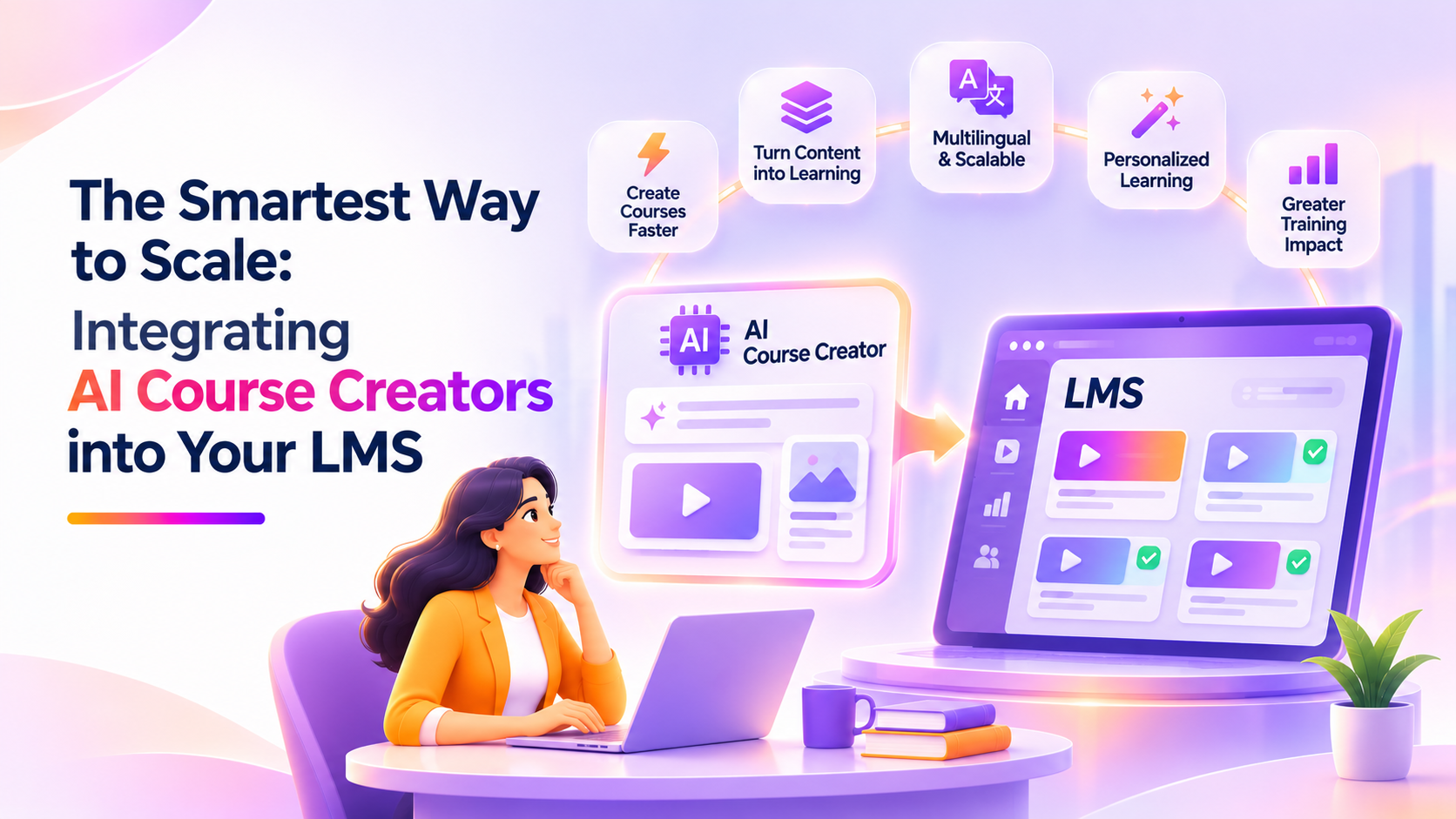
That is why AI course creators have become one of the most practical tools in corporate learning. Generative AI can turn existing documents, policies and expert knowledge into draft courses, quizzes and summaries in a fraction of the time manual authoring takes. The real gain, though, comes when the AI course creator and the learning management system (LMS) work as one process, so content moves from idea to draft, review, publication and tracking without being rebuilt along the way.
This guide explains how to integrate an AI course creator with your LMS in 2027, what the integration should cover, how to keep quality and compliance under control, and what to look for in the tools you choose. It is written for CLOs, L&D heads, HR directors and learning technology leaders.
Quick answer: what is the smartest way to scale corporate training in 2027? Pair an AI course creator with your LMS in one connected workflow. Subject experts provide source material, the AI course creator drafts courses, quizzes and translations, experts review and approve them, and the approved courses are published to the LMS, where they are assigned, tracked and reported on. This cuts content development time, keeps quality under human control and lets a small L&D team support a large, multilingual workforce.
The content bottleneck in corporate learning
Most L&D teams face the same pressures going into 2027:
- More topics, more often. New products, policies, regulations and tools all need training, and they change during the year.
- More audiences. Different roles, regions and languages need versions of the same content.
- Small teams. Instructional design capacity rarely grows as fast as demand.
- Disconnected tools. Content is built in one tool, exported, uploaded to the LMS and fixed again when something changes, with versions drifting in between.
The skills pressure behind this is real. In the World Economic Forum's Future of Jobs Report 2025, 85% of employers said they plan to prioritise upskilling their workforce. Delivering that upskilling at scale is, first of all, a content production problem.
What an AI course creator does
An AI course creator (sometimes called an AI course builder or AI authoring tool) uses generative AI to produce learning content from inputs you provide. Typical capabilities include:
- turning documents, SOPs, policies, presentations or topic outlines into a structured course draft
- generating quizzes, knowledge checks and summaries
- producing short microlearning modules for mobile learners
- translating and localising content into other languages
- applying instructional design templates so courses follow a consistent structure
What it does not replace is expertise. The AI drafts; subject experts and instructional designers check accuracy, context and tone, and approve what goes live.
What integrating an AI course creator with your LMS means
Integration means the AI course creator and the LMS work as one pipeline rather than two separate tools. In practice, a well-integrated set-up covers four things:
- Packaging. Courses are produced in formats the LMS can run and track, typically industry standards such as SCORM, xAPI or cmi5, so completions and scores are recorded correctly.
- Publishing. Approved courses move into the LMS with as little manual re-work as possible, with titles, descriptions and categories intact.
- Versioning. When a course is updated, the new version replaces the old one in the LMS without breaking assignments or records, and the change history is kept.
- Tracking. Once live, the course is assigned, completed and reported on in the LMS like any other, so the data feeds back into what you create next.
The tighter these four steps are, the faster you can respond to change and the fewer errors creep in between tools.
Why integrating an AI course creator with your LMS is the smartest way to scale
1. Faster time from need to live course
When the AI drafts the first version and the LMS is ready to receive it, a course can move from source document to learners in days rather than weeks. That matters most for urgent needs: a policy change, a product launch or a new regulation.
2. More content without a bigger team
AI handles the repetitive parts of authoring, such as structuring modules, writing first-draft questions and producing summaries. Instructional designers and subject experts spend their time on review, judgement and the parts that need human insight.
3. Multilingual training at the same time, everywhere
For organisations working across India, the Middle East, Southeast Asia and beyond, AI-assisted translation means one update can reach every region together, reviewed by local specialists, instead of trickling out language by language.
4. Content that stays current
When procedures or regulations change, the source document is updated, the AI regenerates the affected sections, experts approve the change and the new version replaces the old one in the LMS. Learners always see the current version, and records show who completed which one.
5. Data that improves the next course
LMS reports on completion, assessment scores and drop-off points show which modules work and which need revision. Feeding those findings back into the AI course creator closes the loop between creation and results.
Keep quality and compliance under human control
AI-generated content must be accurate, appropriate and approved, especially for compliance, safety and customer-facing topics. Build these controls into your workflow:
- Expert review before publishing. No AI-generated course goes live without sign-off from a named subject expert.
- Approved source material only. Generate from current, approved documents, not from open-ended prompts.
- Version history. Keep a record of which version was approved, by whom and when.
- Clear rules for sensitive topics. Decide which topics, such as legal or regulatory training, need extra review.
- Data protection. Check what data the AI tool processes and where, in line with your organisation's policies.
AI literacy matters here too. Regulators increasingly expect people who work with AI to understand it, and the Reserve Bank of India's FREE-AI framework, for example, recommends AI training for boards, senior management and staff in financial institutions. The teams using AI course creators should know how the tools work and where they can go wrong.
Example workflow: onboarding three teams in three languages
Illustrative example: a growing company needs onboarding for new sales, support and operations hires in English, Hindi and Arabic within a month.
- Each team lead shares existing onboarding documents and a topic outline.
- The AI course creator drafts a short onboarding path for each role, with quizzes and summaries, using a standard template.
- Team leads and HR review and correct the drafts.
- The approved courses are translated with AI assistance and checked by native-speaking reviewers.
- The courses are published to the LMS and assigned automatically to new joiners by role and location.
- After the first intake, LMS reports show where learners struggled, and those sections are revised for the next group.
Checklist: what to look for in an AI course creator for your LMS
- output in formats your LMS supports, such as SCORM, xAPI or cmi5
- a clear path from approved course to published course in the LMS, with minimal re-work
- version control and update handling that preserves learner records
- built-in review and approval steps
- multilingual creation and translation
- instructional design templates for consistent structure
- mobile-friendly microlearning formats
- clear data protection and security terms
Common mistakes to avoid
- Publishing without review. Speed is wasted if inaccurate content reaches learners.
- Treating AI output as finished. Drafts need context, examples and tone that fit your organisation.
- Ignoring the LMS side. If courses cannot be tracked properly, you lose the data that proves impact.
- Creating more content instead of better content. Use LMS data to decide what to build, update or retire.
These are common pitfalls of bad learning and development practices, and the fix is the same each time: clear ownership, expert review and a connected workflow.
How Invince supports AI course creation and delivery
The Invince AI-powered corporate learning ecosystem brings content creation and delivery together:
- Craft is a GenAI-powered multilingual course builder with support for more than 150 languages and over 25 ready-to-use instructional design templates. Teams can turn documents, policies and expert knowledge into short modules quickly, with subject experts reviewing every output.
- Invince LMS (formerly UpsideLMS) is an AI-powered enterprise learning platform for onboarding, compliance, upskilling and workforce development, where courses are assigned, tracked and reported on.
- Plethora is a curated library of more than 80,000 ready-to-use learning resources, so your team can create custom content only where it adds the most value.
To see which platform features turn faster content into measurable results, read our guide to the 5 key LMS features that boost business ROI in 2027. For a sector example, see how banking compliance training uses fast update modules when regulations change.
Frequently asked questions about AI course creators and LMS integration
What is an AI course creator?
An AI course creator is a tool that uses generative AI to produce learning content, such as course drafts, quizzes, summaries and translations, from documents, outlines or expert input. Experts then review and approve the content before it is published.
Can AI create e-learning courses for corporate training?
Yes. AI can draft complete course structures, microlearning modules and assessments from existing material. For corporate use, every course should be reviewed by a subject expert for accuracy, context and compliance before learners see it.
How do you integrate an AI course creator with an LMS?
Make sure the AI tool produces courses in formats your LMS supports, such as SCORM, xAPI or cmi5, agree a review and approval step, and set up a publishing and versioning process so updated courses replace old ones without losing learner records.
What are the benefits of using an AI course creator with an LMS?
The main benefits are faster course creation, more content without a larger team, multilingual training released at the same time everywhere, easier updates when policies change and LMS data that shows which content works.
Is AI-generated training content reliable?
It can be, when it is generated from approved source material and reviewed by experts before publishing. Treat AI output as a draft, keep version history and add extra review for legal, regulatory and safety topics.
How will AI course creation change in 2027?
In 2027, expect faster generation from more source types, better multilingual output, tighter links between authoring tools and LMS platforms, and more use of learner data to decide what to create or update, with human review still at the centre.
Conclusion: scale with a connected workflow, not just a faster tool
An AI course creator on its own makes content faster. Integrated with your LMS, it changes how your whole training operation works: source material becomes reviewed courses quickly, courses reach every role and language together, updates replace old versions cleanly, and LMS data shows what to improve next.
Start with one high-demand programme, such as onboarding or a frequently updated policy. Map the workflow from source document to LMS report, add expert review at the right step, and measure how much time you save.
Which training programme takes your team longest to create today? Share it in the comments, or pass this guide to the person planning your 2027 content roadmap.
Ready to scale content creation and delivery together? Explore Craft, or book an Invince LMS demo to see how courses are assigned, tracked and reported on.
Ready to Revolutionize Learning at Your Organization?
Join 400+ enterprises using Invince to upskill, reskill, and retain top talent.
Ready to Revolutionize Learning at Your Organization?
Join 400+ enterprises using Invince to upskill, reskill, and retain top talent.

Ready to Revolutionize Learning at Your Organization?
Join 400+ enterprises using Invince to upskill, reskill, and retain top talent.