


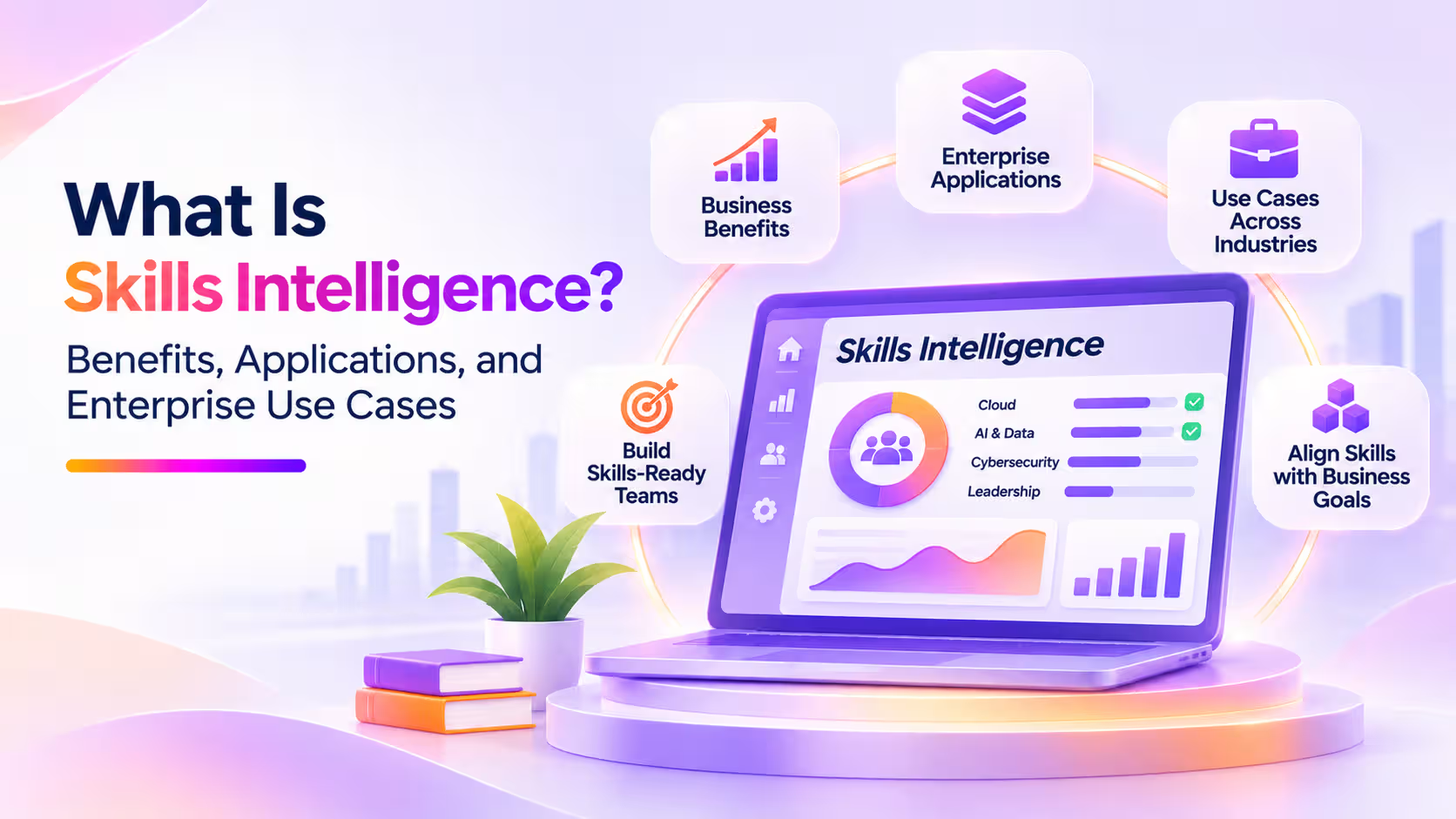
What Is Skills Intelligence? Benefits, Applications, and Enterprise Use Cases
Ask most leadership teams which skills their workforce has today, which ones it will need next year and where the biggest gaps are, and the answers are usually estimates. Job titles, CVs from hiring, scattered training records and manager opinion rarely add up to a reliable picture. Yet skills are now the currency of workforce decisions: who to hire, who to develop, who to move into a new role and where to invest in learning.
[[toc]]
The pressure to get this right is growing. In the World Economic Forum's Future of Jobs Report 2025, employers expect 39% of workers' core skills to change by 2030, and 63% see skills gaps as a major barrier to business transformation, the most-cited barrier in the survey. Organisations cannot close gaps they cannot see.
That is the problem skills intelligence solves. This guide explains what skills intelligence is, how it works, its benefits and applications, and how enterprises are using it as they plan for 2027. It is written for CHROs, CLOs, talent leaders and L&D heads.
Quick answer: what is skills intelligence? Skills intelligence is the continuous, data-driven understanding of the skills an organisation has, the skills it needs and the gaps between them. It combines a skills taxonomy, AI that infers and validates skills from learning, work and assessment data, and analytics that show skills gaps and readiness by person, team and role. Organisations use it to personalise learning, plan the workforce, fill roles internally and measure capability.
What is skills intelligence?
Skills intelligence turns skills from a vague idea into structured, measurable data. Instead of relying on job titles or annual surveys, it keeps an up-to-date view of:
- what skills each employee has, at what proficiency level and with what evidence
- what skills each role requires, now and in the future
- where the gaps are, for individuals, teams and the whole organisation
- how those gaps are changing as people learn and move roles, and as business needs shift
The word intelligence matters. Skills intelligence is not a static skills inventory or a one-off audit. It updates continuously and is designed to drive decisions, from what an employee should learn next to which business units face the greatest skills risk.
How skills intelligence works
Most skills intelligence systems follow the same five steps:
- Define a skills taxonomy. A structured list of skills and proficiency levels, linked to job roles. Most organisations start from a ready-made taxonomy and adapt it rather than build one from scratch.
- Map skills to roles. Each role is given the skills it needs and the proficiency required for each.
- Capture skills evidence. Data comes from learning completions, assessments, self-assessments, manager validation, projects and certifications. AI can infer likely skills from this activity and tag learning content to the skills it builds.
- Analyse gaps. The system compares each person's current skills with their role and career goals, and rolls this up to teams and the organisation.
- Act and update. Gaps drive personalised learning, development plans, internal moves and hiring decisions. As people learn and are validated, the picture updates automatically.
Skills intelligence vs skills data vs talent intelligence
These terms are often used interchangeably, but they are different:
- Skills data is the raw material: lists of skills, assessment scores, course completions and certificates.
- Skills intelligence turns that data into an ongoing, structured view of skills, gaps and readiness inside the organisation, and uses it to guide decisions about learning and internal mobility.
- Talent intelligence is usually broader. It often adds external labour-market data, such as competitor hiring, salary benchmarks and talent availability, to inform recruitment and workforce strategy.
In short, skills intelligence answers the question “what can our people do, and what do they need to learn?” Talent intelligence also asks “what is happening in the wider talent market?” We will cover the difference in more detail in a later guide on talent intelligence vs skills intelligence.
Benefits of skills intelligence
Better talent decisions
When skills are visible, organisations can match people to work more effectively. Deloitte's research on skills-based organisations found that organisations taking a skills-based approach are 107% more likely to place talent effectively and 98% more likely to retain high performers. Skills intelligence provides the data such an approach depends on.
Learning that targets real gaps
Instead of assigning the same courses to everyone, L&D can direct each person to what they actually need, based on their role and gaps. Learning budgets go further, and employees spend less time on content they already know.
Stronger internal mobility
Employees can see which roles they are close to and what they need to develop to get there. Managers and HR can find internal candidates for open roles before hiring externally.
Earlier warning of skills risk
Leaders can see where critical skills are thin, such as a team that depends on two people for a key technology, and act before it becomes a delivery or compliance problem.
Evidence for leadership
Skills intelligence turns learning into a capability story leaders understand: readiness for roles, gaps closed and skills gained, not just courses completed.
Applications of skills intelligence
- Personalised learning: recommendations and learning journeys built from each person's role, gaps and goals.
- Skills gap analysis: individual, team and organisation-wide views of where capability falls short.
- Career pathing and internal mobility: showing employees how far they are from target roles and what to develop.
- Succession planning: identifying ready-now and ready-soon candidates for critical roles based on validated skills.
- Strategic workforce planning: comparing the skills you have with the skills future business plans require.
- Hiring decisions: deciding whether to build, borrow or buy a skill based on internal availability.
- Reskilling programmes: finding people with adjacent skills who can move into roles affected by automation or new technology.
Enterprise use cases
Banking and financial services
A bank introducing AI into credit and fraud operations uses skills intelligence to find which analysts already have data and AI skills, which need upskilling and where to hire. It also tracks regulatory knowledge, so compliance capability stays visible alongside technical skills.
IT and technology services
An IT services company maps cloud, security and data skills across its practices. When a client asks for a team with specific certifications, delivery leaders can see who is ready now and who is close. See our guide to IT skills gap analysis for how this works step by step.
Manufacturing
A manufacturer moving to automated production lines identifies operators with adjacent skills who can be reskilled as technicians, rather than hiring everyone externally.
Healthcare and pharmaceuticals
A pharmaceutical company keeps a live view of SOP, quality and technical competencies across plants, so it can staff new lines with qualified people and show inspectors that roles are filled by trained staff.
Retail
A retailer identifies high-potential store staff with the skills to become supervisors and builds targeted development plans, cutting the time it takes to fill store leadership roles.
These are illustrative examples of how organisations apply skills intelligence, not specific customer results.
How to get started with skills intelligence
- Pick a priority area. Start with one critical role family or business unit rather than the whole organisation.
- Adopt a taxonomy. Use a ready-made skills framework and adapt it to your roles.
- Map roles to skills. Agree the skills and proficiency levels each role needs.
- Connect your data. Link HR records, your LMS and assessments so skills evidence builds automatically.
- Involve managers. Ask managers to validate key skills, so the data is trusted.
- Act on the gaps. Turn gaps into learning journeys, development plans and internal moves, then measure progress.
Metrics to track
- Skills coverage: the share of critical skills held at the required proficiency for each role
- Gap closure: how quickly priority gaps close over time
- Role readiness: the share of employees ready for their current or next role
- Internal fill rate: the share of open roles filled internally
- Time to proficiency: how long it takes to move someone up a proficiency level
Without these measures, skills programmes fall into one of the most common pitfalls of bad learning and development practices: plenty of training activity, but no evidence of capability.
How Invince supports skills intelligence
The Invince AI-powered corporate learning ecosystem connects skills data, learning and action:
- Invince LXP is an AI-driven learning experience platform that delivers personalised, role-based and skills-focused learning journeys. It is built skills-first, with a pre-built skills taxonomy linking skills, proficiency levels and job roles, continuous skill gap analysis, a skills passport for each learner, manager skill validation and organisation-wide skill gap reporting. Read the full walkthrough in Invince LXP: the skills-first learning experience platform.
- Invince LMS (formerly UpsideLMS) is an AI-powered enterprise learning platform for onboarding, compliance, upskilling and workforce development, and shares data with Invince LXP so structured training counts towards skills.
- Craft is a GenAI-powered multilingual course builder with support for more than 150 languages and over 25 ready-to-use instructional design templates, for building content that targets specific skills gaps.
- Plethora is a curated library of more than 80,000 ready-to-use learning resources designed to accelerate enterprise-wide skill development.
- Invince Aura provides enterprise AI agents that automate learning, HR and workforce workflows while delivering personalised experiences and actionable insights.
- Invince Catalyst is an AI-powered roleplay platform that helps employees practise real-world conversations, sharpen critical skills and build confidence through lifelike AI simulations and structured performance feedback.
Frequently asked questions about skills intelligence
What is skills intelligence in simple terms?
Skills intelligence is an up-to-date, data-driven picture of the skills your people have, the skills your roles need and the gaps between them, used to guide learning and talent decisions.
How is skills intelligence different from a skills inventory?
A skills inventory is usually a static list collected once. Skills intelligence updates continuously from learning, assessment and work data, links skills to roles and proficiency levels, and is designed to drive decisions.
What is the difference between skills intelligence and talent intelligence?
Skills intelligence focuses on the skills inside your organisation and how to develop them. Talent intelligence is broader and often adds external labour-market data for recruitment and workforce strategy.
What data does skills intelligence use?
Typical sources include HR records, job role definitions, learning completions, assessments, certifications, manager validation, self-assessment and, in some cases, project or work data.
How does AI help with skills intelligence?
AI tags learning content to skills, infers likely skills from activity, analyses gaps for every employee, generates personalised learning journeys and keeps the picture updated as people learn and move roles.
Why does skills intelligence matter in 2027?
Skills are changing quickly, and organisations need to reskill, redeploy and plan their workforce faster. Skills intelligence gives leaders the data to make those decisions with confidence rather than estimates.
Conclusion: you cannot build skills you cannot see
Skills intelligence gives organisations a clear, current view of the capability they have and the capability they need. It turns learning into targeted development, makes internal mobility practical and gives leaders evidence instead of estimates. In 2027, as skills keep shifting, it is becoming a core part of how enterprises plan and develop their workforce.
Start small: choose one critical role family, map its skills, connect your learning data and act on the first gaps you find.
Which skills decision would your organisation make differently with better skills data? Share it in the comments, or pass this guide to the person leading your skills strategy.
Ready to see skills intelligence in action? Explore Invince LXP or book a demo.
Our latest blogs
Ready to Revolutionize Learning at Your Organization?
Join 400+ enterprises using Invince to upskill, reskill, and retain top talent.
Ready to Revolutionize Learning at Your Organization?
Join 400+ enterprises using Invince to upskill, reskill, and retain top talent.

Ready to Revolutionize Learning at Your Organization?
Join 400+ enterprises using Invince to upskill, reskill, and retain top talent.