


What Is Talent Development? Strategy, Process and Workplace Examples
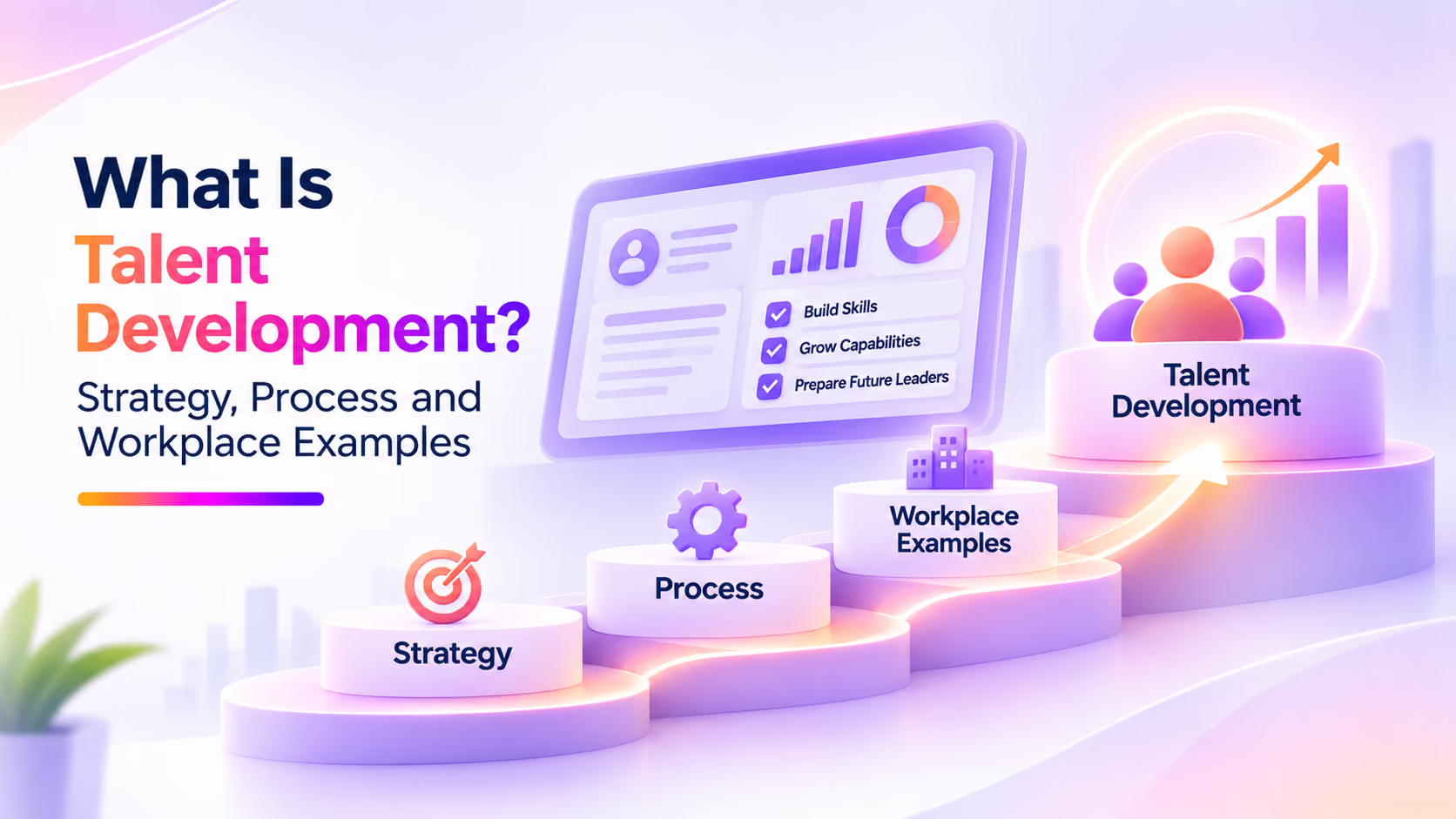
Talent development is the ongoing process of helping employees build the skills, knowledge and experience they need to perform well in their current roles and grow into future ones. It connects learning, coaching, career paths and feedback to business goals, so an organisation builds the capabilities it needs from within.
[[toc]]
Most organisations already train their people. Fewer can say which capabilities the business needs next, who is closest to building them, and what each person should do to get there. Talent development closes that gap by turning scattered training into a deliberate plan for growth.
This guide is for HR leaders, L&D leaders and business managers. It explains what talent development is, how it differs from talent management, training and performance management, the process to follow, and practical examples you can adapt.
What is talent development?
Talent development is a planned effort to grow employee capability over time. It looks at where each person is today, where the business needs them to be, and what learning, experience and support will close the distance.
It usually includes:
- identifying the skills and competencies roles require
- assessing current strengths and gaps
- building individual development plans and learning paths
- giving employees stretch assignments, coaching and mentoring
- preparing people for future roles, including leadership roles
- measuring progress and adjusting the plan
The focus is on potential as well as current performance. Talent development asks not only “Can this employee do the job today?” but also “What could this employee grow into, and what does the business need them to become?”
Talent development vs talent management, training and performance management
These terms are often used as if they mean the same thing. They do not, and separating them makes planning clearer.
- Talent development grows employee capability over time through learning, experience, coaching and career growth.
- Talent management is the wider system for attracting, hiring, developing, engaging, rewarding and retaining people. Talent development is one part of it.
- Training teaches specific knowledge or skills for a task or role. It is one method within talent development, not the whole of it.
- Performance management sets goals, reviews results and gives feedback on how someone is doing now. It provides input to talent development but looks mainly at the current period.
A simple way to remember it: training teaches a skill, performance management reviews results, and talent development connects both to where the person and the business are heading.
Why does talent development matter for business goals?
Talent development supports business goals in several practical ways:
- It builds capability the business needs. Development is aimed at the skills tied to strategy, not at whichever course is available.
- It prepares future leaders. Employees who are developed early are ready when a leadership role opens.
- It improves internal mobility. When skills are visible, roles can be filled from within more often.
- It supports engagement and retention. Employees who can see a path for growth have more reason to stay and contribute.
- It reduces wasted learning spend. Targeted development replaces generic training that does not change how work gets done.
What are the stages of the talent development process?
A talent development process can be run in six stages. The same cycle works for a single team or for the whole organisation.
Stage 1: align with business goals
Start with where the business is going: new markets, products, technologies or ways of working. List the capabilities these goals will need over the next 12 to 18 months.
Stage 2: define roles, skills and competencies
For each critical role, describe the skills, knowledge and behaviours required and the level expected. A clear competency mapping approach gives managers and employees the same reference point.
Stage 3: assess current capability
Combine more than one source of evidence: self-assessment, manager input, skills assessments, performance data and, for senior roles, methods such as an assessment center. This shows where people are strong and where the gaps are.
Stage 4: create development plans
For each employee or group, choose the actions that close priority gaps. These can include learning paths, on-the-job practice, stretch assignments, coaching, mentoring and job rotation. Link each action to a clear outcome.
Stage 5: deliver learning and experience
Make development easy to access and tie it to real work. Short modules, practice tasks and manager conversations tend to work better than a one-time course with no follow-up.
Stage 6: measure, review and adjust
Reassess capability at regular intervals, check whether gaps are closing and update the plan when business needs change. Talent development is a cycle, not a one-off project.
Who is involved in talent development?
Talent development works best when responsibility is shared.
- Employees own their growth: they share goals, take part in assessments and act on their plans.
- Managers give feedback, assign stretch work, coach and release time for learning.
- HR and L&D teams design the framework, provide tools and content, and track results across the organisation.
- Senior leaders sponsor the effort, link it to strategy and model learning themselves.
Workplace examples of talent development
The examples below are illustrative. They show how the process can look in different settings.
Example 1: preparing first-time managers
A company finds that many high-performing individual contributors struggle after promotion. It defines the competencies for a first-time manager, assesses each new manager against them and gives each person a learning path covering feedback, delegation and team communication. Each manager is paired with a mentor and checked in with after 90 days.
Example 2: building a new technical capability
A technology team is moving to a new cloud platform. HR and the team lead list the skills required, assess the current level of each engineer, and set up learning paths and practice projects for the gaps. Engineers who reach the target level take on more responsibility in the migration.
Example 3: growing talent for future roles
An organisation identifies a future need for more data-literate analysts. It offers interested employees from other functions a development track that combines short courses, a mentor and a small project in their own team. Some employees move into analyst roles; others bring data skills back to their original roles.
Common talent development challenges
- Plans not tied to strategy. Development that is disconnected from business goals is hard to justify and easy to cut.
- No shared view of skills. Without a competency reference, managers rate people differently and gaps are hard to compare.
- Too much training, too little experience. Courses alone rarely change how work is done. Practice, coaching and projects matter.
- Manager involvement is inconsistent. Employees need regular, specific feedback to turn learning into growth.
- Progress is not measured. If nobody tracks whether gaps are closing, the programme loses credibility.
How can technology support talent development?
As programmes grow, spreadsheets and email stop being enough. A learning platform can bring the main pieces together: role and competency frameworks, assessments, learning paths, content and progress reports.
Invince supports this in several ways:
- Invince LMS supports competency management alongside learning delivery, assessments and reporting, so learning can be tied to the capabilities people are expected to build.
- Invince LXP offers personalised, role-based learning journeys, helping employees find learning that fits their role and development goals.
- Craft helps L&D teams create learning content and assessments with generative AI, with subject experts reviewing the output.
- Plethora gives access to a curated library of more than 80,000 ready-to-use learning resources for common skills.
To see how role-specific content can support development at scale, read our guide to prebuilt role-based content for talent development.
Frequently asked questions about talent development
What is talent development?
Talent development is the ongoing process of building employee skills, knowledge and experience so people can perform well now and grow into future roles. It links learning, coaching, career paths and feedback to business goals.
What are the stages of talent development?
A common process has six stages: align with business goals, define roles and competencies, assess current capability, create development plans, deliver learning and experience, and measure and adjust.
How does talent development support business goals?
It builds the capabilities the strategy needs, prepares future leaders, improves internal mobility, supports engagement and retention, and directs learning spend to the skills that matter most.
What is the difference between talent development and talent management?
Talent management is the wider system for attracting, hiring, developing, engaging and retaining people. Talent development is the part focused on growing employee capability over time.
Is talent development the same as training?
No. Training teaches specific skills or knowledge. Talent development is broader: it includes training but also coaching, stretch assignments, mentoring and career planning, all linked to future needs.
Conclusion: from training activity to a growth plan
Talent development works when it starts with business goals, uses clear competencies, assesses people fairly and gives each employee a practical route to grow. It does not need to be complicated. Start with one critical role, define the competencies it needs, assess the team and build development plans for the biggest gaps. Then review, learn and extend the approach to more roles.
Ready to build a structured talent development programme? Explore Invince Talent Development to see how role-based learning paths, competency management and skills-focused learning can work together.
Our latest blogs
Ready to Revolutionize Learning at Your Organization?
Join 400+ enterprises using Invince to upskill, reskill, and retain top talent.
Ready to Revolutionize Learning at Your Organization?
Join 400+ enterprises using Invince to upskill, reskill, and retain top talent.

Ready to Revolutionize Learning at Your Organization?
Join 400+ enterprises using Invince to upskill, reskill, and retain top talent.