


Talent Intelligence vs. Skills Intelligence: Key Differences
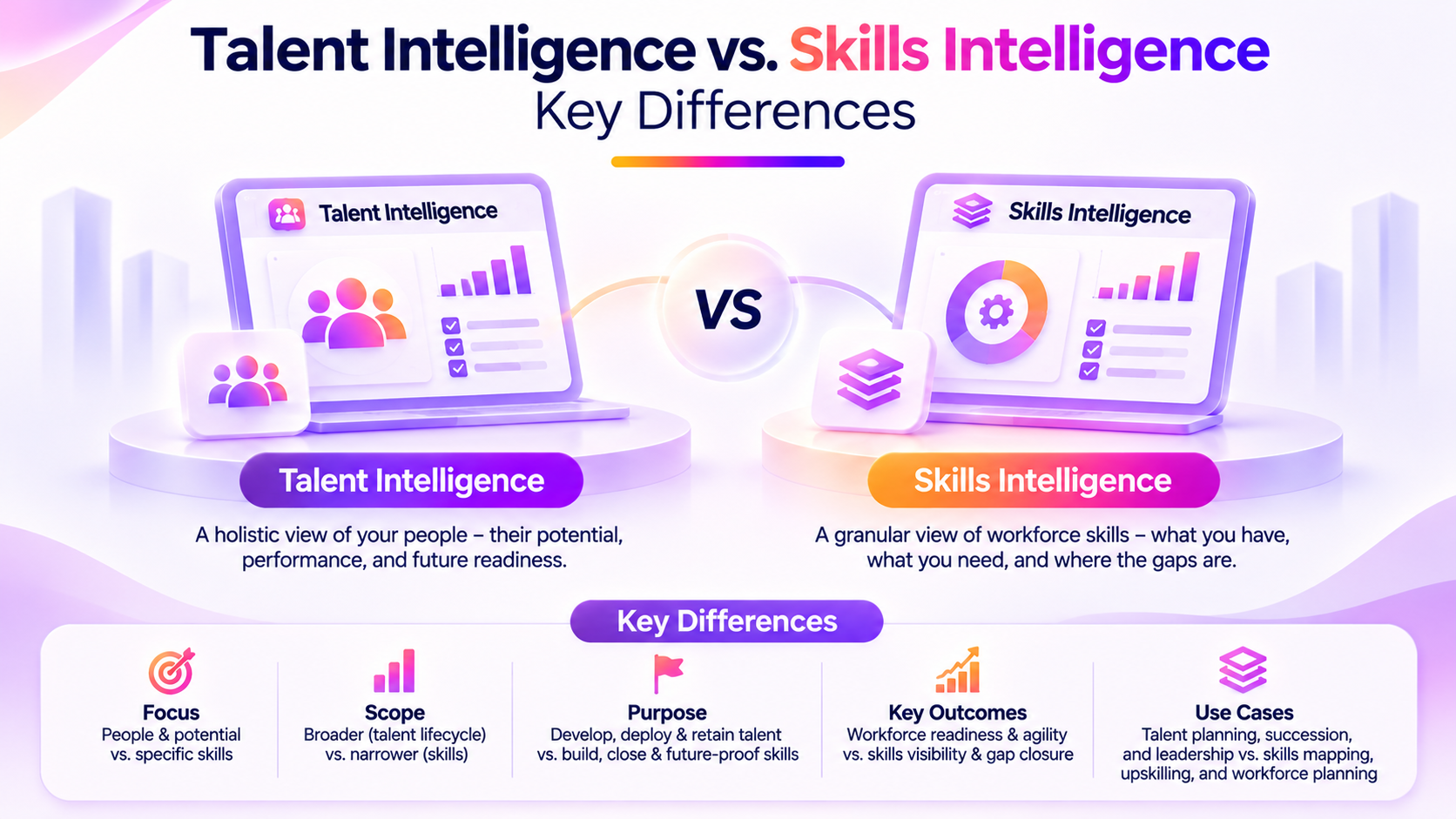
Talent intelligence and skills intelligence are two of the most talked-about ideas in HR technology. They are often used as if they mean the same thing, and vendors describe them in overlapping ways. For HR and L&D leaders deciding where to invest, the confusion matters.
[[toc]]
Interest is high. A 2024 Aptitude Research study, reported by SHRM, found that 84% of CHROs saw talent intelligence as a top priority. Skills sit at the centre of both ideas, but each answers a different set of questions and serves a different set of decisions.
This guide explains what talent intelligence and skills intelligence mean, the key differences, how they work together and which one to start with. It is written for CHROs, CLOs, HR directors, talent acquisition leaders and L&D leaders.
Quick answer: what is the difference between talent intelligence and skills intelligence? Skills intelligence is the detailed, continuously updated understanding of which skills people have, which skills the business needs and where the gaps are, used mainly to guide development and deployment. Talent intelligence is broader: it combines skills data with other people and labour market data, such as performance, potential, career moves, pay and external talent supply, to guide hiring, mobility, retention and workforce planning. Skills intelligence is often the foundation that talent intelligence builds on.
What is skills intelligence?
Skills intelligence is the ability to see, measure and act on the skills in your workforce. It typically brings together:
- a skills taxonomy with definitions and proficiency levels
- role skill profiles that describe what each role needs
- skills data for each person, from assessments, managers, learning and work evidence
- gap analysis at individual, team and organisation level
- recommendations for learning and development to close gaps
Its main questions are: what skills do our people have, what skills do we need and how do we build the difference?
What is talent intelligence?
Josh Bersin describes talent intelligence as the use of large amounts of employee and workforce data to understand skills, job fit, performance, leadership potential, career pathways, pay equity and organisational capability, often matched against data from the external labour market.
Talent intelligence usually draws on:
- skills data, often from a skills intelligence capability
- performance, potential and career history
- internal mobility, promotion and attrition patterns
- compensation and pay equity data
- external labour market data, such as talent supply, competitor hiring and in-demand skills by location
Its main questions are: where can we find the talent we need, who should we hire, move or develop, who is at risk of leaving and how should we plan the workforce?
Talent intelligence vs skills intelligence: key differences
- Scope: skills intelligence focuses on skills. Talent intelligence covers skills plus performance, potential, careers, pay and the external market.
- Main questions: skills intelligence asks which skills we have and need. Talent intelligence asks where talent is, who fits which role and how to plan the workforce.
- Main data sources: skills intelligence uses skills taxonomies, assessments, learning records and manager validation. Talent intelligence adds HR system data, recruitment data and external labour market data.
- Primary users: skills intelligence is used heavily by L&D, managers and employees. Talent intelligence is used by talent acquisition, HR business partners, workforce planners and senior leaders.
- Typical decisions: skills intelligence guides learning, development plans, internal project staffing and readiness. Talent intelligence guides hiring, internal mobility, succession, retention and long-term workforce planning.
- Focus: skills intelligence is mostly internal and capability-focused. Talent intelligence looks both inside and outside the organisation.
How they work together
The two are complementary rather than competing. Skills intelligence provides the detailed, trusted skills data. Talent intelligence uses that data, together with other sources, for broader talent decisions.
For example:
- Skills intelligence shows that a team has a significant gap in cloud security skills and identifies five employees with adjacent skills.
- Talent intelligence adds that cloud security talent is scarce and expensive in the local market, and that two of the five employees are at risk of leaving.
- The combined decision: reskill the five employees with a targeted learning path, prioritise retention conversations with the two at risk, and hire one senior specialist externally to lead the team.
Without skills intelligence, talent intelligence relies on job titles and self-reported profiles. Without talent intelligence, skills intelligence may miss external market and retention factors.
Which one should you start with?
- Start with skills intelligence if your main challenge is building capability, closing skills gaps, making learning more targeted or preparing people for changing roles. It is also the right first step if your skills data is incomplete, because talent intelligence depends on it.
- Add talent intelligence when your main challenges include hard-to-fill roles, high attrition in key groups, location decisions or long-range workforce planning that needs external market data.
Most organisations find that getting skills data right is the harder and more valuable first step. Once skills data is trusted, broader talent decisions become far more reliable.
Use cases side by side
- Closing a skills gap: mainly skills intelligence. Identify gaps, assign learning, track proficiency.
- Filling an internal project: skills intelligence finds people with matching or adjacent skills; talent intelligence can add availability and career interest.
- Hiring for a scarce role: mainly talent intelligence. Understand market supply, competitor demand and fit.
- Succession planning: both. Skills intelligence shows readiness; talent intelligence adds performance, potential and flight risk.
- Strategic workforce planning: both. Skills intelligence shows current capability; talent intelligence adds market trends and long-term supply.
Common misconceptions
- “They are the same thing.” They overlap, but talent intelligence is broader and draws on more data sources.
- “Talent intelligence replaces skills intelligence.” Talent intelligence depends on good skills data. Weak skills data leads to weak talent decisions.
- “AI alone will solve it.” AI helps infer and update skills, but a clear taxonomy, validation and governance are still needed.
- “It is only for HR.” Managers and employees use skills intelligence every day for development and staffing decisions.
How Invince supports skills intelligence
Invince focuses on the skills intelligence layer within learning and development, connecting skills data directly to the learning that closes gaps:
- Invince LXP is an AI-driven learning experience platform built skills-first. It includes a configurable skills taxonomy, AI tagging of content to skills, continuous skill gap analysis, a skills passport for each learner, manager tools to validate skills and organisation-wide skill gap and readiness reporting.
- Invince LMS (formerly UpsideLMS) supports competency management, assessments and individual development plans, and shares data with Invince LXP so structured training and skills development form one connected experience.
- Catalyst provides AI roleplay practice with structured performance feedback, adding evidence for conversation-based skills.
- Aura provides enterprise AI agents that automate learning, HR and workforce workflows while delivering personalised experiences and actionable insights.
- Craft and Plethora supply the learning content, from custom multilingual courses to a library of more than 80,000 ready-to-use resources.
Frequently asked questions
What is talent intelligence?
Talent intelligence is the use of employee, workforce and external labour market data to understand skills, fit, performance, potential, career paths and organisational capability, and to guide hiring, mobility, retention and workforce planning.
What is skills intelligence?
Skills intelligence is the continuously updated understanding of which skills people have, which skills the business needs and where the gaps are, used to guide learning, development and deployment.
Is skills intelligence part of talent intelligence?
Often, yes. Skills intelligence provides the skills data that talent intelligence combines with other people and market data. Many organisations build skills intelligence first.
Which is better for L&D teams?
Skills intelligence is usually more directly useful for L&D, because it links skills gaps to learning and shows whether gaps are closing.
Do I need both?
Large organisations with complex hiring and workforce planning needs often benefit from both. Most should start by making their skills data accurate and current.
Conclusion: get the skills right first
Talent intelligence and skills intelligence answer different questions. Skills intelligence tells you what your people can do and what they need to learn. Talent intelligence adds the wider picture of performance, careers and the external market. Together they support better talent decisions, but the quality of both depends on trusted skills data.
If your skills data is patchy, start there. Agree a skills taxonomy, build reliable skills profiles and connect them to learning. Broader talent intelligence will be far more useful once that foundation is in place.
Which talent decision in your organisation would improve most with better skills data? Share it in the comments, or pass this guide to the person leading your HR technology strategy.
Ready to build a skills intelligence foundation? Explore Invince LXP or book a demo.
Ready to Revolutionize Learning at Your Organization?
Join 400+ enterprises using Invince to upskill, reskill, and retain top talent.
Ready to Revolutionize Learning at Your Organization?
Join 400+ enterprises using Invince to upskill, reskill, and retain top talent.

Ready to Revolutionize Learning at Your Organization?
Join 400+ enterprises using Invince to upskill, reskill, and retain top talent.