

Thinking of Replacing Your LMS/LXP in 2026? Read This Before You Make a Million-Dollar Mistake
Recent years have fundamentally changed the landscape of organizational learning.
Previously, most organizational learning platforms focused on course delivery, completion tracking, and compliance management, which was once sufficient.
Today’s workplace is increasingly distributed, dynamic, and reliant on specialized skills.
L&D leaders are now accountable for training, capability building, talent mobility, organizational culture, and workforce resilience.
AI has raised expectations, enabling intelligent systems to perform tasks that once required entire teams of instructional designers, analysts, and administrators.
As a result, many organizations are now asking what to prioritize in their next LMS or LXP.
This guide provides a practical, strategic framework for L&D leaders in 2026, helping you evaluate which features to retain, upgrade, or require in a modern learning platform.
But before jumping right into the factors to look for, let’s have a brief look at the reasons why L&D teams outgrow their learning platforms in a few years.
Why Have Organizations Outgrown their LMS/LXP?
1. Workforce complexity has increased significantly
Employees now work across multiple locations and functions, requiring training for:
- In-office employees
- remote teams
- distributed service partners
- franchise networks
- customers
A single, one-dimensional LMS or LXP cannot effectively support these diverse audiences without causing fragmentation and redundant infrastructure.
2. Learning use cases have expanded
Training now extends beyond onboarding and compliance. L&D teams are responsible for:
- competency development
- leadership pipelines
- digital skill acceleration
- partner enablement
- customer education
- continuous learning culture
3. AI has transformed expectations
AI-enabled platforms can now:
- auto-generate microlearning
- personalize learning paths
- predict skill gaps
- auto-tag content
- surface insights for managers
- support multilingual delivery automatically.
Systems developed before 2020 were not designed to support this level of intelligence.
4. Skills have become the new currency
Organizations can no longer use “learning hours” as the sole measure of progress. They require real-time evidence of:
- competency
- readiness
- behavioral change
- succession potential
Traditional LMS reporting doesn’t provide that visibility.
The Learning Platform Evaluation Framework for 206
This three-layer framework reflects how top global organizations are going to evaluate their next LMS/LXP in 2026— not by what they can host, but by what they can predict, influence, and transform.
Layer 1 — Intelligence (AI, Analytics, Adaptability)
This layer determines whether the platform is a tactical training tool or a strategic capability engine. A modern LMS/LXP must demonstrate cognitive capacity, not just operational features.
Ask whether the system can:
Personalize learning at enterprise scale
• Does it understand roles, behaviors, performance, and context?
• Does it adapt difficulty, sequencing, and reinforcement for each learner?
Auto-generate and auto-update courses with GenAI
• Can SOPs, manuals, PDFs, and process updates become structured microlearning in minutes?
• Does the engine support multilingual creation, tone adaptation, and role-based variations?
Map skills, competencies, and readiness in real time
• Does the platform create a dynamic “skills graph” of the organization?
• Can it visualize current vs. future capabilities and identify high-potential talent?
Predict performance gaps — before they impact outcomes
• Does it flag learners who need interventions?
• Can it detect teams at compliance risk or roles where capability gaps are emerging?
Reduce administrative workload through automation
• Does AI manage tagging, distribution, versioning, and learning assignments?
• Does it automate refresher cycles, recertifications, and multi-audience segmentation?
This layer distinguishes legacy LMSs from AI-orchestrated learning ecosystems that drive workforce capability rather than merely track it.
Layer 2 — Infrastructure (Scalability, Multi-Audience, Reliability)
This layer addresses the architecture needed to support complex, global organizations.
Ask whether the system can accommodate real-world operational complexity:
Multi-portal / multi-tenant deployments
• Can you run multiple branded portals for employees, partners, customers, and franchise networks?
• Can they be centrally managed without duplicating content or admin effort?
Device diversity & real-world accessibility
• Does it support desktops, tablets, mobiles, rugged devices, kiosk systems, and BYOD models?
• Does the interface dynamically adapt to each device category?
Mobile + offline learning with bandwidth intelligence
• Can training continue in low-network, high-latency, or offline environments?
• Does it cache progress locally and sync automatically when reconnected?
Secure integrations with enterprise systems
• Does it support real-time syncing with HRMS, CRM, ITSM, IAM, and data lakes?
• Are APIs secure, stable, and well-documented?
Global delivery at enterprise scale
• Does it handle large user volumes across regions?
• Does it offer regional hosting, compliance with data residency laws, and multilingual capabilities?
Layer 3 — Impact (Engagement, Capability, Performance, ROI)
This layer answers the only question the C-suite ultimately cares about: Does learning produce measurable business value?
Key evaluation areas include:
Skill development and competency progression
• Does the platform track mastery, not just completions?
• Can it show how skills improve over time at individual, team, and org levels?
Behavioral change
• Does it use scenario assessments, spaced repetition, and reinforcement loops to influence real actions?
• Can it demonstrate whether compliance knowledge turns into compliant behavior?
Readiness and career mobility
• Can it identify who is “ready now,” “ready soon,” and “needs development”?
• Does it automate development journeys aligned to succession pathways?
Team-level performance shifts
• Can supervisors view how training impacts output, quality, safety, customer satisfaction, or sales?
• Does it connect learning analytics to departmental KPIs?
Proof of ROI
• Can the platform quantify reductions in ramp-up time, errors, incidents, attrition, rework, and compliance cost?
• Does it support executive reporting with predictive insights?
This final layer separates systems that “deliver courses” from systems that build organizational capability and generate tangible financial return.
What Are the Top LMS/LXP Features L&D Leaders Require in 2026?
The following layer-wise distribution of features/capabilities will help you distinguish platforms that merely host courses from those that drive capability development.
Layer 1 — Intelligence (AI, Analytics, Adaptability) Features
1. AI-Powered Personalization: From Content Push to Contextual Precision
The old model of “recommended courses” is obsolete. In high-performing organizations, personalization is built on context, not lists.
Modern platforms analyze a complex mix of signals:
- role expectations and job architecture
- historical performance patterns
- behavioral indicators from past learning
- competency gaps
- task-level proficiency data
- industry-specific compliance requirements
- current and upcoming business priorities
The outcome is dynamic learning paths that evolve in real time — adjusting based on:
- what the learner already knows
- where they struggle
- what the role demands next quarter
- how the business is shifting
This is the difference between a system that delivers information and a system that improves capability.
2. GenAI Course Creation: The Only Scalable Way to Keep Content Current
Learning leaders today are responsible for supporting teams that that handle new markets, new product releases, regulatory changes, process updates, mergers, technological shifts — all at once.
Traditional instructional design workflows simply can’t keep pace. A next-generation platform must support three GenAI workflows:
a. Document-to-Microlearning Conversion
SOPs, compliance manuals, audits, policy updates, or product changes should convert into structured microlearning within minutes — not months.
b. Prompt-to-Course Generation
A simple natural-language prompt (“Create a 7-minute course on the updated privacy workflow for field teams”) should yield a ready-to-review microlearning sequence.
c. Advanced Template Library
Pre-built, industry-specific templates enable teams to create consistent learning experiences without reinventing structure. In 2026, GenAI creation must also cover:
- AI voiceovers
- adaptive assessments
- scenario-based simulations
- multilingual versions
- role-based tone adaptation
- automatic content versioning
This elevates instructional teams from “content builders” to learning strategists, while the platform handles scale.
3. Competency Intelligence: Real-Time Visibility Into Workforce Capability
Skills are now the currency of competitiveness, yet most organizations still track them using spreadsheets or annual reviews. A modern learning ecosystem must:
- continuously map every employee’s skills to job roles
- track proficiency using assessments, behaviors, and project outcomes
- benchmark competency growth across teams and regions
- correlate skill data with performance and business results
- identify readiness for next-level roles
Competency intelligence replaces guesswork with evidence. It gives learning leaders a live, enterprise-wide skills graph — showing exactly:
- where talent is strong
- where it is vulnerable
- where succession pipelines are thin
- where proactive development is required
It transforms development from a scheduled event into a continuous, measurable engine.
4. Predictive Analytics: From Reporting to Foresight
Dashboards summarize the past. Predictive intelligence protects the future. Learning leaders now require systems that detect patterns earlier than humans can, including:
- early signs of performance decline
- rising compliance risk within specific roles or regions
- training gaps that could impact customer experience
- geographies with emerging skill shortages
- teams likely to struggle with upcoming product rollouts
A predictive platform should automatically:
- recommend targeted interventions
- assign micro-boosters
- trigger retraining workflows
- notify managers of risk groups
- forecast the impact of development gaps on KPIs
This elevates learning from a reporting function to a business-critical risk-mitigation system.
5. AI Orchestration Across Multiple Audiences: Eliminating Hidden Administrative Cost
Enterprises now train more than just employees:
- franchise networks
- retail associates
- channel partners
- global distributors
- customer communities
- service staff
- contractors
Each audience requires unique permissions, branding, and content sequencing. Previously, this meant running multiple LMS instances — duplicating content, workflows, and effort.
AI orchestration eliminates that burden by:
- auto-tagging and classifying content
- pushing updates across multiple portals
- localizing learning paths by geography
- segmenting analytics automatically
- generating audience-specific recommendations
- controlling access based on role, region, or license type
This ensures the organization delivers personalized learning at enterprise scale without administrative expansion.
6. Adaptive Learning Paths: Precision Development at Individual Pace
A modern platform should behave like a high-performing coach — observing how each learner progresses and adjusting accordingly. Adaptive learning uses AI to:
- modify difficulty based on mastery
- accelerate learning for experts
- slow down and reinforce for novices
- reorder modules to build confidence
- offer micro-boosters when learners struggle
- skip content when mastery is already demonstrated
These systems balance cognitive load, reduce frustration, and increase absorption — resulting in measurable improvements in retention and job-level performance. For distributed workforces, adaptive paths ensure every learner gets the level of challenge and support they need — no more, no less.
Layer 2 — Infrastructure (Scalability, Multi-Audience, Reliability) Features
1. Multi-Portal Architecture: Scaling for Every Audience You Train
Today’s organizations don’t train a single workforce—they train employees, franchisees, distributors, retail networks, contractors, and customers, each requiring distinct branding, permissions, content pathways, and analytics.
A modern platform must:
- create multiple fully branded portals from one backend system
- allow isolated content experiences for each group
- enable central administration without duplicating content
- auto-sync updates, metadata, and versioning across all portals
- give leaders analytics segmented by audience type
This architecture eliminates the hidden administrative cost of managing parallel systems. In 2026, the expectation is not just segregation—it’s AI-driven orchestration across audiences, ensuring personalized learning at scale without multiplying admin effort.
2. Device Diversity & Real-World Accessibility
Workforces are no longer desk-bound. They operate in:
- warehouses
- factories
- retail floors
- oil fields
- hospitals
- airports
- customer environments
- delivery fleets
A learning platform must adapt to workflows, not the other way around. Key capabilities learning leaders must demand:
- support for desktops, tablets, mobiles, kiosks, rugged devices, and BYOD
- responsive interfaces that reflow intelligently across screen types
- compatibility with enterprise mobility management (EMM) tools
- intuitive UX that works even for non-technical frontline workers
In 2026, device diversity is not a “nice to have”—it is a direct determinant of learning accessibility and adoption.
3. Mobile + Offline Learning With Network Intelligence
The modern workforce is increasingly mobile, decentralized, and globally distributed. Connectivity cannot be assumed. A next-generation LMS/LXP must:
- detect network quality in real time
- auto-optimize media for low bandwidth
- cache modules locally for offline usage
- sync completions, scores, and evidence the moment connectivity returns
- prevent data loss during incomplete sessions
- support microlearning designed specifically for intermittent connectivity
In aviation, maritime, logistics, retail, and construction—learning must work even where the internet doesn’t. This capability determines whether compliance, safety, and operational training reaches people who need it most.
In 2026, mobile + offline learning becomes a governance requirement, not a convenience.
4. Secure Integrations With Enterprise Systems
Learning systems now sit at the center of enterprise architecture, exchanging data with HRMS, CRM, IAM, ITSM, productivity suites, BI tools, and data lakes.
Learning leaders must ensure the platform supports:
- real-time HRMS sync for jobs, roles, org charts, and managers
- CRM-driven training for sales enablement
- IAM for secure authentication and access control
- ITSM for automated provisioning and de-provisioning
- data lake integrations for analytics correlation
- secure, well-documented APIs that prevent unauthorized access
In 2026, integration quality determines whether learning becomes a strategic data source or an operational bottleneck. Without secure, stable integrations, learning cannot influence performance, compliance, or readiness at scale.
5. Global Delivery at Enterprise Scale
Learning today operates across continents, languages, and regulatory environments. The platform must scale in both volume and geography.
Future-ready systems provide:
- high-load tolerance for thousands of simultaneous learners
- distributed hosting across US/EU/Middle East regions
- compliance with local data residency laws
- multilingual translation and UI localization
- global content delivery networks (CDNs) for fast access everywhere
In 2026, global delivery is not about “being available worldwide”—it’s about being compliant, consistent, and performant worldwide.
Layer 3 — Impact (Engagement, Capability, Performance, ROI) Features
1. Capability Progression & Skills Maturity
For decades, L&D success was measured through completions — the least meaningful metric in the enterprise. In the new era, CLOs judge systems by their ability to track mastery, not attendance.
A modern LMS/LXP must analyze:
- Skill acquisition speed — How quickly do employees move from novice → proficient → expert?
- Role readiness — How prepared is an employee for their next role or project?
- Team capability density — Which teams have the highest (or weakest) skill concentration?
- Longitudinal growth curves — How do individuals progress quarter-over-quarter?
AI-driven systems do this by using signals such as scenario outcomes, behavioral data, project delivery quality, assessment accuracy, and microlearning performance — giving CLOs a living map of workforce capability, not static reports.
2. Behavioral Change & Real-World Application
Executives care less about whether people learned something and more about whether they did something differently after learning.
That’s why modern learning platforms must demonstrate:
- mastery during skill application (e.g., scenario-based decisions)
- consistency of correct behavior over time
- reinforcement of high-risk areas (safety, compliance, customer handling)
- reduction in error rates, rework, or escalations
Systems should use spaced repetition, adaptive quizzes, and scenario engines to reinforce behavior.
More importantly, the platform must show how those behaviors affect actual outcomes — fewer safety incidents, improved customer scores, better quality audits.
This is where platforms evolve from “training tools” to behavior change engines.
3. Leadership Readiness & Career Mobility
Organizations lose millions each year because they can’t see who is ready for the next role.
A high-impact modern platform must give CLOs clarity into:
- who is “ready now” vs. “ready soon”
- which employees are silently stagnating
- where succession pipelines are at risk
- which competencies distinguish high performers
AI plays a critical role here. By evaluating skill mastery, speed of learning, engagement trends, project success, and behavioral data, the platform must be able to predict promotability far earlier than traditional performance reviews.
This is where capability becomes culture — when employees see visible career pathways tied directly to learning.
4. Team-Level Performance Shifts
In 2026, CLOs must connect learning to operational KPIs — not just learning KPIs. A mature platform should show how learning impacts:
- productivity
- sales performance
- quality metrics
- safety outcomes
- service consistency
- customer satisfaction
- output per employee
This requires the LMS to integrate with HRMS, CRM, ERP, and operational systems — allowing AI to correlate learning interventions to real performance signals. This moves L&D from “training cost” to capability investment in executive conversations.
5. Proof of ROI With Predictive Insights
Boards and CEOs want proof — not anecdotes. A modern learning platform must quantify the financial return on learning efforts by showing:
- reduced ramp-up time for new hires
- fewer compliance incidents
- lower error rates
- improved retention of high-potential talent
- reduced reliance on external hiring
- fewer failed audits
- fewer hours lost to retraining
- faster product adoption
AI elevates this by forecasting:
- future skill gaps,
- emerging performance risk zones,
- potential compliance vulnerabilities,
- and workforce capability trends.
This foresight allows CLOs to shift from reactive course creation to proactive capability planning, positioning learning as a strategic lever in business performance.
How AI-Powered Learning Ecosystem Invince Turns Enterprise Learning Into a Living System
Invince is built on a simple but transformative premise: learning is not an event — it is an operating system for organizational performance. Most platforms deliver content. Invince delivers capability.
Its three products — Craft, UpsideLMS/LXP, and Plethora — work together as a single, synchronized intelligence layer, transforming how enterprises create, deliver, measure, and scale learning across regions, business units, and roles.
This is not an LMS/LXP upgrade. It’s the shift from learning management to learning intelligence.
Craft: GenAI Microlearning Builder
Craft is your launchpad—unleashing AI to craft bite-sized, multilingual microlearning, enhanced with stunning templates and customization. It delivers device-agnostic access, live progress insights, text-to-speech flair, and smooth integrations, sparking a dynamic culture of growth for your global teams.
Because courses are built atomically — as short, high-utility learning units — organizations can respond instantly to product changes, regulatory updates, or operational shifts.
UpsideLMS/LXP: AI-Orchestrated Enterprise Delivery
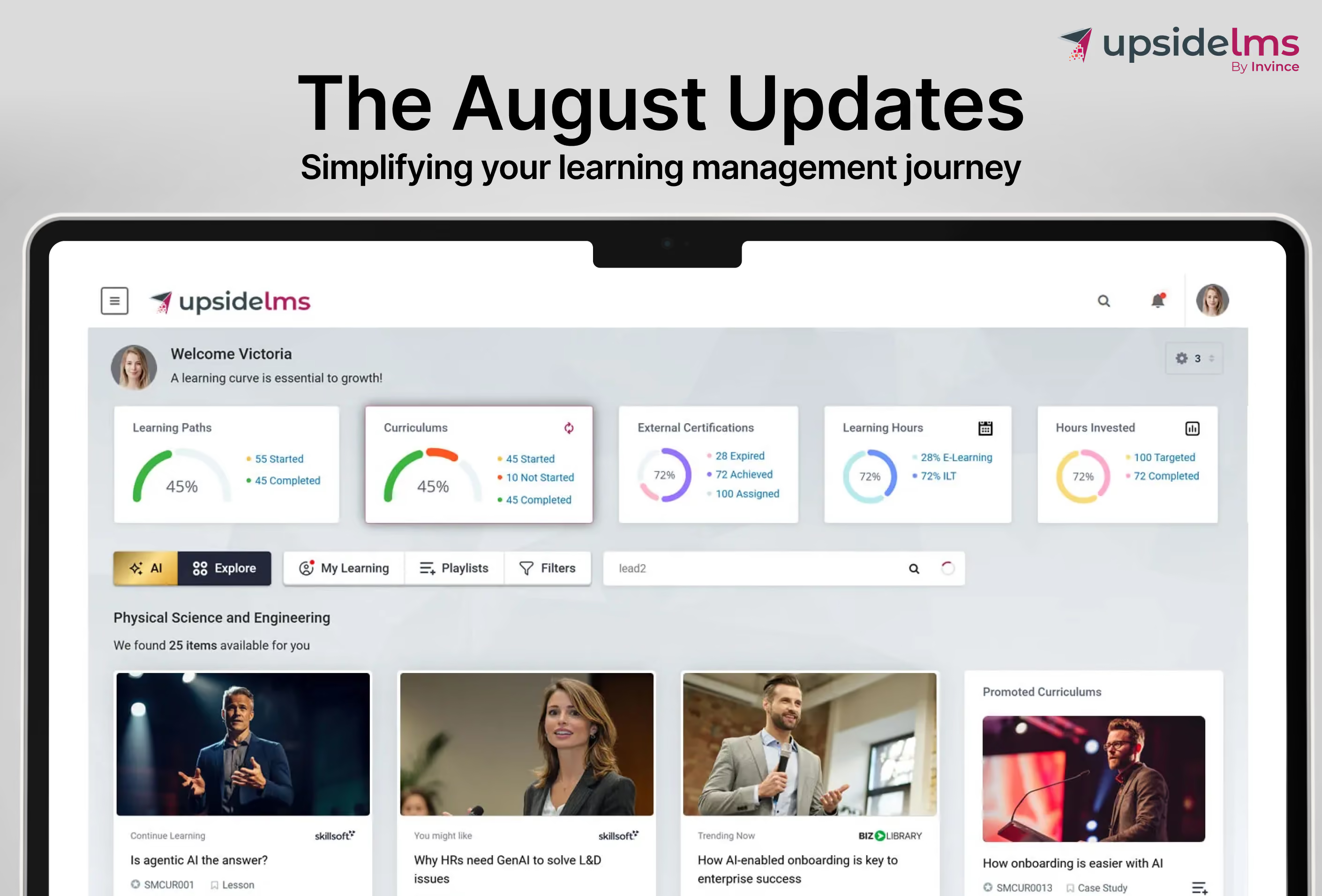
UpsideLMS/LXP serves as the intelligence and orchestration layer of the Invince ecosystem — built for the complexity of modern enterprises.
Its architecture supports:
- multi-portal deployments for employees, partners, contractors, customers, and franchise networks
- real-time skill intelligence that maps capability against roles and future readiness
- predictive analytics that flag performance risks and learning needs before they become problems
- mobile, low-bandwidth, and offline learning for frontline and distributed teams
- integration with HRMS, CRM, IAM, and operational systems
- competency frameworks that unify self-assessments, manager validations, and automated upskilling
This is not an LMS that “hosts courses.”
It is a platform that connects learning to outcomes, continuously adjusting delivery based on data, context, and business priorities.
Plethora: 80,000+ Courses for Instant Capability Building
Plethora gives organizations breadth and agility — a global library designed to fill gaps before they impact performance.
It offers:
- leadership development
- compliance and regulatory training
- digital transformation and technology skills
- behavioral and professional development
- global safety and industry-specific certifications
Courses are aligned with international standards and continuously updated, ensuring enterprises always have access to relevant, up-to-date learning without reinventing content internally.
Combined with Craft and UpsideLXP, Plethora becomes the rapid-response engine that ensures no skill gap remains unaddressed.
Together, Craft, UpsideLMS, and Plethora form a learning ecosystem that:
- accelerates competency development
- personalizes learning paths automatically
- automates content creation and deployment
- strengthens compliance and audit readiness
- improves internal mobility and leadership readiness
- supports complex, distributed, and frontline workforces
- connects learning with real business KPIs
- produces verifiable ROI visible at the executive level
This is more than learning technology.
It is an enterprise capability platform — a living system that evolves with your business, adapts with your people, and delivers intelligence that fuels strategy.
Are you ready to transform your Organization’s Learning Experience with an AI-powered Learning Ecosystem for Skilling, Engagement, and Impact?
Write to us at contact@invince.com or visit click to get a free L&D consultation.

Ready to Revolutionize Learning at Your Organization?
Join 400+ enterprises using Invince to upskill, reskill, and retain top talent.
Ready to Revolutionize Learning at Your Organization?
Join 400+ enterprises using Invince to upskill, reskill, and retain top talent.

Ready to Revolutionize Learning at Your Organization?
Join 400+ enterprises using Invince to upskill, reskill, and retain top talent.