

Why Global Financial Institutions Are Turning to AI-Powered Learning to Manage Enterprise Risk
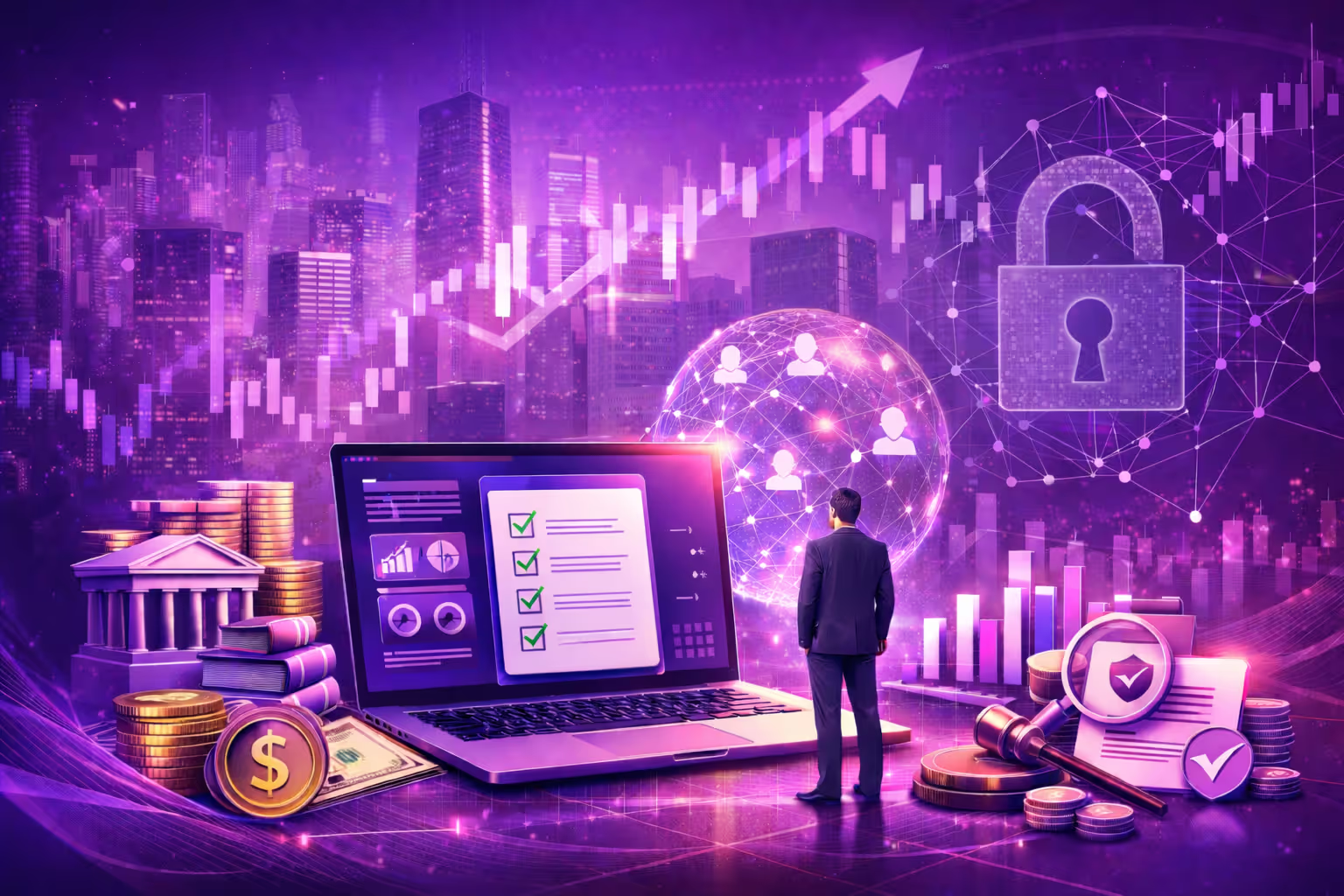
For years, financial institutions viewed risk as a puzzle to be solved with controls, policies, and audits. As long as the rulebook was thick and the checklist ticked, risk seemed safely contained.
That assumption no longer holds.
Now, the most significant failures in banking, insurance, and capital markets rarely come from missing policies or faulty systems. Instead, they are born in split-second human decisions: a choice made under stress, a regulation misread across borders, a process followed just shy of perfection.
These small moments quietly pile up, only to erupt later as regulatory penalties, customer fallout, or reputational scars.
This shift has sparked an uneasy awakening in the boardroom. Risk exposure is no longer just a matter of systems and frameworks. It now hinges on how people interpret, remember, and act on rules in the heat of the moment.
Risk in Financial Services Has Become Intensely Human
Today, compliance demands stretch across borders. Products outpace policies. Teams become more scattered, specialized, and ever-changing.
Amid this complexity, most risk events trace back to a familiar source. Someone knew the rule but missed its meaning. Someone finished the training but missed the moment. Someone followed the process, but not quite to the letter.
Regulators have noticed this pattern. Supervisory expectations have evolved accordingly. It is no longer sufficient to prove that training occurred. Institutions are increasingly expected to demonstrate that employees understand their obligations, can apply them correctly, and receive reinforcement when risk conditions change.
This new expectation transforms the role of learning. It is no longer just about education, but about exerting control.
Why Traditional LMS-Based Compliance Models No Longer Hold Up
Most Learning Management Systems in finance were built for an earlier era. Their main goal was efficiency: assigning courses, tracking completions, and churning out reports.
This model assumes that seeing content means understanding it. That annual certification means true readiness. That ticking off a module means risk is gone.
In practice, these assumptions create blind spots.
Completion metrics provide a false sense of security. Dashboards may glow green while confusion spreads beneath the surface. Generic content overlooks the fact that risk shifts by role, region, and responsibility. Manual tracking and scattered systems only add stress when speed and clarity matter most.
Most dangerously, traditional LMS models play catch-up. They react after the rules change, after the incident, after the audit. By then, the damage is already done.
For risk leaders, this model feels more out of step with reality every day.
Reframing Learning as a Risk Management Capability
Forward-thinking institutions are reimagining learning, not as a box to check, but as a living, breathing risk control.
This shift begins with a simple truth: if risk is shaped by people, then risk mitigation must shape behavior every day. That means learning systems must adapt to roles, respond to signals, and track understanding as it evolves.
Learning must be ongoing, not occasional. It should strengthen judgment, not just deliver facts. It must create proof that withstands regulatory scrutiny.
This is where AI-powered LMS platforms come into play.
How AI-Powered LMS Platforms Alter the Risk Equation
Artificial intelligence brings a new level of precision and scale that old systems simply cannot match.
Instead of serving up the same content to everyone, AI tailors learning to each role, risk exposure, performance, and location. A frontline advisor, a compliance manager, and an executive each follow a unique learning path shaped by their respective risk landscapes.
Learning moves from yearly check-ins to constant reinforcement. Quick, focused interventions arrive when risk peaks, not months too late. Scenario-based simulations let employees rehearse real-world decisions, testing their judgment in lifelike situations instead of abstract quizzes.
Automation steps in as a key player. Certifications renew on their own. Retraining kicks in when needed. Regulatory updates ripple instantly to the right people, no manual effort required.
For leaders, the biggest shift is newfound visibility. AI-powered analytics link learning data to risk signals, spotlighting where understanding fades, exposure grows, or action is needed. Learning transforms into a live monitoring system, not just a static content vault.
Managing Compliance Risk Through Learning Intelligence
Compliance functions benefit directly from this shift.
In areas such as AML and fraud prevention, learning adapts to emerging typologies and role-specific exposure. Employees are assessed on decision accuracy, not just awareness. Evidence of comprehension becomes auditable and defensible.
Data privacy and information security training moves beyond policy acknowledgment. Employees demonstrate correct responses to simulated incidents. Reinforcement occurs regularly, reducing reliance on memory during high-pressure moments.
Market conduct and ethics training becomes grounded in real dilemmas rather than abstract principles. Patterns of judgment can be observed, measured, and addressed before they surface as misconduct.
Regulatory change management improves as well. Updates are mapped automatically to affected roles and regions. Evidence of dissemination and understanding is generated continuously, reducing audit friction.
Reducing Operational Risk Before It Becomes Visible
Operational failures rarely announce themselves in advance. They emerge from the gradual erosion of knowledge and consistency.
AI-powered learning platforms surface hidden risks sooner. Analytics show where execution drifts across teams. Skill gaps tied to new products or systems appear before trouble hits. Onboarding risks for new hires and contractors are tackled with flexible learning paths, not rigid courses.
This predictive power marks a real turning point. Institutions shift from reacting to failures to staying one step ahead.
A Realistic Institutional Scenario
A multinational financial institution operates across North America, the UK, and the Middle East. Regulatory pressure is constant. Training systems have evolved independently by region. Audit preparation is manual and time-consuming.
Even with impressive completion rates, the same issues keep cropping up. Leaders remain unconvinced that training results reflect true readiness.
The institution implements an AI-powered learning platform designed around role-based personalization, continuous reinforcement, and real-time analytics. Compliance and risk teams gain shared visibility into learning outcomes. Frontline staff receive targeted, scenario-driven reinforcement aligned to their daily decisions.
Within a year, audit prep time shrinks. Regulatory responses speed up. Most importantly, leaders finally trust that risk is being tackled at the source, not just recorded after the damage.
The metrics in this scenario are illustrative, based on synthesized data used for explanatory purposes, but the pattern reflects a growing industry reality.
The Invince View on Risk-Ready Learning
Invince looks at learning through the same lens that risk leaders apply to controls, systems, and governance. Not as a single platform deployed in isolation, but as an interconnected learning ecosystem designed to reduce uncertainty created by human behavior.
In regulated enterprises, risk does not arise because content is missing. It arises because the right knowledge does not reach the right people at the right moment, or because understanding cannot be demonstrated when it matters most. Invince’s approach addresses this problem end to end by combining three tightly aligned capabilities.
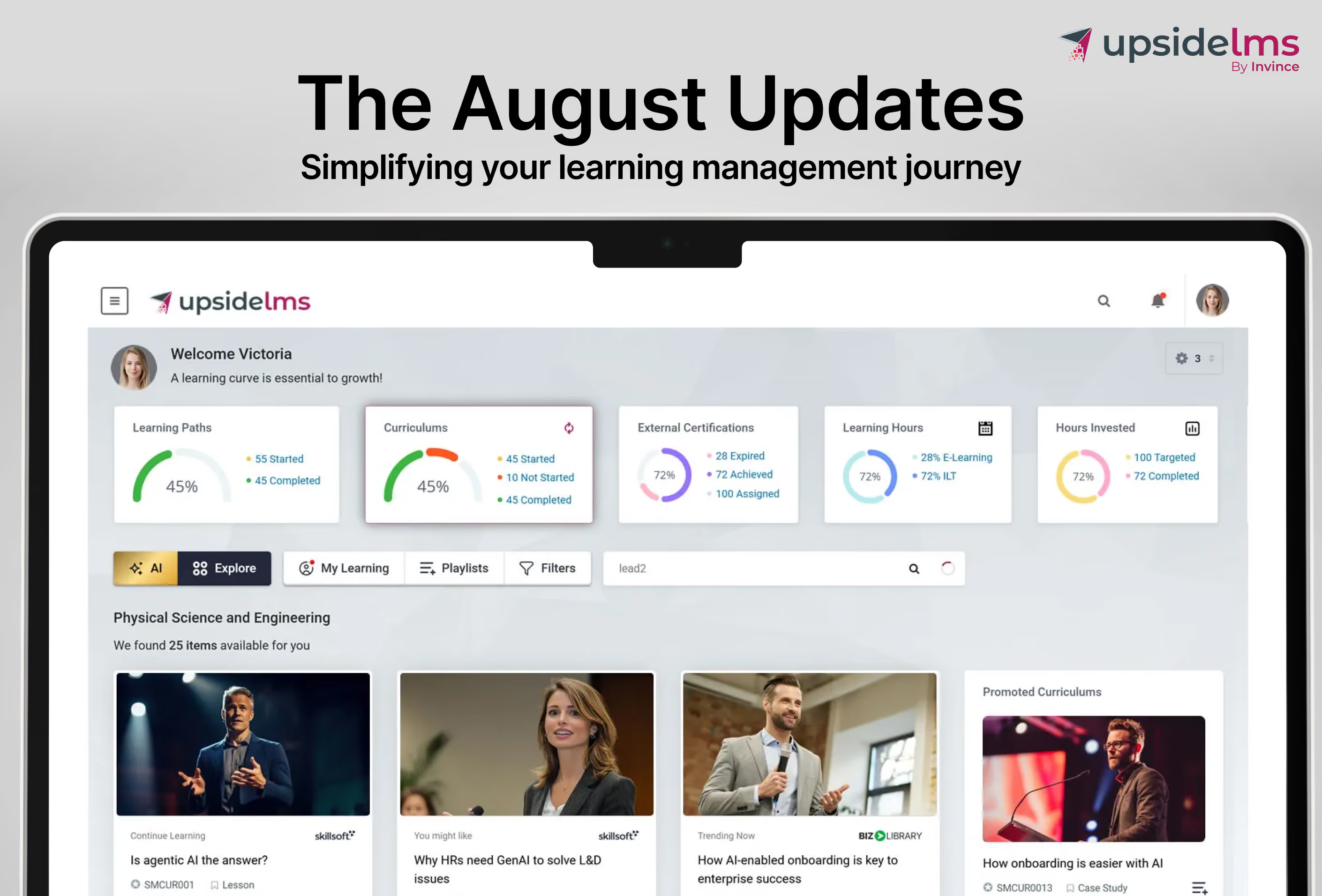
UpsideLMS sits at the core of this ecosystem. It functions as the system of record for risk-aligned learning across the enterprise. Rather than treating all learners equally, UpsideLMS structures learning around roles, regulatory exposure, geography, and risk criticality. AI-driven delivery ensures that frontline teams, managers, and executives receive learning that reflects the decisions they are accountable for.
Continuous reinforcement, automated certification logic, and audit-ready analytics allow learning to operate like a control mechanism rather than a one-time intervention.
Craft addresses a different but equally important dimension of risk: speed and accuracy of content creation. In financial services, regulations change faster than traditional content pipelines can respond. Craft uses AI to help subject matter experts convert policies, regulatory updates, and internal guidance into structured, role-ready microlearning assets in over 150+ international languages.
This reduces reliance on manual instructional design cycles and lowers the risk posed by delayed or inconsistent communication of regulatory changes. What matters here is not just efficiency, but control. Content remains traceable, consistent, and aligned with approved source material.
Plethora completes the ecosystem by bringing learning intelligence into the risk conversation. It aggregates data from learning activity, assessments, and behavioral signals to surface patterns that matter to leadership. Instead of reporting only who completed training, Plethora highlights where understanding is weakening, where risk exposure is rising, and where intervention is required. For risk, compliance, and audit leaders, this creates a continuous line of sight into organizational readiness across regions and roles.
Together, these products shift the purpose of learning. The objective is no longer to demonstrate activity, but to build confidence that people can execute correctly under pressure. Control becomes measurable. Consistency becomes scalable. Learning moves from the background into the enterprise risk stack.
For global organizations under intense regulatory scrutiny, this integrated approach enables learning to support governance in ways that standalone systems cannot. It aligns people, policy, and proof, which is exactly where modern risk management now lives.

Ready to Revolutionize Learning at Your Organization?
Join 400+ enterprises using Invince to upskill, reskill, and retain top talent.
Ready to Revolutionize Learning at Your Organization?
Join 400+ enterprises using Invince to upskill, reskill, and retain top talent.

Ready to Revolutionize Learning at Your Organization?
Join 400+ enterprises using Invince to upskill, reskill, and retain top talent.