

Talent Pipelining: The L&D Perspective (Podcast)

“The more that you read, the more things you will know. The more that you learn, the more places you’ll go.” - Dr. Seuss
This saying stands true for each one of us reading this right now.
So how can organizations that want to build an empire with trustworthy and empowered employees who will be ready to stick around for the longer haul be able to achieve this by focusing on the need that is mentioned above?
Sounds overbearing? Let me try to decode it.
Let’s have a look at the 3 main factors that are important for an employee in selecting and staying in a job. The most common reply you would get is as follows (and in this order, mostly):
1.Money
2.Work
3.satisfaction
While nothing gives the impetus to work more and better than a monetary reward, it is the self-actualization (hint: Maslow’s Hierarchy of Needs) element of our jobs (and life) that keep us going and growing.
Employee Capability Development & Succession Planning
Every employee wants to be in an organization that invests in him/ her – learning and development being a key component of the same. They want to ensure that along with contributing to the organization’s success, they keep developing (read: upskilling) too.
And this can only be possible with a robust L&D program which’ll take into account not just what skills can a particular employee learn today (as per his/ her job role) but also the ones needed for tomorrow, perhaps from the perspective of getting a promotion (or the corner office!). This will ensure the creation of a high performance culture that lends a competitive edge over others.
Furthermore, employee capability development and training programs feed into Succession Planning by ensuring a pool of highly skilled and motivated employees who would be more than willing to take up the next role as they would feel more confident in doing so. For example – Someone who doesn’t know how to operate a coffee machine would be more confident in making it the traditional way than trying to operate a machine whose workings he/she doesn’t know and vice versa.
Another factor to consider is COVID-19, which is just an example to show how unpredictable life is. Companies need to be future-ready in terms of having identified successors to senior roles if, God forbid, the need to do so arises before time.
Leveraging Learn-tech for Talent Pipelining
In today’s age when Facebook delivers news faster than the newspaper, companies need to ensure that they are at par with the world. The learning-in-the-flow-of-work that the employees yearn for needs to be imparted using new modern technologies like a Learning Management System (LMS) and a wide repository of relevant and engaging content. Having learn-tech is an investment which will definitely give you an ROI in terms on both tangible & intangible benefits – intangible in terms of “happier, more productive employees” and tangible in terms of high due to the increased productivity. It would be independent of any external forces (like for eg. – COVID-19) which have a magnitude of affecting businesses irrevocably. Employees can engage in continuous learning even when working-from-home (remote working). Employees can choose the time they would like to dedicate for self-learning and skills enhancement as per role requirement.
Employee Happiness & Employer Branding
There is a side effect of employee skilling programs in areas outside company growth. It’s the employee satisfaction and happiness. Happier employees mean “employees who will talk positively about the organization”. And the more positivity that spreads around would eventually lead to the creation of a positive and respectful “Employer Brand”. Once any organization is able to create this image or buzz around about themselves, it’ll lead to them being an entity that attracts more sales, better talent which means they will be able to reach their goals faster.
So to sum it up – ‘Investment in L&D is directly proportional to a company’s success and future readiness.’
Talent Pipelining: The L&D Perspective (Podcast)
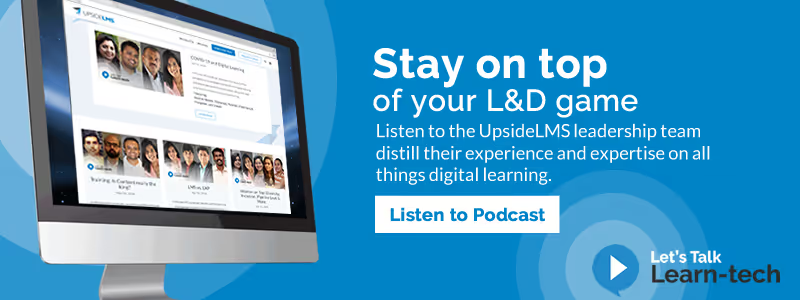
In this month’s ‘Let’s Talk Learn-Tech’ podcast titled ‘Talent Pipelining: The L&D Perspective’, I, along with my colleagues, discuss the role of L&D in future-proofing an organization, managing succession planning and giving it a competitive advantage through relevant, engaging and personalized training mapped to the competency needs of today and tomorrow.
Listen to the full episode to learn:
1. How can organizations (a) Ensure a skilled talent pool and (b) Connect the dots between this and Sustainable Talent Pipeline?
2. How can organizations, HR in particular, leverage employee capability development and training interventions to establish an Employer Brand?
3. How can L&D identity and plug in the skill gaps in light of shrinking shelf life of skills?
4. How to optimize performance calibration and stay agile?
https://www.youtube.com/watch?v=bQ2mAYDmElc&feature=emb_logo
Our latest blogs


Ready to Revolutionize Learning at Your Organization?
Join 400+ enterprises using Invince to upskill, reskill, and retain top talent.
Ready to Revolutionize Learning at Your Organization?
Join 400+ enterprises using Invince to upskill, reskill, and retain top talent.

Ready to Revolutionize Learning at Your Organization?
Join 400+ enterprises using Invince to upskill, reskill, and retain top talent.