


What Is Workforce Development? Strategies, Programmes and Examples for 2027
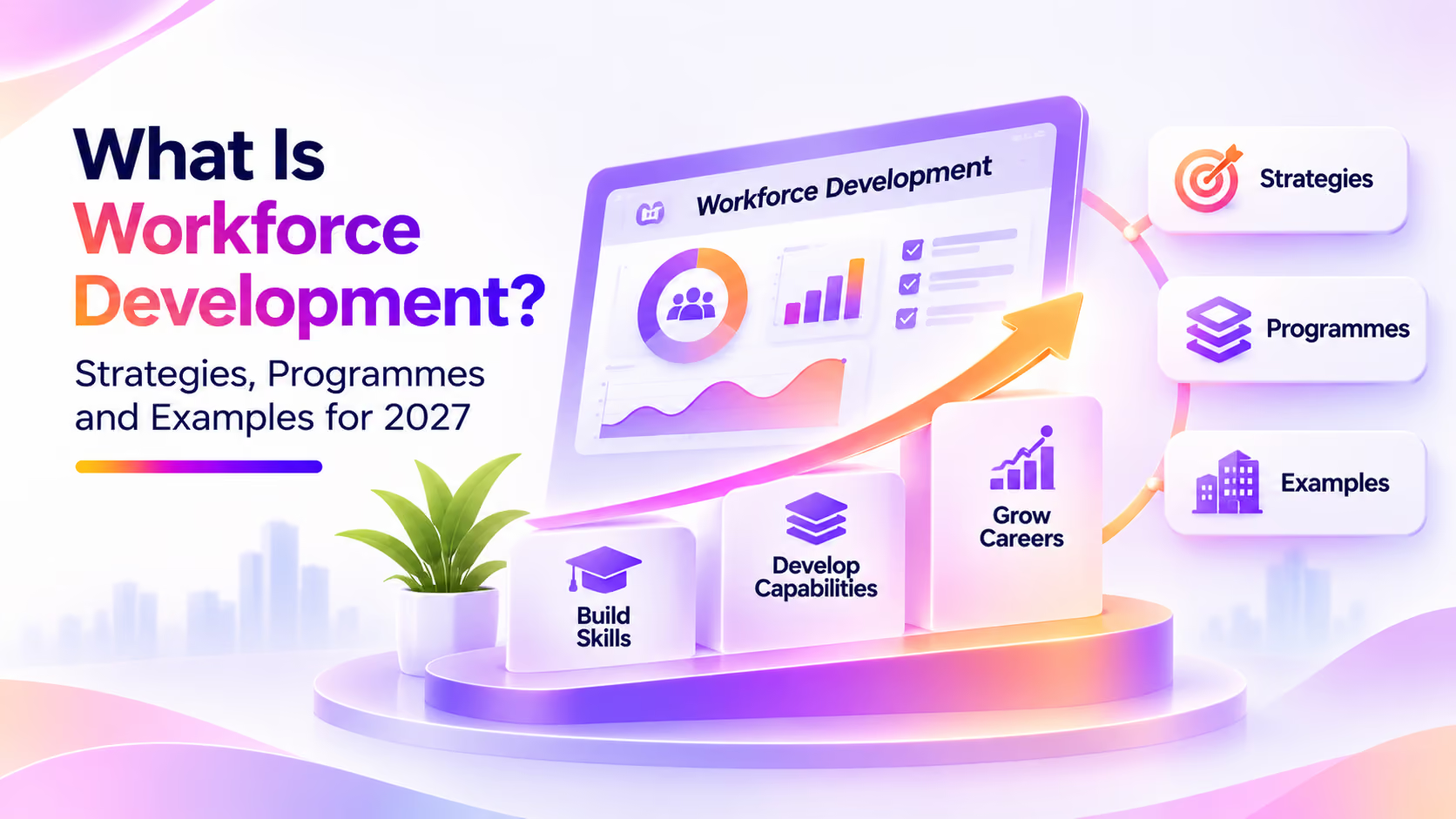
Every organisation depends on the capability of its people. When technology, customers and regulations change, that capability has to change with them. Some organisations try to hire their way through each shift. Others build the skills they need from within, deliberately and continuously. The second approach is workforce development.
[[toc]]
It is also one of the most direct ways to keep good people. In LinkedIn's Workplace Learning Report 2025, 88% of organisations said they were concerned about employee retention, and providing learning opportunities was their number one retention strategy. Yet only 36% of organisations qualified as career development champions with mature programmes that deliver business results.
This guide explains what workforce development is, how it differs from training and talent development, the strategies and programmes that work, a step-by-step way to build a plan and how to measure results. It is written for CHROs, CLOs, HR directors and L&D leaders planning for 2027.
Quick answer: what is workforce development? Workforce development is an organisation's planned, ongoing effort to build the skills its workforce needs to meet current and future business goals. It combines skills assessment, learning, on-the-job experience, career paths and measurement, so the organisation can grow capability from within rather than relying only on external hiring.
What is workforce development?
Workforce development looks at capability across the whole organisation, not just one person at a time. It asks three questions: which skills does the business need now and next, which skills does the workforce have today, and how will the gap be closed?
A workforce development approach usually includes:
- a clear view of the skills critical to the business strategy
- an assessment of current skills across teams, roles and regions
- learning and development programmes aimed at priority gaps
- on-the-job experience, such as projects, rotations and stretch assignments
- career paths and internal mobility, so people can move to where their skills are needed
- measurement that links skills growth to business results
The term is also used for public programmes that build skills across a region or industry. This guide focuses on workforce development inside organisations.
Workforce development vs training vs talent development
- Training teaches specific knowledge or skills for a task or role. It is one tool within workforce development.
- Talent development focuses on growing individual employees over time, including future leaders, through learning, coaching and career planning.
- Workforce development takes an organisation-wide view. It aligns skills building across all employees with business strategy and workforce plans.
Put simply, training builds a skill, talent development grows a person and workforce development builds the capability of the whole organisation.
Why workforce development matters in 2027
Skills are changing quickly
In the World Economic Forum's Future of Jobs Report 2025, employers expect 39% of workers' core skills to change by 2030, and 63% see skills gaps as a major barrier to business transformation, more than any other barrier. Workforce development is how organisations keep pace.
AI is changing work in every function
AI is reshaping tasks in sales, service, operations, finance and HR. People need new skills to work with AI tools, and some roles will shift significantly. A workforce development plan prepares people for these changes rather than reacting after they happen.
Building is often faster than buying
When critical skills are scarce, hiring takes time and costs more. Developing people who already know the business can close gaps faster and keeps knowledge in the organisation.
Retention depends on growth
Employees stay where they can see a future. Visible learning and career paths give people a reason to grow with the organisation rather than leave it.
The key components of workforce development
- Skills strategy. A short list of the skills that matter most to the business over the next one to three years.
- Skills framework. Agreed definitions and proficiency levels for those skills, linked to roles. Competency mapping gives everyone the same reference point.
- Skills data. An up-to-date view of the skills people have, built from assessments, manager input and learning records. This is where skills intelligence comes in.
- Learning programmes. Role-based learning paths, microlearning, blended programmes and content libraries aimed at priority gaps.
- Experience and practice. Projects, rotations, mentoring and practice opportunities that turn learning into capability.
- Career paths and mobility. Visible routes for people to grow, move sideways or step up.
- Measurement. Metrics that show whether skills are improving and whether that improvement shows up in business results.
Workforce development strategies that work
- Start from business priorities. Link every programme to a goal, such as entering a new market, adopting a new technology or improving service quality.
- Focus on critical roles first. Concentrate effort where skills gaps have the biggest business impact.
- Personalise learning. Give each person a path based on their role, current skills and goals, rather than one programme for everyone.
- Learn in the flow of work. Use short modules, mobile access and on-the-job tasks so learning fits into the working day.
- Combine learning with practice. Add projects, roleplay and coaching so people apply what they learn.
- Mix upskilling, reskilling and cross-skilling. Match the approach to the need. Our guide to upskilling vs reskilling vs cross-skilling explains when to use each.
- Involve managers. Managers release time for learning, give feedback and spot people ready for new challenges.
- Make skills a shared language. Use skills, not just job titles, in development, mobility and planning decisions. Our guide to the skills-based organisation explains how.
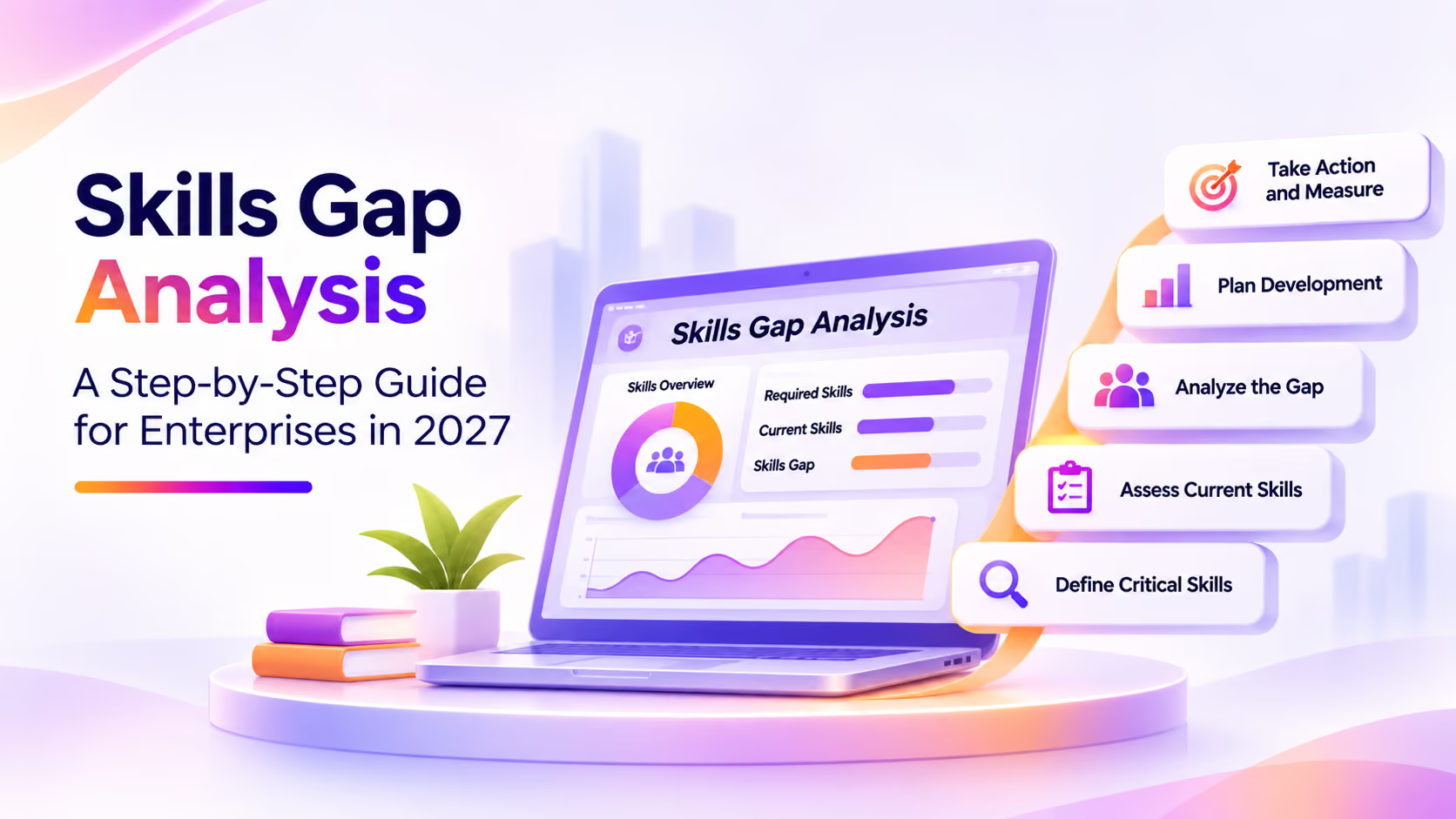
How to build a workforce development plan: step by step
- Clarify business goals. List the strategic priorities for the next 12 to 36 months and the capabilities each one needs.
- Identify critical skills and roles. Decide which skills and roles matter most to those goals.
- Assess current skills. Combine self-assessment, manager input and skills assessments to see where the workforce stands.
- Analyse the gaps. Compare current skills with required skills by team, role and region, and prioritise the biggest risks.
- Choose the approach for each gap. Decide whether to build (upskill or reskill), borrow (projects and mobility) or buy (hire).
- Design and deliver programmes. Build learning paths that combine content, practice and coaching, and make them easy to access.
- Measure and adjust. Track skills growth, internal moves and business outcomes, and update the plan as priorities change.
Examples of workforce development programmes
The examples below are illustrative.
- Frontline capability: a retailer gives store teams short mobile modules on new products and service standards, followed by on-the-floor practice and manager check-ins.
- AI readiness: a financial services firm builds a learning path on using AI tools safely in daily work, with role-specific scenarios for operations, risk and customer teams.
- First-time managers: a technology company assesses new managers against a leadership competency framework and gives each a path covering feedback, delegation and difficult conversations, with roleplay practice.
- Reskilling into growth roles: a manufacturer identifies employees whose skills are close to those needed for new data and quality roles and offers a structured reskilling track with a mentor and project.
How to measure workforce development
Completion rates show activity, not impact. Use a mix of measures:
- Skills measures: skill gaps closed, movement in proficiency levels and readiness for critical roles.
- Talent measures: internal mobility rate, roles filled internally, time to productivity and retention of key people.
- Learning measures: engagement, completion and assessment results for priority programmes.
- Business measures: the operational results each programme was designed to improve, such as sales, quality, service scores or error rates.
Set a baseline before you start, so you can show change over time. For a simple way to value results, see our guide to LMS features that boost business ROI.
Common workforce development mistakes
- Starting with courses instead of business needs. Programmes without a clear goal are hard to fund and harder to measure.
- Treating everyone the same. Generic programmes waste time for experienced people and miss the gaps that matter.
- No reliable skills data. Without a current view of skills, priorities are based on guesswork.
- Learning without practice. Skills grow through use. Build in projects, roleplay and coaching.
- Measuring only completions. Track skills, mobility and business outcomes as well.
How Invince supports workforce development
The Invince AI-powered corporate learning ecosystem covers each component of workforce development:
- Invince LMS (formerly UpsideLMS) is an AI-powered enterprise learning platform for onboarding, compliance, upskilling and workforce development, with competency management and individual development plans.
- Invince LXP is an AI-driven learning experience platform that delivers personalised, role-based and skills-focused learning journeys, with a configurable skills taxonomy and skill gap reporting.
- Craft is a GenAI-powered multilingual course builder with support for more than 150 languages and over 25 ready-to-use instructional design templates.
- Plethora is a curated library of more than 80,000 ready-to-use learning resources designed to accelerate enterprise-wide skill development.
- Catalyst is an AI-powered roleplay platform that helps employees practise real-world conversations and sharpen critical skills through lifelike AI simulations and structured performance feedback.
- Aura provides enterprise AI agents that automate learning, HR and workforce workflows while delivering personalised experiences and actionable insights.
Frequently asked questions about workforce development
What is workforce development?
Workforce development is an organisation's planned, ongoing effort to build the skills its workforce needs to meet current and future business goals, through skills assessment, learning, experience, career paths and measurement.
What is the difference between workforce development and training?
Training teaches specific skills for a task or role. Workforce development is broader: it aligns skills building across the whole organisation with business strategy and includes assessment, experience, mobility and measurement.
What are examples of workforce development programmes?
Common examples include frontline skills programmes, AI readiness paths, first-time manager development, leadership pipelines and reskilling tracks into growth roles.
Why is workforce development important?
It helps organisations keep pace with changing skills, prepares people for AI and new technologies, reduces reliance on external hiring and supports retention by giving employees visible growth.
How do you measure workforce development?
Measure skill gaps closed, readiness for critical roles, internal mobility, retention of key people and the business results each programme was designed to improve, against a baseline set before launch.
What role does skills intelligence play in workforce development?
Skills intelligence provides the current view of skills across the workforce. It shows where gaps are, which people are ready for new roles and which learning will close the gaps.
Conclusion: build the workforce your strategy needs
Workforce development turns learning from a list of courses into a plan for building the capability your business needs. Start from strategy, get a clear view of skills, close the biggest gaps with a mix of learning and practice, and measure what changes.
Pick one business priority and one group of critical roles for 2027. Assess the skills, build the paths and track the results. Then extend the approach across the organisation.
What is the biggest skills gap your organisation needs to close in 2027? Share it in the comments, or pass this guide to the person planning your workforce strategy.
Ready to build your 2027 workforce development plan? Explore Invince for workforce development or book a demo.
Ready to Revolutionize Learning at Your Organization?
Join 400+ enterprises using Invince to upskill, reskill, and retain top talent.
Ready to Revolutionize Learning at Your Organization?
Join 400+ enterprises using Invince to upskill, reskill, and retain top talent.

Ready to Revolutionize Learning at Your Organization?
Join 400+ enterprises using Invince to upskill, reskill, and retain top talent.